Take our FREE Quiz
Ready to Grow With an approach That Works?
Ready to Grow With an approach That Works?
GainLine® comes from NZ’s big game. Yes it is a Rugby analogy.
Traditionally the backs score the try’s. Whilst the game has evolved and forwards score a good deal of try’s too, sales and marketing too has evolved.
Ultimately neither can get good results or points on the board, without a solid platform. In rugby that means good clean, front-foot ball from the engine room. Digital Marketing is no different. A solid platform is required to get continuity and go forward; only then can you see results
The gain line (also known as the advantage line) is the point you have to cross to move forward.
GainLine® is the work in the engine room that gives your sales team a better starting position every time.
Instead of persuading people to buy, GainLine® removes the uncertainty that stops them.
Tackle the Tough Stuff. We answer the questions your competitors avoid. What it costs.What the risks are. Where it falls short. Who it is not for.
Open Up the Engine Room. We show how the work happens, not just what it produces.Proof instead of claims.
Gain the Tactical Advantage. Tools that let buyers work out fit and cost themselves,without a sales call.
Play for the Jersey. Plain English, real people, and long-game thinking. Helping beforeselling.

There are five things buyers use to make a decision:
Most businesses avoid all five of these topics. We help them change that; and smash these topics head-on.
If a buyer cannot understand your price or whether you are a fit without calling you, your website is a blocker.
Price is the first thing buyers look for and the last thing most businesses are willing to publish. The fear is that showing numbers scares people off. In practice, hiding them scares off the wrong people and the right people both, because nobody wants to book a call just to find out whether they can afford you. This topic covers what things actually cost, what drives that cost up or down, and what a realistic range looks like for a buyer in their situation. It does not require a fixed price list. It requires honesty about the bands, the variables, and the trade-offs. Done properly, it filters out the buyers who were never a fit and brings the rest to the table already comfortable with the number.
Every solution has a downside, and buyers know it. When a business presents only upside, buyers assume the downside is being hidden, and they go looking for it somewhere less flattering. This topic names the problems openly: where the approach falls short, what commonly goes wrong, what it demands of the client, and who it is genuinely not right for. Saying “this is not for you if” is one of the most trust-building sentences available, because it proves you are not trying to sell to everyone. The buyers who stay after reading it are the ones who can live with the trade-offs, which makes for a far better engagement.
This is the one that feels counterintuitive: openly discussing who else is strong in your space. Buyers searching for the best option will find your competitors anyway. The question is whether they find them through you, with your context attached, or on their own with none. Covering best in class means naming the serious players, explaining what each is genuinely good at, and being clear about the kind of work each suits. It costs you the buyers who were always a better fit elsewhere, which is not a real loss. What it buys you is the position of the trusted guide rather than another vendor making claims.
Buyers compare. They will do it whether or not you help them, and if you do not, they will do it using your competitors’ framing. This topic puts the comparison in plain sight: how your approach stacks up against the alternatives, including the alternative of doing nothing or doing it in-house. The rule is fairness. A comparison that makes every competitor look foolish reads as marketing and gets discounted immediately. A comparison that says “if you need X, they are a better choice than us, but if you need Y, we are” reads as useful and earns credibility. Being honest about where you lose is what makes buyers believe you about where you win.
Claims are free, which is why buyers discount them. Proof is what moves people. This topic covers real outcomes from real work: what the situation was, what was done, what changed, and what it took. Crucially, it includes what happens when things do not go to plan. A body of proof that contains only wins is not believable. One that includes a project that went sideways, and what was learned and fixed, is. The standard here is specific over impressive: a modest result described precisely beats a spectacular one described vaguely, and invented or inflated proof undoes everything the other four topics build.
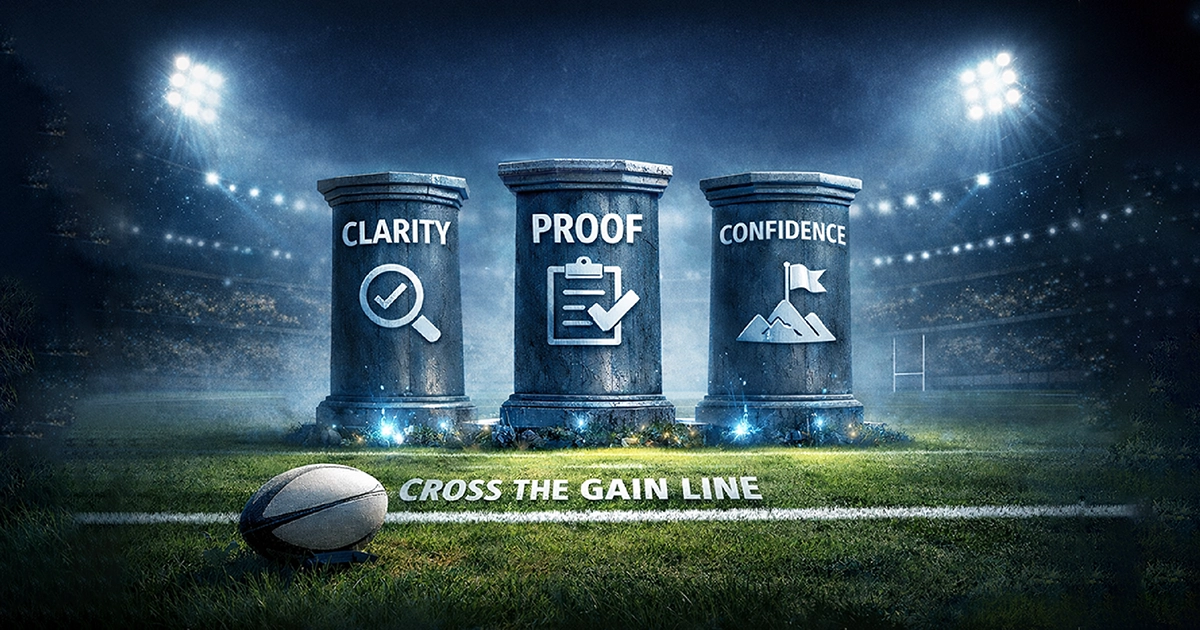
Start with a GainLine® Gameplan. A paid, fixed-scope session that gets everyone aligned on direction, priorities, and what not to do. From $2,500 + GST.
Build the content foundation. Integrating the Drivers of Trust and the Tight 5, written plain and built to help people decide.
Put it to work. We call it Foundation Selling. The right content in front of the right buyer at the right moment, so conversations start informed.
Keep it compounding. An ongoing retainer where we publish, measure, and improve. From$2,000-$12,000 per month.
It probably is if you sell considered, high-trust services, your buying cycle is long or complex, you want better-fit clients rather than more leads, and you are willing to be honest even when it is uncomfortable.
It probably is not if you want quick wins without commitment, you would rather keep your messaging vague, or you do not want to talk about price, risks, or trade-offs.
If transparency feels risky, GainLine will feel uncomfortable. That is by design

Where others optimise for attention, we help you optimise for trust and authority. Trust builds confidence, which leads to better decisions.
It is not louder marketing. It is quieter confidence.