
Pricing & Self-Selection Tools: Why Hiding Prices Is Costing You Trust
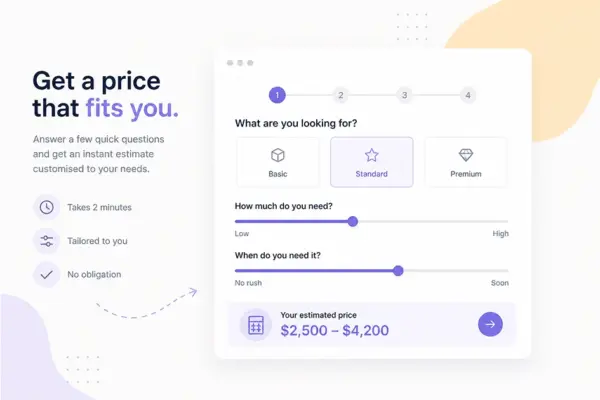




Filters
Results
Let’s be honest.
Most businesses avoid talking about pricing online like it’s some kind of state secret.
“We’ll tailor a quote.”
“Contact us to discuss.”
“Pricing varies depending on requirements.”
And while that can be true… buyers are still sitting there wondering:
“Cool. But are we talking $500 or $50,000?”
The reality is simple.
People want clarity before they want a conversation.
That’s where pricing content and self-selection tools come in.
Not to replace sales.
Not to remove the human element.
But to help buyers understand where they fit, what things generally cost, and whether they’re even in the right ballpark before they pick up the phone.
Ironically, the businesses willing to talk openly about pricing are often the ones that build trust the fastest.
Table of Contents
What Are Pricing & Self-Selection Tools?
In simple terms, they’re tools, content, or experiences that help people qualify themselves before speaking to you.
Think:
- Pricing guides
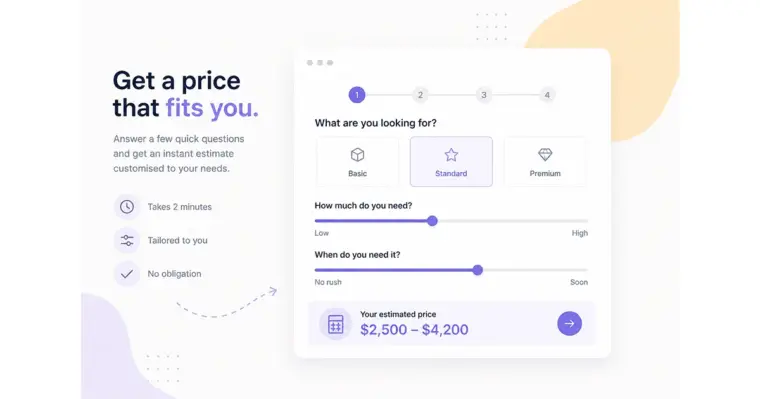
- Cost calculators
- Package comparison pages
- “Which option is right for me?” quizzes
- Budget estimators
- ROI calculators
- Interactive recommendation tools
- Service comparison charts
- Transparent FAQs around pricing and process
They help buyers answer questions themselves.
And that matters because modern buyers don’t want to feel sold to every five minutes.
They want confidence.
They want context.
They want to know they’re not about to waste everyone’s time.
Why Buyers Actually Want This Stuff
People don’t wake up hoping to “book a discovery call”.
They wake up wanting a problem solved.
Before they contact you, they’re usually trying to figure out:
- Can we afford this?
- Is this overkill for us?
- Are these people even a good fit?
- What’s included?
- What happens next?
- What’s the catch?
- Why is this company more expensive than the other one?
And if your website avoids answering those questions?
They’ll leave and find someone who will.
Or worse…
They’ll book a meeting with completely unrealistic expectations.
That’s how you end up with awkward conversations where someone wants a Ferrari on a bicycle budget.
Nobody enjoys those meetings.
Transparency Builds Trust Faster
One of the biggest myths in marketing is:
“If we show pricing, competitors will see it.”
Newsflash:
Your competitors already know roughly what you charge.
The only people being kept in the dark are your buyers.
Pricing transparency doesn’t mean publishing a giant spreadsheet with every possible variation.
It means giving people enough information to understand:
- Typical investment ranges
- What affects pricing
- Why prices vary
- What outcomes they’re paying for
- What different levels of service look like
That alone reduces friction massively.
It also filters out poor-fit leads before they ever hit your inbox.
Which, frankly, saves everyone time and headaches.
Self-Selection Tools Help Qualify Better Leads
This is where things get interesting.
Good self-selection tools don’t just help buyers.
They help your sales process too.
When someone uses a calculator, pricing guide, or recommendation tool, they arrive at conversations far more informed.
That means:
- Better questions
- More realistic expectations
- Faster decisions
- Higher trust
- Less back-and-forth
- Less ghosting
Instead of spending half the meeting explaining basics, you can focus on strategy, outcomes, and fit.
That’s a much better conversation.
Examples of Self-Selection Tools That Actually Work
Pricing Calculators
These don’t need to be perfect.
They just need to provide realistic ranges.
For example:
- Website cost calculators
- Kitchen renovation cost calculators
- Solar installation savings estimators
- Mortgage repayment calculators
- Vehicle finance repayment tools
- Moving or freight cost estimators
- Insurance premium calculators
- Wedding budget planners
- Home loan borrowing calculators
- Power usage and energy savings calculators
- Meal kit subscription builders
Even a rough estimate is often better than no estimate at all.
Because uncertainty kills momentum.
Package Comparison Pages
This is one of the simplest wins.
A clean comparison table showing:
- What’s included
- Who each option suits
- Investment ranges
- Key differences
…can dramatically improve conversion quality.
It also helps buyers feel in control.
People like feeling smart when they buy.
“Which Option Fits You?” Tools
Interactive recommendation tools work incredibly well because they reduce overwhelm.
Especially in industries where buyers don’t understand technical jargon.
Nobody wants to decode a list of acronyms just to figure out what they need.
Sometimes your job is simply helping people understand themselves better.
ROI & Savings Calculators
These are powerful because they shift the conversation from:
“What does it cost?”
to:
“What’s the value?”
There’s a big difference.
Especially when your service improves efficiency, saves time, reduces risk, or generates revenue.
The Real Benefit? Better Buyers.
The biggest benefit of pricing transparency and self-selection tools isn’t just conversions.
It’s alignment.
The right people move forward faster.
The wrong people opt out earlier.
That’s healthy.
Not every lead should become a client.
And contrary to popular belief, making it easier for people to self-disqualify is actually a good thing.
Because your sales team shouldn’t be spending their lives convincing bad-fit leads to buy things they don’t fully understand.
“But Won’t This Scare People Off?”
Yes.
That’s kind of the point.
Good marketing is not about attracting everybody.
It’s about attracting the right people.
If someone disappears because they saw your pricing range?
They were probably never buying anyway.
Meanwhile, the people who do contact you arrive more informed and more serious.
That’s a win.
In an AI & Search-Everywhere World, Transparency Matters Even More
There’s enough of a push these days to suggest SEO in the the traditional sense is evolving. Search Engine is now becoming Search Everywhere Optimisation. This is because buyers are researching everywhere now.
Google.
YouTube.
Reddit.
TikTok.
ChatGPT.
Comparison sites.
Review platforms.
People are piecing together buying decisions long before they contact you.
Businesses that openly educate buyers are gaining an advantage because they become the source of truth.
That creates trust before the first conversation even happens.
And trust shortens sales cycles.
Final Thought
Pricing content and self-selection tools are not about removing people from the buying process.
They’re about removing uncertainty.
The businesses winning online today are the ones willing to answer the questions others avoid.
Even the uncomfortable ones.
Especially the uncomfortable ones.
Because buyers remember transparency.
And in most industries, trust is still the real competitive advantage.
Frequently Asked Questions
Should every business show pricing online?
Not necessarily exact pricing. But most businesses should provide some level of pricing guidance, ranges, or explanations to help buyers understand investment expectations.
What is a self-selection tool?
A self-selection tool helps buyers determine whether a product or service is right for them before speaking with sales. Examples include calculators, quizzes, pricing guides, and package comparison tools.
Do pricing calculators need to be exact?
No. The goal is to provide clarity and realistic expectations, not perfect quoting accuracy.
Why do self-selection tools improve lead quality?
They educate buyers upfront, reduce uncertainty, and help people understand whether they are a good fit before making contact.
Can pricing transparency reduce bad leads?
Absolutely. Transparent pricing helps filter out unrealistic enquiries and attracts buyers who are more aligned with your services and budget ranges.