
Are Websites in 2026 Getting a Passing Grade?




Filters
Results
Introduction: The Rules Have Changed
For years, businesses judged their website by how it looked. Then if you’re lucky, came performance scores, mobile optimisation, and search rankings. But right now, are websites in 2026, is this still the case?
Well, today, in 2026, we can confidently tell you, the standard has shifted again.
Table of Contents
A website is no longer just a digital brochure.
It’s a credibility engine — the place people, search engines, and now AI systems go to verify whether your business can be trusted.
In the past, strong design and basic SEO were perceived as enough.
In 2026, they’re now! A passing grade requires something deeper:
- Clear expertise
- Helpful content
- Consistent signals of trust
- And a structure that helps buyers qualify themselves before they ever speak to you.
The question isn’t just:
“Does your website work?”
It’s:
“Does your website build confidence (and therefore trust) from the start and before the first conversation?”
Are Websites in 2026 Getting a Passing Grade?
The average website still sits around the middle of the pack.
Many look modern.
Some may load faster.
But most still struggle with one thing:
They talk about themselves more than they help the buyer make a decision.
The biggest gap isn’t technical anymore.
And that gap is growing as AI surfaces answers directly inside search results — meaning people often decide who they trust before they even visit a site.
The Four Metrics Still Matter, But They Mean Something New
1. Website Performance; Speed Builds Confidence
Performance is still about load times and efficiency.
But in 2026, speed isn’t just technical.
It’s psychological.
Fast websites feel more credible.
Slow websites feel uncertain.
Users expect pages to load instantly.
AI crawlers and search engines also favour clean, efficient architecture because it’s easier to understand.
A fast site signals clarity.
And clarity reduces doubt.
2. SEO; Visibility Is Now About Credibility
SEO used to be about rankings.
Now it’s about presence.
Your content might appear:
- Inside AI summaries
- In featured answers
- Across social snippets
- Or embedded in conversational search results
This means optimisation isn’t just technical anymore.
It’s educational.
Businesses that openly answer real questions — pricing, problems, comparisons, expectations — are easier for search engines and AI systems to trust.
The goal isn’t just traffic.
It’s becoming the source people rely on when they’re trying to understand their options.
3. Mobile; Friction Is the New Failure
Mobile design used to be about responsiveness.
Now it’s about flow.
If a visitor can’t quickly:
- understand what you do
- find helpful information
- or feel guided toward a decision
they leave.
The best mobile experiences don’t overwhelm people.
They guide them.
Clear structure reduces hesitation — and hesitation is often what stops leads from moving forward.
4. Security; Trust Starts Before the First Click
Security has become a baseline expectation.
SSL certificates, updated libraries, and reliable hosting are no longer “nice to have”.
They are proof of professionalism.
Modern browsers warn users before they enter insecure sites.
And AI systems increasingly evaluate trust signals behind the scenes.
If your foundation isn’t secure, everything else becomes harder.
The Hidden Website Metric: Trust Momentum
Here’s what’s changed the most since the early 2020s.
Websites used to be destinations.
Now they are checkpoints.
People arrive after:
- seeing content
- hearing about you
- reading reviews
- or interacting with AI answers
By the time someone lands on your website, they are already forming an opinion.
Businesses that earn higher grades today do something differently:
They reduce uncertainty.
Instead of hiding information, they make decisions easier by being clear about:
- who they help
- what the process looks like
- what to expect
- and whether they are the right fit.
This approach builds trust long before a sales conversation begins.
What a Passing Grade Looks Like for Websites in 2026
A strong website now balances two things:
Technical Excellence
- Fast loading
- Clean structure
- Secure architecture
- Mobile-first experience
Trust Signals
- Helpful educational content
- Honest explanations
- Clear expectations
- Consistent messaging across channels
When these work together, something powerful happens:
Visitors don’t just browse.
They move forward with confidence.
Why Content Matters for websites in 2026: Now More Than Ever
AI-driven search has changed discovery.
Due to AI Overviews now commonly referred to as ‘Zero Click Search Results” People don’t always click links anymore.
Instead, they see summaries generated from trusted sources.
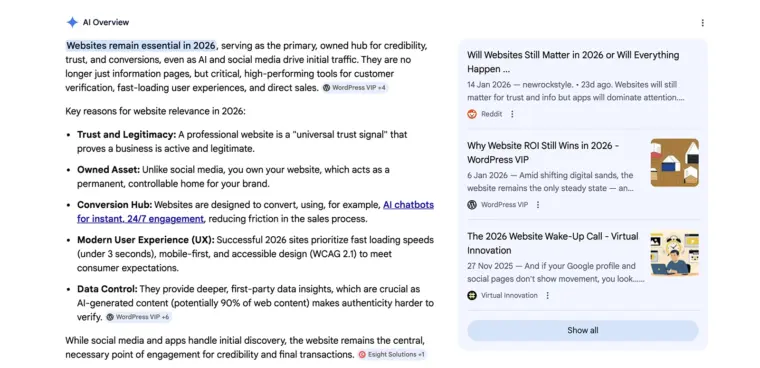
That means businesses need to create content that:
- answers real questions
- builds authority over time
- and supports buyers at every stage of their journey.
Not more content for the sake of noise.
Better content that removes doubt.
The goal isn’t to push people toward a sale.
It’s to help the right people feel ready.
Conclusion — Passing the Real Test
In 2024, and 2025, the question was:
“Is your website technically strong enough?”
In 2026, the real question is:
“Does your website genuinely help people? Which means means they can trust you faster?”
Performance, SEO, mobile experience, and security still matter.
But the websites getting top marks today do one extra thing:
They lead with clarity.
They educate openly.
And they build trust across every channel; not just on their homepage.
If your website helps buyers feel informed, confident, and understood before they reach out, you’re not just passing.
You’re leading.