
Should You Show Prices on Your Website?

Suggested Reads



Filters
Results
If you have ever heard or asked yourself if you should show prices on your website, you’re not alone!
The Short answer? Probably yes.
Long answer? Still yes… but there’s nuance to it.
Because the real question usually isn’t:
“Should we show pricing?”
It’s:
“Are we willing to answer the questions buyers are already asking?”
And in most industries, price is one of the first questions people think about.
Not because buyers are cheap.
Because buyers are trying to understand risk.
They’re trying to work out:
- Are we even in the right ballpark?
- Is this affordable?
- Is this premium?
- Are we talking hundreds, thousands, or six figures?
- Is this company aligned with what we need?
When businesses avoid pricing altogether, buyers don’t magically stop wondering.
They just go searching elsewhere.
Usually to competitors.
Table of Contents
The Internet Changed the Buying Process
Years ago, buyers expected to contact sales early.
Now?
The future of Google Search has changed… It’s because People now research first – A lot.
They compare.
They read reviews.
They watch videos.
They ask ChatGPT.
They stalk your Google reviews.
They check Reddit threads.
They look for social proof.
They try to self-educate before talking to anyone.
And during that process, trust is either built… or lost.
That’s why pricing content matters so much now.
Not because every visitor wants an exact quote.
But because transparency builds confidence.
The Biggest Fear Businesses Have About Showing Prices
Usually it’s one of these:
- “Our competitors will see it.”
- “Every project is different.”
- “People will judge us on price.”
- “We’ll scare people away.”
- “We need to explain the value first.”
Some of those concerns are valid.
But here’s the reality:
Your competitors probably already know roughly what you charge.
And buyers are already judging your pricing anyway.
The difference is whether they’re doing it with context… or assumptions.
Because when no pricing exists, people tend to assume one of two things:
- “This is probably expensive.”
- “These guys are hiding something.”
Neither is ideal.
Showing Pricing Is Bigger Than Just Pricing
This is where it ties directly into the GainLine philosophy and the Trust Drivers.
One of the core Trust Drivers is:
Tackle the Tough Stuff
Most businesses avoid hard conversations online.
Pricing.
Problems; Drawbacks. Timeframes, Limitations, Fit.
But buyers actively look for those answers.
The companies willing to front-foot difficult topics immediately stand out because they feel honest.
Not polished.
Not corporate.
Human.
And that matters.
Because trust is rarely built through hype.
It’s built through clarity.
Pricing Content Fits Directly Into the Tight 5
Inside the Tight 5 framework, pricing is one of the highest-impact content categories you can create.
Why?
Because it sits incredibly close to buying intent.
People searching:
- “How much does it cost to build a new home?”
- “What should I budget for a family holiday to Fiji?”
- “How much does a heat pump installation cost?”
- “What does a new roof typically cost?”
- “How much should I expect to pay for braces?”
- “What does it cost to move house across New Zealand?”
- “How much does artificial turf installation cost?”
- “What should I budget for a wedding?”
- “How much does farm fencing usually cost per metre?”
- “What does a new driveway cost?”
- “How much to paint a house in NZ?“
…are not casually browsing.
They’re evaluating decisions.
That makes pricing content some of the most commercially valuable content on your website when done properly.
The Goal Isn’t Exact Pricing
This is where people get stuck.
Showing pricing doesn’t mean every business needs a giant “Buy Now” button with fixed numbers.
Sometimes that works.
Sometimes it doesn’t.
What buyers actually want is guidance.
Things like:
- Starting-from pricing
- Typical project ranges
- What affects cost
- Different service tiers
- What’s included
- What changes pricing
- What makes something more expensive
- What makes something cheaper
That alone reduces uncertainty massively.
Transparency Filters Better Leads
Here’s the part many businesses miss.
Pricing transparency doesn’t just attract leads.
It repels the wrong ones.
That’s a good thing.
Because not every enquiry is a good fit.
If someone has a $500 budget for a $20,000 project, finding that out after three meetings helps nobody.
Transparent pricing creates alignment earlier.
Which means:
- Better conversations
- Less ghosting
- Less wasted time
- Faster decisions
- More qualified enquiries
- Higher trust from day one
“But What If Competitors Undercut Us?”
They probably already are.
Businesses that compete purely on price will always exist.
Trying to hide your pricing rarely changes that.
What does change things is explaining:
- Why you charge what you charge
- What outcomes buyers get
- What’s included
- What process you follow
- What risks you reduce
- What experience people can expect
That’s value positioning.
And value positioning builds trust far better than silence ever will.
The Best Pricing Pages Don’t Feel Like Sales Pages
They feel educational.
Helpful.
Clear.
Balanced.
They answer questions buyers are already thinking. They acknowledge complexity without hiding behind it.
And importantly…
They don’t pretend every buyer is identical. Good pricing content helps people self-select.
That’s one of the most powerful things a website can do.
Should Every Business Show Prices?
Not necessarily exact pricing.
But most businesses should show something.
Even if it’s:
- Typical investment ranges
- “Starting from” pricing
- Budget guidance
- Package comparisons
- Cost factors
- Pricing FAQs
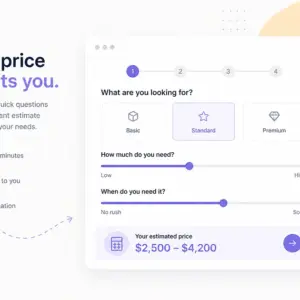
- Self-selection tools or calculators
Because clarity creates momentum.
And momentum creates better buying experiences.
Final Thought
In a Search Everywhere world, buyers reward businesses that answer questions openly.
Pricing is one of the biggest questions buyers have.
Avoiding it doesn’t remove friction.
It creates it.
The businesses building trust fastest today are usually the ones willing to talk about the things others avoid.
That’s not just good marketing.
That’s good business.
Frequently Asked Questions
Should I put exact pricing on my website?
Not always. Many businesses benefit more from showing pricing ranges, starting prices, or explaining the factors that influence cost.
Does showing pricing scare people away?
Sometimes. But usually the wrong people. Pricing transparency helps qualify leads earlier and improves alignment.
Why is pricing content important for SEO?
Pricing-related searches often have high buying intent. People searching for pricing are usually much closer to making a decision.
What is pricing transparency?
Pricing transparency means openly helping buyers understand likely costs, pricing structures, and what influences investment levels.
How does pricing content build trust?
It shows buyers you’re willing to answer difficult questions honestly, which reduces uncertainty and improves confidence before sales conversations even begin.