
SEO vs GEO vs AEO: 5 Essential Differences Explained




Filters
Results
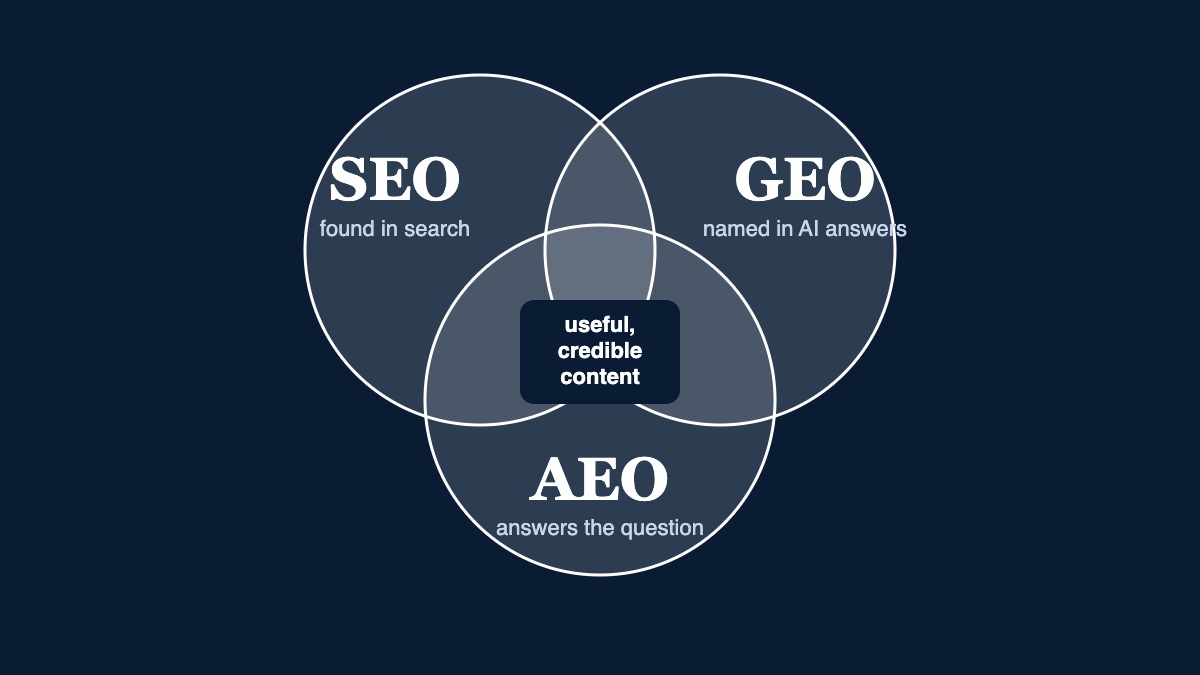
SEO vs GEO vs AEO can sound like three different services you suddenly need to buy. The terms describe overlapping approaches to helping people discover and use your information.
SEO focuses on visibility in search engines. GEO focuses on visibility in generative AI answers. AEO focuses on answering questions clearly enough to be useful in answer-led experiences.
The boundaries are not universally agreed, and the work often overlaps. For a New Zealand business, the useful question is what your buyers need to find out, and whether your published information helps them.
This guide explains the distinctions, what they mean for your marketing, and how they fit with Search Everywhere and Back9’s GainLine® approach.
SEO vs GEO vs AEO at a glance
| Approach | Main emphasis | Example outcome | Practical work |
|---|---|---|---|
| SEO: Search Engine Optimisation | Discovery through search engines | A buyer finds your service page or guide through Google | Accessible pages, relevant content, internal links and a usable website |
| GEO: Generative Engine Optimisation | Visibility and accurate representation in generated answers | Your resource is cited, or your business mentioned, in an AI answer | Clear source material, evidence, relevant crawler access and checks of how you appear |
| AEO: Answer Engine Optimisation | Resolving specific questions | Your explanation helps answer a cost or comparison question | Direct answers supported by detail, context and examples |
These are working definitions, not separate technical standards. In the SEO vs GEO vs AEO debate, a single useful resource can support all three.
1. SEO covers more than a position in a list of links
Search Engine Optimisation helps search engines discover and understand your pages, and helps people find information relevant to their needs.
It includes technical access, page content, navigation, internal links and the experience people have when they arrive.
Reducing SEO to keywords and backlinks misses much of that work. It also overlooks how search results now present information.
Google’s guidance on AI features says existing SEO practices remain relevant to AI Overviews and AI Mode. Supporting pages must be indexed and eligible to appear with a snippet. No additional AI-specific technical requirements apply.
That is why replacing an SEO plan purely because someone calls their service GEO deserves a closer look. Ask what work will actually change.
2. GEO concerns the generated answer, not how you wrote the article
Generative Engine Optimisation describes work aimed at improving visibility and accurate representation in AI-generated answers.
A business might want its guide cited, its product information represented correctly, or its services considered when someone researches suitable providers.
Those are different outcomes. A citation identifies a source. A business mention is not automatically an endorsement, and neither guarantees a visit or enquiry.
Using AI to write a blog post is not, by itself, GEO. An article written by a person can be useful source material for an AI answer. An AI-written article can still be inaccurate, generic or inaccessible.
Likewise, GEO does not mean geographical optimisation. Local relevance can matter to a local buying question, but “generative” is what the G stands for here.
For the practical work behind this, see our guide to how to rank in AI search.
3. AEO starts with the question someone needs answered
Answer Engine Optimisation places particular emphasis on answering questions directly and clearly.
A useful answer usually needs more than a short definition. It needs enough context to prevent someone drawing the wrong conclusion.
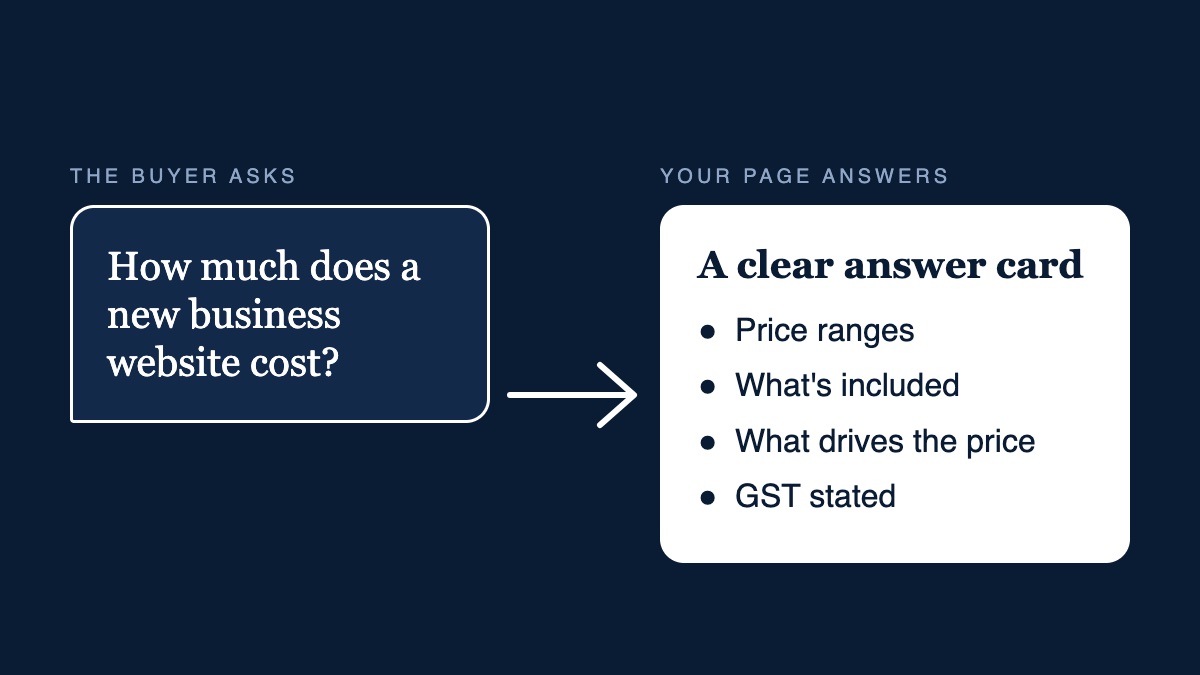
Take the question: “How much does a new business website cost?”
A helpful resource explains likely ranges, what is included, what changes the price and which type of website suits which situation. Where relevant, it also distinguishes GST, ongoing fees and optional work.
That is useful whether someone encounters the explanation in search, an AI answer, a video or a sales conversation.
AEO overlaps with GEO because generated answers respond to questions. It also overlaps with established SEO because answering search intent has long been part of useful website content.
Treat it as a way to improve the answer, rather than a reason to turn every page into a list of shallow FAQs.
4. Visibility needs different measures
Traditional search positions remain useful, but they do not describe everything that happens in an AI answer. The SEO vs GEO vs AEO labels each imply a different kind of evidence.
| Question | Useful evidence |
|---|---|
| Can buyers find our pages in search? | Search performance, landing-page visits and relevant query visibility |
| Are we appearing in the AI answers we care about? | Repeated checks using a documented sample of buyer questions |
| Is our information being represented correctly? | The actual answer, cited source and context |
| Does discovery lead to business? | Identifiable referrals, enquiry quality, sales feedback and qualified opportunities |
For AI-answer checks, record the platform, question and date. Keep the checking method consistent enough to compare results.
A screenshot is evidence of one result at one moment. It cannot establish that everyone asking a similar question will see your business.
Assess progress across several measures. A burst of mentions has limited value if those mentions are irrelevant or send buyers to information that does not help them.
5. The labels should not dictate three separate budgets
Different platforms may require specific access checks, monitoring or content formats. That does not mean every business needs three parallel content programmes.
Start with the problem, not the acronym. The SEO vs GEO vs AEO labels are a way to describe work, not a shopping list.
If your service pages cannot be indexed, fix access. If buyers cannot understand the price, improve the pricing information. If you make claims without evidence, develop credible proof. If you already have strong resources, look at how they are connected and distributed.
When evaluating a proposal, ask:
- What specific problem have you found?
- Which pages or platforms will you work on?
- What will you publish, improve or measure?
- What evidence supports the recommended work?
- How will we judge its contribution to the business?
You should be able to understand the deliverables without needing to buy into a new acronym first.
What stays the same across SEO vs GEO vs AEO?
Your information still needs a clear purpose and a credible basis.
Make the business, service and intended audience easy to understand. Explain limitations as well as benefits. Use specific examples where they help. Keep important details accurate, and connect related resources.
For Google’s AI features, there is no special schema that secures inclusion. Google explicitly says new AI text files and special markup are not required. Accurate structured data can support the information you publish, but it is not a citation switch.
Our recommendation on SEO vs GEO vs AEO is to maintain a shared content foundation, then make platform-specific improvements where the evidence justifies them.
Where does Search Everywhere fit?
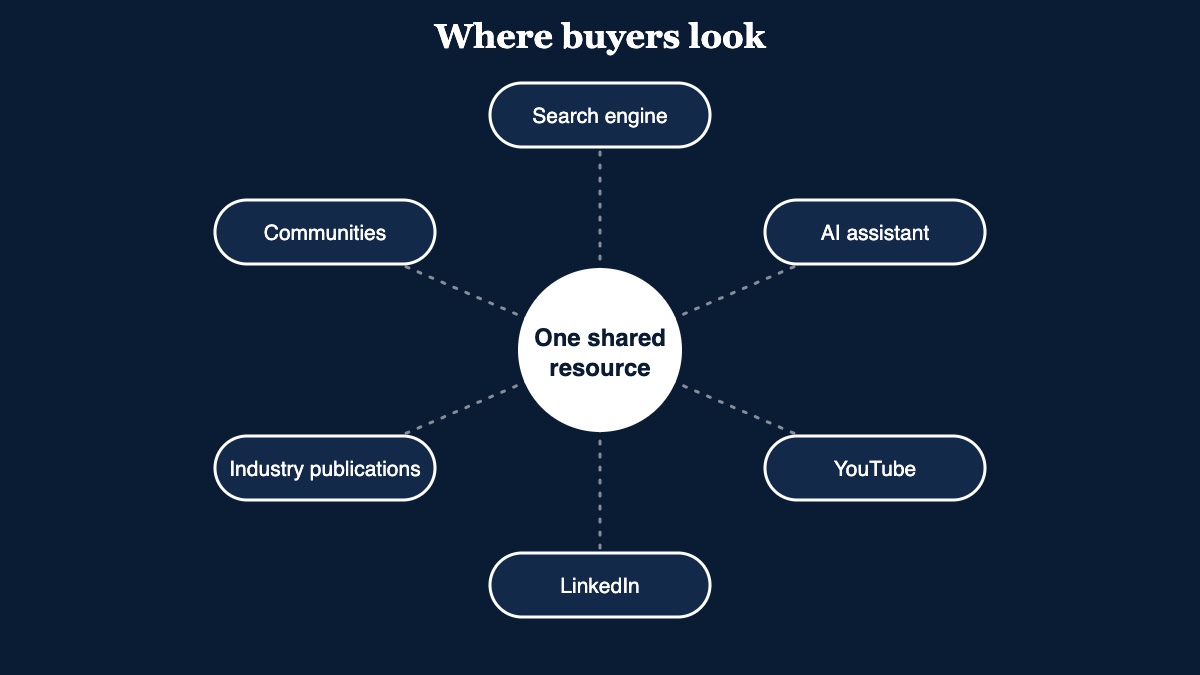
Search Everywhere is the broader planning perspective: where do your buyers look for help, and how should your expertise appear there?
That can include search engines, AI tools, YouTube, social platforms, industry publications and relevant communities.
A detailed website comparison might support a video explanation, a LinkedIn discussion and a resource used during sales conversations. Each version should suit its audience and format.
Choose the channels that fit your buyers and your team’s capacity. Publishing on more platforms does not automatically cause AI citations.
SEO, GEO and AEO can each contribute to that broader discovery work.
How GainLine connects discovery with a buying decision
At Back9, GainLine® connects the content work with the uncertainty buyers need to resolve.
The Tight 5 gives us a starting point: pricing, problems, best-fit solutions, comparisons, and reviews or proof.
This SEO vs GEO vs AEO article belongs in the comparisons category. It helps someone assess competing descriptions of a service before deciding what they need.
The four Drivers of Trust guide how we deliver that information: Tackle the Tough Stuff, Open Up the Engine Room, Gain the Tactical Advantage and Play for the Jersey.
For example, a cost guide should explain assumptions and trade-offs. A case study should show what changed and what contributed. A comparison should help the reader choose, including when another approach suits them better.
Discovery creates an opportunity. Useful information helps someone move through the buyer’s journey with more confidence.
Which approach should your business prioritise?
Start with the foundations your buyers need most. When weighing SEO vs GEO vs AEO, let your situation set the order.
| Your situation | Sensible starting priority |
|---|---|
| Important pages are inaccessible or missing from search | Technical SEO and discovery checks |
| Buyers repeatedly ask questions your website avoids | Content addressing those questions |
| You have useful content but little evidence behind it | Demonstrations, worked examples and specific project proof |
| Buyers research your category through AI tools | A baseline of relevant AI-answer checks alongside search performance |
| Your website explains things well but reaches few people | Distribution through channels your buyers use |
These priorities are our planning recommendations, not guaranteed ranking factors.
For the practical checklist, read How to Rank in AI Search.
Frequently asked questions about SEO vs GEO vs AEO
Is GEO replacing SEO?
No. The work overlaps, and Google explicitly connects its AI Search features with existing SEO practices. Other platforms have their own systems, so check their requirements individually.
Are GEO and AEO the same?
The terms are often used interchangeably. A useful working distinction is that GEO focuses on generated answers, while AEO focuses on resolving questions across answer-led experiences.
Does GEO require AI-generated content?
No. The aim concerns how your information appears in generated answers. The tool used to draft the source material does not establish its quality or usefulness.
Should we create separate versions for Wellington, Christchurch and Invercargill?
Keep this educational SEO vs GEO vs AEO explanation as one shared resource. Use regional service pages for local availability, relevant projects and market context. A city-name swap alone gives readers little additional help.
Get clear on what your business needs
If you are weighing up SEO vs GEO vs AEO, start with the buying questions your marketing needs to answer.
Rather than choosing between SEO vs GEO vs AEO, a GainLine Gameplan helps connect those questions with your existing content, discovery opportunities and commercial priorities.