
Warning: Undefined array key "url" in /container/application/public/back9/b9/wp-content/plugins/seo-by-rank-math/includes/modules/schema/snippets/class-author.php on line 41

SEO vs GEO vs AEO: 5 Essential Differences Explained

SEO vs GEO vs AEO can sound like three different services you suddenly need to buy. The terms describe overlapping approaches to helping people discover and use your information.

SEO focuses on visibility in search engines. GEO focuses on visibility in generative AI answers. AEO focuses on answering questions clearly enough to be useful in answer-led experiences.

The boundaries are not universally agreed, and the work often overlaps. For a New Zealand business, the useful question is what your buyers need to find out, and whether your published information helps them.

This guide explains the distinctions, what they mean for your marketing, and how they fit with Search Everywhere and Back9’s GainLine® approach.

SEO vs GEO vs AEO at a glance

ApproachMain emphasisExample outcomePractical work
SEO: Search Engine OptimisationDiscovery through search enginesA buyer finds your service page or guide through GoogleAccessible pages, relevant content, internal links and a usable website
GEO: Generative Engine OptimisationVisibility and accurate representation in generated answersYour resource is cited, or your business mentioned, in an AI answerClear source material, evidence, relevant crawler access and checks of how you appear
AEO: Answer Engine OptimisationResolving specific questionsYour explanation helps answer a cost or comparison questionDirect answers supported by detail, context and examples

These are working definitions, not separate technical standards. In the SEO vs GEO vs AEO debate, a single useful resource can support all three.
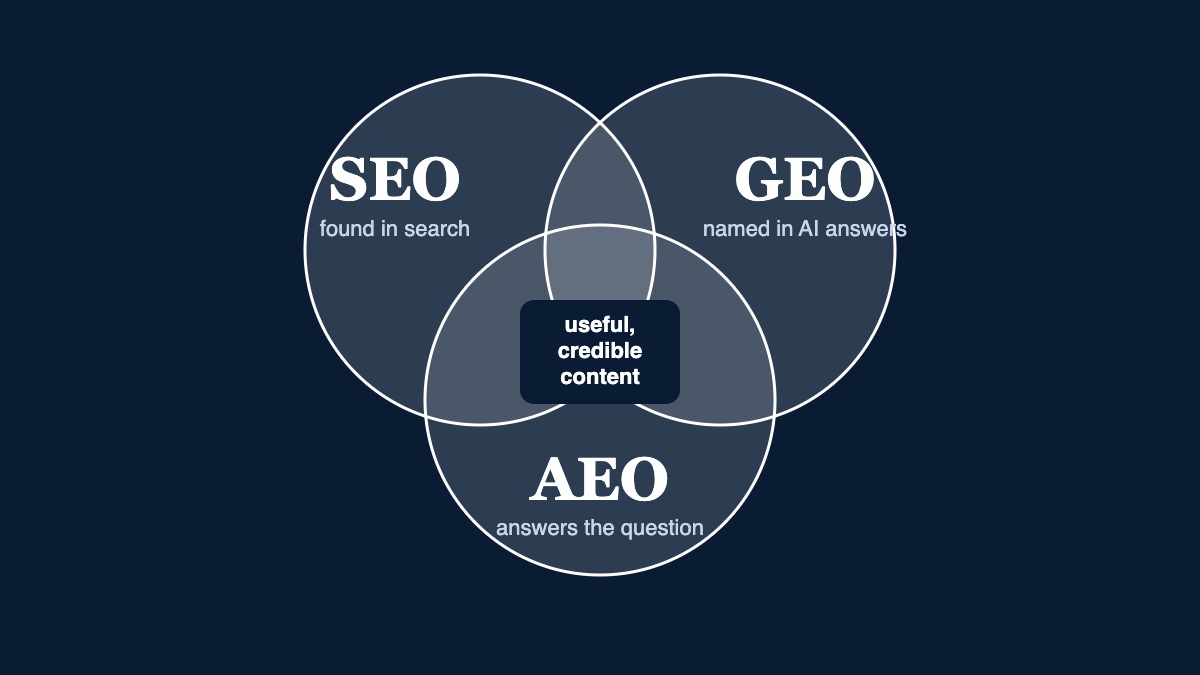
Venn Diagram Showing Seo Vs Geo Vs Aeo Overlapping Around One Shared Foundation Of Useful Content

1. SEO covers more than a position in a list of links

Search Engine Optimisation helps search engines discover and understand your pages, and helps people find information relevant to their needs.

It includes technical access, page content, navigation, internal links and the experience people have when they arrive.

Reducing SEO to keywords and backlinks misses much of that work. It also overlooks how search results now present information.

Google’s guidance on AI features says existing SEO practices remain relevant to AI Overviews and AI Mode. Supporting pages must be indexed and eligible to appear with a snippet. No additional AI-specific technical requirements apply.

That is why replacing an SEO plan purely because someone calls their service GEO deserves a closer look. Ask what work will actually change.

2. GEO concerns the generated answer, not how you wrote the article

Generative Engine Optimisation describes work aimed at improving visibility and accurate representation in AI-generated answers.

A business might want its guide cited, its product information represented correctly, or its services considered when someone researches suitable providers.

Those are different outcomes. A citation identifies a source. A business mention is not automatically an endorsement, and neither guarantees a visit or enquiry.

Using AI to write a blog post is not, by itself, GEO. An article written by a person can be useful source material for an AI answer. An AI-written article can still be inaccurate, generic or inaccessible.

Likewise, GEO does not mean geographical optimisation. Local relevance can matter to a local buying question, but “generative” is what the G stands for here.

For the practical work behind this, see our guide to how to rank in AI search.

3. AEO starts with the question someone needs answered

Answer Engine Optimisation places particular emphasis on answering questions directly and clearly.

A useful answer usually needs more than a short definition. It needs enough context to prevent someone drawing the wrong conclusion.

Take the question: “How much does a new business website cost?”

A helpful resource explains likely ranges, what is included, what changes the price and which type of website suits which situation. Where relevant, it also distinguishes GST, ongoing fees and optional work.

That is useful whether someone encounters the explanation in search, an AI answer, a video or a sales conversation.

AEO overlaps with GEO because generated answers respond to questions. It also overlaps with established SEO because answering search intent has long been part of useful website content.

Treat it as a way to improve the answer, rather than a reason to turn every page into a list of shallow FAQs.
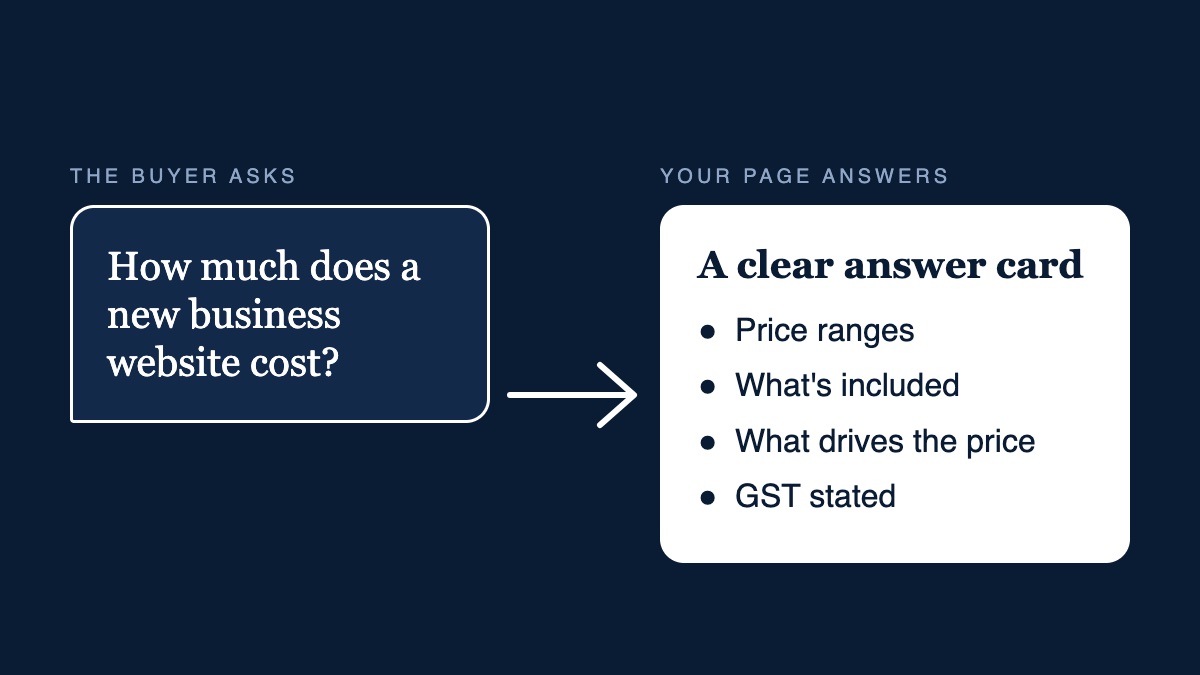
Answer Engine Optimisation Example: A Buyer'S Cost Question Answered With Ranges, Inclusions And Context

4. Visibility needs different measures

Traditional search positions remain useful, but they do not describe everything that happens in an AI answer. The SEO vs GEO vs AEO labels each imply a different kind of evidence.

QuestionUseful evidence
Can buyers find our pages in search?Search performance, landing-page visits and relevant query visibility
Are we appearing in the AI answers we care about?Repeated checks using a documented sample of buyer questions
Is our information being represented correctly?The actual answer, cited source and context
Does discovery lead to business?Identifiable referrals, enquiry quality, sales feedback and qualified opportunities

For AI-answer checks, record the platform, question and date. Keep the checking method consistent enough to compare results.

A screenshot is evidence of one result at one moment. It cannot establish that everyone asking a similar question will see your business.

Assess progress across several measures. A burst of mentions has limited value if those mentions are irrelevant or send buyers to information that does not help them.

5. The labels should not dictate three separate budgets

Different platforms may require specific access checks, monitoring or content formats. That does not mean every business needs three parallel content programmes.

Start with the problem, not the acronym. The SEO vs GEO vs AEO labels are a way to describe work, not a shopping list.

If your service pages cannot be indexed, fix access. If buyers cannot understand the price, improve the pricing information. If you make claims without evidence, develop credible proof. If you already have strong resources, look at how they are connected and distributed.

When evaluating a proposal, ask:

  • What specific problem have you found?
  • Which pages or platforms will you work on?
  • What will you publish, improve or measure?
  • What evidence supports the recommended work?
  • How will we judge its contribution to the business?

You should be able to understand the deliverables without needing to buy into a new acronym first.

What stays the same across SEO vs GEO vs AEO?

Your information still needs a clear purpose and a credible basis.

Make the business, service and intended audience easy to understand. Explain limitations as well as benefits. Use specific examples where they help. Keep important details accurate, and connect related resources.

For Google’s AI features, there is no special schema that secures inclusion. Google explicitly says new AI text files and special markup are not required. Accurate structured data can support the information you publish, but it is not a citation switch.

Our recommendation on SEO vs GEO vs AEO is to maintain a shared content foundation, then make platform-specific improvements where the evidence justifies them.

Where does Search Everywhere fit?

Search Everywhere is the broader planning perspective: where do your buyers look for help, and how should your expertise appear there?

That can include search engines, AI tools, YouTube, social platforms, industry publications and relevant communities.

A detailed website comparison might support a video explanation, a LinkedIn discussion and a resource used during sales conversations. Each version should suit its audience and format.

Choose the channels that fit your buyers and your team’s capacity. Publishing on more platforms does not automatically cause AI citations.

SEO, GEO and AEO can each contribute to that broader discovery work.
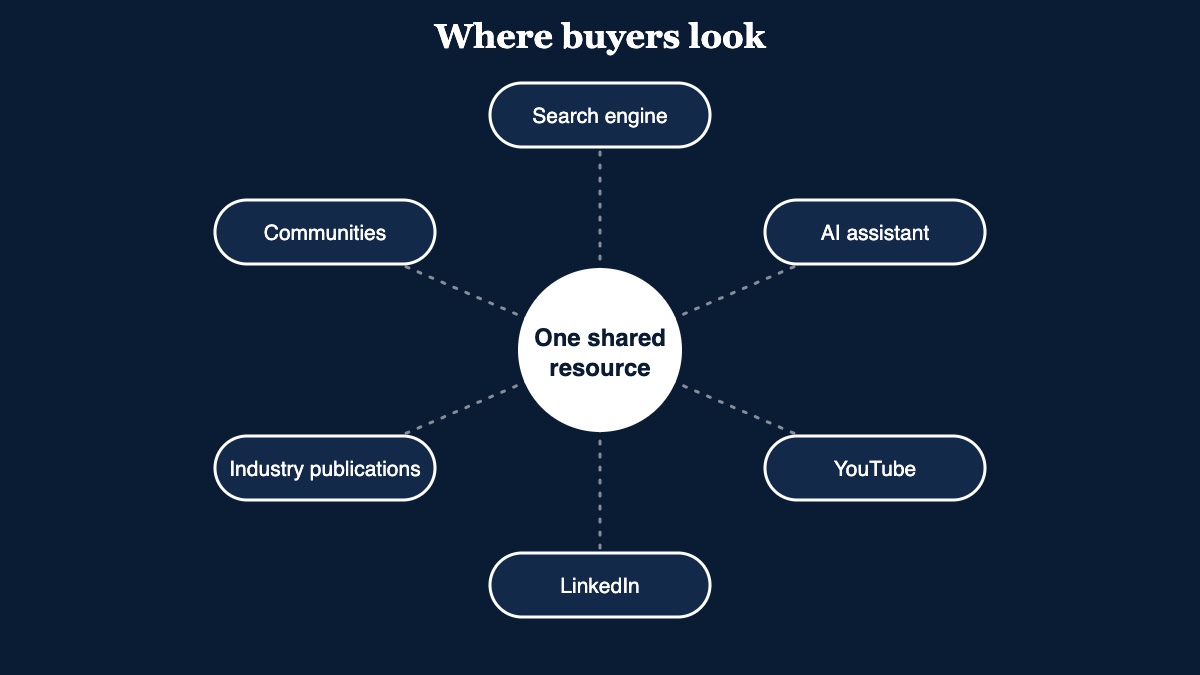
Search Everywhere Map Showing Where Buyers Look Beyond Seo Vs Geo Vs Aeo: Search, Ai Tools, Video And Social

How GainLine connects discovery with a buying decision

At Back9, GainLine® connects the content work with the uncertainty buyers need to resolve.

The Tight 5 gives us a starting point: pricing, problems, best-fit solutions, comparisons, and reviews or proof.

This SEO vs GEO vs AEO article belongs in the comparisons category. It helps someone assess competing descriptions of a service before deciding what they need.

The four Drivers of Trust guide how we deliver that information: Tackle the Tough Stuff, Open Up the Engine Room, Gain the Tactical Advantage and Play for the Jersey.

For example, a cost guide should explain assumptions and trade-offs. A case study should show what changed and what contributed. A comparison should help the reader choose, including when another approach suits them better.

Discovery creates an opportunity. Useful information helps someone move through the buyer’s journey with more confidence.

Which approach should your business prioritise?

Start with the foundations your buyers need most. When weighing SEO vs GEO vs AEO, let your situation set the order.

Your situationSensible starting priority
Important pages are inaccessible or missing from searchTechnical SEO and discovery checks
Buyers repeatedly ask questions your website avoidsContent addressing those questions
You have useful content but little evidence behind itDemonstrations, worked examples and specific project proof
Buyers research your category through AI toolsA baseline of relevant AI-answer checks alongside search performance
Your website explains things well but reaches few peopleDistribution through channels your buyers use

These priorities are our planning recommendations, not guaranteed ranking factors.

For the practical checklist, read How to Rank in AI Search.

Frequently asked questions about SEO vs GEO vs AEO

Is GEO replacing SEO?

No. The work overlaps, and Google explicitly connects its AI Search features with existing SEO practices. Other platforms have their own systems, so check their requirements individually.

Are GEO and AEO the same?

The terms are often used interchangeably. A useful working distinction is that GEO focuses on generated answers, while AEO focuses on resolving questions across answer-led experiences.

Does GEO require AI-generated content?

No. The aim concerns how your information appears in generated answers. The tool used to draft the source material does not establish its quality or usefulness.

Should we create separate versions for Wellington, Christchurch and Invercargill?

Keep this educational SEO vs GEO vs AEO explanation as one shared resource. Use regional service pages for local availability, relevant projects and market context. A city-name swap alone gives readers little additional help.

Get clear on what your business needs

If you are weighing up SEO vs GEO vs AEO, start with the buying questions your marketing needs to answer.

Rather than choosing between SEO vs GEO vs AEO, a GainLine Gameplan helps connect those questions with your existing content, discovery opportunities and commercial priorities.


Explore GainLine and start the conversation.

How to Appear in Google AI Overviews: 7 Essential Steps

To understand how to appear in Google AI Overviews, start with your existing SEO foundations. Your page must be indexed and eligible for a search snippet to qualify as a supporting link. Inclusion is never guaranteed.

The same eligibility principle applies to AI Mode. You do not need a separate website or a special “AI-ready” version of each article.

For a New Zealand business, the practical aim is to make useful expertise discoverable, then help the people who find it assess whether you can help.

This guide explains the two experiences, the checks worth making and how Back9 connects the work with GainLine®. For the wider strategy, see how to rank in AI search.

Concept Illustration Of How To Appear In Google Ai Overviews, Showing A Search Summary Linked To Source Photos And Plans On A Desk
Concept illustration: how to appear in Google AI Overviews starts with an answer that links back to your own source material.

What is the difference between AI Overviews and AI Mode?

FeatureWhat it doesWhat to keep in mind
AI OverviewsSummarises a topic within Google Search, with supporting linksAn overview does not appear for every query
AI ModeSupports more involved exploration and comparisons through an AI search experienceIts answers and supporting links may differ from AI Overviews

Google’s guidance for website owners describes both features as part of Search. It says established SEO practices apply, with no additional technical eligibility requirements.

Treat a source link, a business mention and a visit as different outcomes. Being cited for one explanation does not mean your business has been endorsed.

How to appear in Google AI Overviews and AI Mode

The first step deals with technical eligibility. The remaining steps combine established website practice with Back9’s recommendations for content, buyer confidence and evaluation. They are not a disclosed formula for securing AI citations.

1. Check the page Google can actually access

Start with the resource you want buyers to find. Use Search Console’s URL Inspection tool to investigate its current indexing status and any reported problems.

Ask your developer or SEO team to check:

  • The intended public URL returns the correct page.
  • It has no accidental noindex instruction.
  • Googlebot is not blocked by robots.txt, hosting or firewall settings.
  • Canonical signals identify the intended version.
  • Important answers are accessible as page text.
  • Internal links lead to the page.
  • Snippet controls have not unintentionally restricted its use.

Google’s SEO Starter Guide is a useful reference for the broader fundamentals.

For these Search features, Googlebot is the relevant crawler control. Do not assume Google-Extended is the switch for AI Overviews.

Make targeted corrections and test again. An indexing request does not establish that a page has been indexed or selected.

Business Website Being Checked On A Laptop And Smartphone To Confirm The Page Is Accessible And Readable
Concept illustration: check how your key pages look and work on both laptop and phone.

2. Identify the buying question your page should resolve

Choose questions from actual enquiries, proposals, sales conversations and customer support.

At Back9, the GainLine Tight 5 provides five starting areas: pricing, problems, best-fit solutions, comparisons, and reviews or proof.

A building company, for example, might explain:

  • What changes the cost of a home extension?
  • When does rebuilding make more sense than renovating?
  • What commonly delays consent or construction?
  • How should a homeowner compare proposals?
  • What did a completed project involve?

These are editorial examples, not claims of measured search demand.

Start with the questions that create uncertainty for a suitable customer. Then check whether an existing page can answer them more effectively before creating another URL.

3. Make the answer useful before making it longer

Give a direct answer near the beginning, followed by the detail needed to apply it.

For a comparison, explain the conditions under which each option makes sense. For a cost guide, state the assumptions, inclusions, GST treatment and variables. For a process guide, identify responsibilities and common points of delay.

Use descriptive headings and tables where they help someone compare.

Avoid adding paragraphs merely to reach a plugin word-count target. Google’s people-first content guidance explicitly rejects a preferred word count and encourages original, useful work.

Our article on showing prices on your website explores how to handle one of the questions businesses often hesitate to answer.

A reader should leave better informed even if they never contact you.

4. Give readers something they can verify

Look for evidence that makes your explanation more useful than a generic summary.

That might include a worked example, a real project, an original photograph, a demonstration or research with a clear method.

Explain what happened, what changed and what the result does—and does not—show. Distinguish actual outcomes from illustrative examples.

Google’s content guidance encourages clear sourcing, accurate authorship and evidence of relevant expertise. Give advice an accountable author and link to their genuine experience.

A useful starting exercise is to ask your team: what do we know from doing this work that a buyer would struggle to find elsewhere?

Turn that knowledge into a clear explanation. Do not invent a client story or result to make the page sound more authoritative.

Professionals Examining An Architectural Model And Material Samples As First-Hand Business Expertise
Concept illustration: first-hand expertise, such as a real project or worked example, gives readers something to verify.

5. Connect the resource with the rest of your website

A useful guide should have a clear role in the buyer’s research.

Link from the relevant service page to the guide where it resolves a question. Link from the guide to a suitable comparison, project or next step.

For example:

Reader’s questionUseful destination
What affects the price?Cost guide with assumptions
Which approach suits us?Fair comparison
Can this business do the work?Relevant project and team information
What happens next?Service process and enquiry route

Keep anchor text descriptive and links relevant. Avoid placing the same block of links everywhere simply to increase the count.

Check the experience on a phone. Make tables usable, images appropriately sized and enquiry forms straightforward. Information that is hard to read or act on creates unnecessary friction.

6. Make local and commercial details accurate

When location matters to the buyer, explain your actual availability and experience.

For a NZ service business, that might include your office location, areas served, remote arrangements and relevant local projects.

Keep your Google Business Profile and important public business information accurate. Product businesses should also maintain dependable product details, prices and availability wherever those are published.

Our recommendation is to keep general educational advice together and use regional service pages for meaningful local differences.

A separate article for every suburb is difficult to justify if the advice stays identical. A local case study may provide much more useful context.

Do not imply a physical presence you do not have.

7. Measure discovery alongside business outcomes

Google reports traffic from AI features within Search Console’s overall Web performance data. Do not treat all growth or decline in that report as an AI-feature effect.

Combine search performance with your analytics, enquiry quality and sales feedback.

MeasureWhat it can help you assess
Search Console queries and pagesChanges in search visibility and traffic
Documented AI-answer checksWhich sources appeared for the questions checked
Landing-page behaviourWhether visitors use the resource and take relevant actions
Qualified enquiriesWhether discovery contributes to suitable opportunities
Sales feedbackWhether buyers arrive with useful prior understanding

For repeatable checks, record the exact question, date, location, device and which experience you used. Record absence too, including when no overview appeared.

Keep AI Mode checks separate from AI Overview checks. A favourable result in one should not be counted as evidence of inclusion in both.

Review performance over an agreed period and note major website changes, seasonality or other marketing activity. Google’s guide to investigating search traffic changes helps frame broader diagnosis.

A screenshot is a sample of visibility. It is not a universal position or proof that a particular edit caused the result.

What schema do you need to appear in Google AI Overviews?

Google says no special schema or AI text file is required for these features.

Use relevant structured data accurately, reflecting what visitors can see. Do not add fabricated reviews, qualifications or claims.

For an article, the WordPress publishing process can include suitable Article markup with accurate author, publisher, date and image information. Your developer should check that the theme and plugins do not produce conflicting output.

Treat schema as part of accurate publishing, rather than a guaranteed route to a citation.

How GainLine connects Google visibility with trust

GainLine® helps us connect discovery with the questions that hold up a buying decision.

If someone arrives through an AI answer, they still need to understand your suitability, process and likely costs.

That is where the content should do more than attract attention. Explain difficult issues, show how the work happens and help people assess their options.

A pricing range may resolve an affordability concern. A fair comparison may clarify suitability. A self-selection tool may help someone prepare for a conversation.

These are useful commercial resources whether discovery starts through Google, ChatGPT, video or a referral.

How does this fit with SEO, GEO and Search Everywhere?

Keep your work on how to appear in Google AI Overviews connected to the rest of your search strategy.

SEO supplies the website foundations. GEO describes the focus on visibility in generated answers. Search Everywhere broadens the distribution plan to the places your buyers use.

Our SEO vs GEO vs AEO comparison explains the terminology. Our ChatGPT citation guide covers a different platform’s access checks.

Use the shared resources where appropriate, while checking platform requirements individually.

Frequently asked questions about how to appear in Google AI Overviews

Can you guarantee inclusion in AI Overviews or AI Mode?

No. Technical eligibility and useful content create opportunities; they do not give a business control over source selection.

Do AI Overviews and AI Mode use the same sources?

Not necessarily. Google says the experiences may use different models and techniques, and their supporting links can vary.

Is this a replacement for SEO?

No. Google connects both experiences with existing SEO practices. Review the foundations alongside content and measurement.

Do I need an llms.txt file?

Google does not require an AI text file for these features. Focus first on the issues affecting your actual pages and buyers.

Will an FAQ section make my page appear?

There is no guaranteed effect. Use FAQs for useful remaining questions. A comparison, case study or worked example may be more appropriate for the main topic.

How long will improvements take?

There is no dependable universal timeframe. Check access, establish a baseline, record changes and assess progress at sensible intervals.

Build your plan to appear in Google AI Overviews and AI Mode

To put how to appear in Google AI Overviews into practice, start with one important service and the questions buyers need answered.

A GainLine Gameplan can help connect your existing content, website checks, evidence and distribution into a practical set of priorities.

Explore GainLine and start the conversation.

How to Get Cited in ChatGPT: 7 Essential Steps for Businesses

If you want to understand how to get cited in ChatGPT, start with two priorities: make your useful public content accessible to its search crawler, and publish information that helps answer a buyer’s question.

Access creates an opportunity to be found. Clear explanations, specific evidence and accurate business information give people something useful to discover. Neither guarantees that ChatGPT will choose your page.

For NZ businesses, the aim should be relevant visibility that helps buyers understand their options and take a sensible next step.

Our guide on how to get cited in ChatGPT focuses on ChatGPT’s web-search answers. For the broader strategy, see how to rank in AI search.

Concept Illustration Of How To Get Cited In Chatgpt, With A Laptop Answer Linked To Source Material In A Portfolio Book
Concept illustration: how to get cited in ChatGPT starts with an answer that can be traced back to your own source material.

What does getting cited in ChatGPT mean?

A citation links an answer to a source. A mention names your business. A recommendation suggests an option for someone to consider.

These outcomes should be measured separately.

OutcomeExampleWhat it tells you
CitationYour cost guide is linked as a sourceThat resource was surfaced in the answer checked
Business mentionYour company name appears in the explanationYour business was included in that context
RecommendationYour business appears among suggested providersIt was presented as an option for that particular request
ReferralSomeone follows a link to your websiteDiscovery produced a visit that may be measurable

A citation does not mean ChatGPT endorses your whole business. It may reference one fact, definition or example.

OpenAI’s search guidance explains that web-search responses may include citations and source links. It also warns that results can be incomplete or incorrect. Check the cited page and the claim it is being used to support.

How to get cited in ChatGPT: seven practical steps

Each step below explains how to get cited in ChatGPT in practical terms. The access requirements come from official OpenAI documentation. The content and measurement steps are Back9’s recommendations for building useful resources and evaluating discovery. They are not a disclosed ChatGPT ranking formula.

1. Check whether ChatGPT’s search crawler can access your content

OpenAI identifies OAI-SearchBot as the crawler for its search features. It recommends allowing that crawler in robots.txt and permitting requests from its published IP ranges.

Ask your developer to review the complete access path:

  • Does robots.txt permit the relevant public pages?
  • Does the firewall or CDN block verified search-crawler requests?
  • Does the page return its intended content without a login or challenge?
  • Are important answers available as readable page text?
  • Do internal links lead to the resources you want people to discover?

A permissive robots.txt file will not solve a firewall block.

Make targeted changes while maintaining appropriate security. Validate crawler traffic using the current documentation rather than trusting a user-agent name alone.

Crawler access is the first technical step in how to get cited in ChatGPT, but it is only the first.

2. Separate search access from model training

You do not need to treat every OpenAI crawler as the same thing.

CrawlerRole described by OpenAI
OAI-SearchBotSearch discovery
GPTBotCrawling material that may be used for model training
ChatGPT-UserCertain user-initiated page visits; not the control for search inclusion

OpenAI provides independent controls for search and training. Your developer can therefore review them against your publishing preferences separately.

Allowing search access does not guarantee a citation. Allowing training is not a shortcut to being recommended.

Understanding how to get cited in ChatGPT includes knowing which control does what.

3. Choose questions that matter before a purchase

Start with the questions your sales team repeatedly answers.

At Back9, the GainLine Tight 5 covers pricing, problems, best-fit solutions, comparisons, and reviews or proof. Our article on GainLine in the buyers journey explains why starting with the right questions matters.

Those categories provide a practical content shortlist when you are planning how to get cited in ChatGPT.

For example, a company selling commercial fit-outs might answer:

  • What changes the cost of an office fit-out in New Zealand?
  • When is refurbishment a poor choice?
  • How should a small business compare fit-out proposals?
  • What can delay a project?
  • What happened on a completed project with similar constraints?

These are editorial examples, not claims of measured search volume.

Prioritise questions that help someone make a decision. A broad definition may attract attention, but a detailed comparison can resolve a more immediate buying concern.

4. Make each answer clear, specific and checkable

Answer the main question near the beginning, then explain the assumptions and exceptions.

A useful cost article should identify what the estimate covers, what changes it, whether GST is included and whether fees are one-off or ongoing.

A useful comparison should explain when each option makes sense. A useful problem-solving guide should state where its advice stops applying.

Use descriptive headings, short paragraphs and tables where they improve understanding. Link to relevant supporting resources and authoritative sources for factual claims.

If you are unsure how open to be about cost, our guide to showing prices on your website explores the decision.

These choices help readers use and verify the information. They do not establish that a particular page format will earn citations. Clear, checkable answers are a sound foundation for how to get cited in ChatGPT, not a guarantee.

5. Add evidence your business can stand behind

Evidence is where how to get cited in ChatGPT becomes specific to your business. Look for the knowledge a generic article cannot supply.

That might be a worked example, a process demonstration, original research, or a case study explaining the starting point, actions, timeframe and result.

Distinguish actual outcomes from illustrative scenarios. Explain limitations, and obtain permission before publishing client information.

Name the people responsible for advice and describe their relevant experience. If you use AI to help draft, your team still needs to check the information and supply the underlying expertise.

A modest result explained accurately is more useful to a buyer than a sweeping claim with nothing behind it. Our piece on honest marketing and trust covers the same principle.

Business Professionals Recording A Timber Joinery Demonstration In A Workshop As Original Expertise For Content
Concept illustration: a recorded process demonstration is one kind of original evidence a generic article cannot supply.

6. Keep your business information clear wherever buyers encounter it

Accurate business information supports how to get cited in ChatGPT wherever buyers look. Make your website explicit about what you do, who you help, where you work and how someone can contact you.

Check important public profiles and partner listings for outdated descriptions, locations or services. Correct information you control and request corrections elsewhere when appropriate.

For a NZ business, distinguish an actual office from a region you service remotely. Add local projects and context when they help explain suitability.

Develop relevant third-party relationships through useful contributions and genuine work. Do not manufacture reviews or buy lists claiming to guarantee ChatGPT recommendations.

This fits the wider Search Everywhere approach: put useful expertise in the places your buyers use. It is not a claim that any particular directory, social platform or mention causes a citation.

7. Test relevant questions and track what happens next

Testing is how you learn whether your approach to how to get cited in ChatGPT is working. Build a small, repeatable sample of questions covering the buying decisions you care about.

Use a mix of:

  • Unbranded questions, such as “What affects the cost of a commercial fit-out in NZ?”
  • Provider questions, such as “How should I choose a fit-out company in Wellington?”
  • Branded questions, such as “What services does [business name] offer?”

Branded checks test how you are represented. They do not establish discovery among people who have never heard of you.

When checking web-search visibility, use ChatGPT search and record whether sources appeared. Start a fresh conversation for each check and document relevant settings; this improves consistency but does not eliminate variation.

OpenAI explains that location and relevant saved memories can influence search queries. Record the conditions rather than assuming your result represents every buyer.

Business Owner Checking Chatgpt Citations By Comparing An Ai Answer With Original Project Photos And Notes
Concept illustration: checking an AI answer against the original source material, as you would when reviewing ChatGPT citations.

A simple ChatGPT visibility log

FieldWhat to record
QuestionExact wording used
ConditionsDate, fresh conversation, search used, relevant location and memory settings
AppearanceCitation, mention, recommendation, or absent
SourceThe actual linked URL
AccuracyWhether the answer correctly represents the source and your business
Follow-upA specific correction or content improvement

Use the log to review your progress on how to get cited in ChatGPT. Repeat the same sample at agreed intervals, such as monthly, and note changes to your content between checks.

A result is a sample, not a universal ranking. Avoid repeatedly changing the question until you get a favourable screenshot.

In analytics, examine identifiable visits from ChatGPT and what those visitors do next. Attribution can be incomplete, so also ask new prospects where they found you and what they researched.

Qualified enquiries, informed sales conversations and commercial outcomes matter alongside visibility.

How GainLine connects citations with buyer confidence

Knowing how to get cited in ChatGPT is only half the job. A citation can introduce someone to you, and the page they reach still has work to do.

GainLine® helps connect discovery with the information people need to assess fit.

The practical application here is straightforward: answer difficult questions, make your evidence visible, help people compare options, and communicate in plain English.

Give readers a next step that matches their readiness. That might be a relevant case study, a pricing explanation, a tool or a conversation.

Our article on pricing and self-selection tools explores how to help buyers assess their options themselves, and our overview of buyer self-service tools covers the wider idea.

What should you avoid?

Be cautious about promises of guaranteed citations, guaranteed recommendations or a fixed number-one position in ChatGPT.

Avoid publishing large volumes of near-identical articles, adding unsupported “best provider” claims, or changing every page into a short FAQ just because an answer tool responds to questions.

Keep established SEO work connected to your plan for how to get cited in ChatGPT. Accessible pages and useful information support the wider discovery strategy.

If the terminology is getting in the way, read our SEO vs GEO vs AEO comparison.

Frequently asked questions

Can you guarantee that my business will be cited in ChatGPT?

No. When it comes to how to get cited in ChatGPT, we can review access, improve source material and monitor a defined set of questions. We cannot control which sources ChatGPT chooses for each response.

Does allowing GPTBot help me appear in ChatGPT search?

GPTBot and OAI-SearchBot have different purposes. OpenAI documents separate controls for them. Review search access specifically rather than assuming training access is required.

Do I need to submit every article to ChatGPT?

When working out how to get cited in ChatGPT, start with the published crawler-access guidance. Pasting a URL into your own conversation is not evidence that the page will appear in other people’s search answers.

Will FAQ sections get my website cited?

There is no guaranteed effect. Include FAQs when they answer useful remaining questions. A detailed guide, comparison or worked example may be a better format for the main topic.

How long does getting cited in ChatGPT take?

There is no reliable universal timeframe. Fix access issues, establish a baseline and review changes over time. A crawl-access adjustment is not a promise of a citation within a set period.

Do I need separate articles for every NZ city?

Keep shared educational advice together. Create regional content when availability, local evidence or the answer itself meaningfully changes. Avoid duplicating articles with a different city name.

Build a practical plan for how to get cited in ChatGPT

The simplest way to begin with how to get cited in ChatGPT is to start with one important service, the questions buyers ask, and the information you already have.

A GainLine Gameplan can help identify access checks, content gaps, evidence and distribution priorities worth acting on.

Explore GainLine and start the conversation.