Warning: Undefined array key "url" in /container/application/public/back9/b9/wp-content/plugins/seo-by-rank-math/includes/modules/schema/snippets/class-author.php on line 41

Local SEO, what NZ Businesses Need to Know in 2026!

Have you ever heard of local SEO? If you haven’t, don’t fret — it’s not as complicated as it sounds. In fact, if you’re a business owner in New Zealand, it could make all the difference for how successful your business is. Let’s dive into the basics of local Search Engine Optimisation (SEO) and how it can help NZ businesses succeed.

Key Takeaways

Local SEO helps New Zealand businesses appear in “near me” searches and on Google Maps by aligning content and profiles with local intent. Focus on a complete, accurate Google My Business profile (consistent name, address, phone, hours, photos) and actively gather reviews to boost trust and rankings. Pair this with locally relevant keywords and consistent listings to drive more qualified nearby traffic and sales.

Summary

Local SEO helps NZ businesses appear prominently when nearby customers search for products and services, by optimizing for location-based queries and visibility in maps and search. It’s vital because local results are often prioritized, and tools like Google My Business let you manage key business info, reviews, and insights. By completing and maintaining a consistent GMB profile, optimizing your site for local keywords, and encouraging reviews, businesses can increase visibility and drive more sales.

Local SEO is an effective way to make sure that people in your area know about your business and find you quickly when they search for a product or service that your business provides. It involves optimizing your website to appear higher in search engine results pages (SERPs) when someone searches with terms related to your business and location. That way, when someone searches “vegan restaurants near me,” they are more likely to see a list of vegan restaurants near them—as opposed to those based in other parts of the world!

Local Seo Call-To-Action

Why is Local SEO important?

In today’s digital age, many consumers turn to their phones or computer screens first when looking for information about local businesses. This means that if you want potential customers to be able to find your business online, then you need to invest in local SEO. With local SEO, businesses can increase their visibility online and reach more customers who are actively searching for the products or services they provide. As an added bonus, local search results are often prioritized over global or generic ones — which makes them even more likely to be seen by potential customers.

How does Local SEO work?

One of the most effective ways to optimize for local search results is with Google My Business (GMB). GMB is a free tool from Google that helps businesses manage their online presence across Google Search and Maps. It allows businesses to create profiles that include information such as physical addresses, opening hours, contact details and much more — all of which helps ensure that potential customers can easily find information about your business online. Additionally, GMB also provides valuable insights into how customers interact with your business profile — including clicks through rates on links, customer reviews and more!

NZ businesses can get more eyes on them

Local SEO has become increasingly important over the past few years — especially for small businesses located in New Zealand who want to get noticed online. With tools like Google My Business allowing businesses to easily create profiles and manage their online presence across multiple platforms — properly utilising local SEO can help get more eyes on your business and drive more sales! So if you haven’t already done so — now is the time for NZ businesses owners to start investing in local SEO! Now all you need to do is figure out How to find the best SEO agency

Seo-Graphic-Linking-To-Back9-Creative-Seo-Pricing-Nz

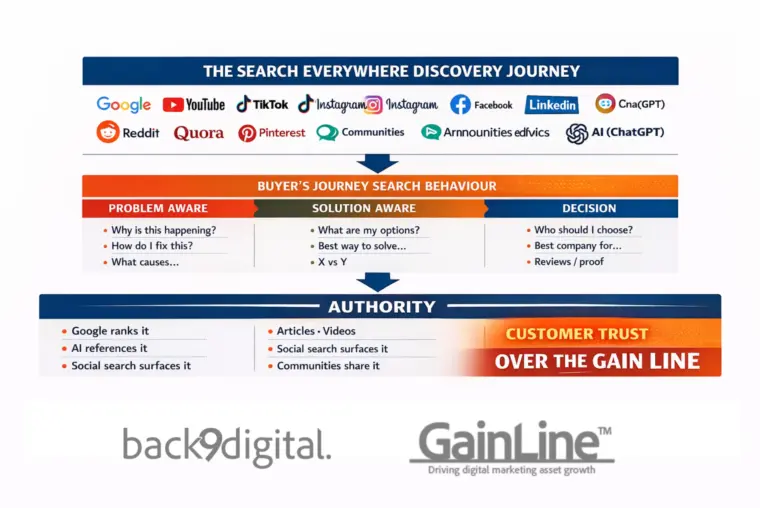
The GainLine Discovery Engine

Search Everywhere Meets the Buyer’s Journey

Understanding the GainLine in Buyers Journey is crucial for effective decision-making.

For example, the GainLine in Buyers Journey can dictate the success of marketing strategies.

Infographic-Defining-A-Search-Everywhere-Philosphy-Connected-To-The-Buyers-Journey

How This Actually Works

1. Buyers Start With Questions

Every buying journey starts with a question.

Problem Aware

A potential buyer might search:

Given the ‘Search Everywhere‘ take, these searches might happen on:

  • Google
  • YouTube
  • TikTok
  • Reddit
  • AI tools like ChatGPT, Gemini, Claude etc

2. Then They Explore Solutions

Once the problem is understood, the buyer searches for solutions.

Example searches:

  • “Best ecommerce platform NZ”
  • “SEO vs Google Ads”
  • “How to secure a WordPress website”

This is where comparison and educational content becomes critical.

3. Finally They Look For Proof

Before buying, people want reassurance.

They search for:

  • reviews
  • comparisons
  • pricing
  • case studies
  • results

These are exactly the topics most businesses avoid.

Which is why the brands that answer them win.

This Is Where GainLine Comes In

The GainLine philosophy exists to capture trust at every stage of the buyer journey. Below are the 4 key foundations of trust we have identified

1. Tackle the Tough Stuff

Answer the difficult questions buyers are already searching.

Price.
Problems.
Comparisons.

2. Open the Engine Room

Explain how things actually work.

Show process.
Reveal expertise.
Build credibility.

3. Gain the Tactical Advantage

Create content that helps buyers make better decisions.

Guides
Best-of lists
Explainers

4. Play for the Jersey

Prove your credibility.

Reviews
Results
Case studies

Why This Works in a Zero-Click World

Modern discovery often happens inside platforms.

Research reported by Search Engine Journal and analysis from SparkToro show that a large percentage of searches now end without a click to another website.

That means your content may influence buyers even when they never visit your site.

Which makes being visible across the ecosystem even more important.

The Back9 Way to Explain It

Old thinking: Rank in Google.

Modern reality: Be discoverable wherever your buyers search.

GainLine version:

Create trusted content that answers buyer questions and your brand becomes visible across the entire search ecosystem.

Should You Show Prices on Your Website?

If you have ever heard or asked yourself if you should show prices on your website, you’re not alone!

The Short answer? Probably yes.

Long answer? Still yes… but there’s nuance to it.

Because the real question usually isn’t:

“Should we show pricing?”

It’s:

“Are we willing to answer the questions buyers are already asking?”

And in most industries, price is one of the first questions people think about.

Not because buyers are cheap.

Because buyers are trying to understand risk.

They’re trying to work out:

  • Are we even in the right ballpark?
  • Is this affordable?
  • Is this premium?
  • Are we talking hundreds, thousands, or six figures?
  • Is this company aligned with what we need?

When businesses avoid pricing altogether, buyers don’t magically stop wondering.

They just go searching elsewhere.

Usually to competitors.

The Internet Changed the Buying Process

Years ago, buyers expected to contact sales early.

Now?

The future of Google Search has changed… It’s because People now research first – A lot.

They compare.
They read reviews.
They watch videos.
They ask ChatGPT.
They stalk your Google reviews.
They check Reddit threads.
They look for social proof.
They try to self-educate before talking to anyone.

And during that process, trust is either built… or lost.

That’s why pricing content matters so much now.

Not because every visitor wants an exact quote.

But because transparency builds confidence.

The Biggest Fear Businesses Have About Showing Prices

Usually it’s one of these:

  • “Our competitors will see it.”
  • “Every project is different.”
  • “People will judge us on price.”
  • “We’ll scare people away.”
  • “We need to explain the value first.”

Some of those concerns are valid.

But here’s the reality:

Your competitors probably already know roughly what you charge.

And buyers are already judging your pricing anyway.

The difference is whether they’re doing it with context… or assumptions.

Because when no pricing exists, people tend to assume one of two things:

  1. “This is probably expensive.”
  2. “These guys are hiding something.”

Neither is ideal.

Showing Pricing Is Bigger Than Just Pricing

This is where it ties directly into the GainLine philosophy and the Trust Drivers.

One of the core Trust Drivers is:

Tackle the Tough Stuff

Most businesses avoid hard conversations online.

Pricing.
Problems; Drawbacks. Timeframes, Limitations, Fit.

But buyers actively look for those answers.

The companies willing to front-foot difficult topics immediately stand out because they feel honest.

Not polished.

Not corporate.

Human.

And that matters.

Because trust is rarely built through hype.

It’s built through clarity.

Pricing Content Fits Directly Into the Tight 5

Inside the Tight 5 framework, pricing is one of the highest-impact content categories you can create.

Why?

Because it sits incredibly close to buying intent.

People searching:

  • “How much does it cost to build a new home?”
  • “What should I budget for a family holiday to Fiji?”
  • “How much does a heat pump installation cost?”
  • “What does a new roof typically cost?”
  • “How much should I expect to pay for braces?”
  • “What does it cost to move house across New Zealand?”
  • “How much does artificial turf installation cost?”
  • “What should I budget for a wedding?”
  • “How much does farm fencing usually cost per metre?”
  • “What does a new driveway cost?”
  • How much to paint a house in NZ?

…are not casually browsing.

They’re evaluating decisions.

That makes pricing content some of the most commercially valuable content on your website when done properly.

The Goal Isn’t Exact Pricing

This is where people get stuck.

Showing pricing doesn’t mean every business needs a giant “Buy Now” button with fixed numbers.

Sometimes that works.

Sometimes it doesn’t.

What buyers actually want is guidance.

Things like:

  • Starting-from pricing
  • Typical project ranges
  • What affects cost
  • Different service tiers
  • What’s included
  • What changes pricing
  • What makes something more expensive
  • What makes something cheaper

That alone reduces uncertainty massively.

Transparency Filters Better Leads

Here’s the part many businesses miss.

Pricing transparency doesn’t just attract leads.

It repels the wrong ones.

That’s a good thing.

Because not every enquiry is a good fit.

If someone has a $500 budget for a $20,000 project, finding that out after three meetings helps nobody.

Transparent pricing creates alignment earlier.

Which means:

  • Better conversations
  • Less ghosting
  • Less wasted time
  • Faster decisions
  • More qualified enquiries
  • Higher trust from day one

“But What If Competitors Undercut Us?”

They probably already are.

Businesses that compete purely on price will always exist.

Trying to hide your pricing rarely changes that.

What does change things is explaining:

  • Why you charge what you charge
  • What outcomes buyers get
  • What’s included
  • What process you follow
  • What risks you reduce
  • What experience people can expect

That’s value positioning.

And value positioning builds trust far better than silence ever will.

The Best Pricing Pages Don’t Feel Like Sales Pages

They feel educational.

Helpful.

Clear.

Balanced.

They answer questions buyers are already thinking. They acknowledge complexity without hiding behind it.

And importantly…

They don’t pretend every buyer is identical. Good pricing content helps people self-select.

That’s one of the most powerful things a website can do.

Should Every Business Show Prices?

Not necessarily exact pricing.

But most businesses should show something.

Even if it’s:

  • Typical investment ranges
  • “Starting from” pricing
  • Budget guidance
  • Package comparisons
  • Cost factors
  • Pricing FAQs
  • Self-selection tools or calculators

Because clarity creates momentum.

And momentum creates better buying experiences.

Final Thought

In a Search Everywhere world, buyers reward businesses that answer questions openly.

Pricing is one of the biggest questions buyers have.

Avoiding it doesn’t remove friction.

It creates it.

The businesses building trust fastest today are usually the ones willing to talk about the things others avoid.

That’s not just good marketing.

That’s good business.

Frequently Asked Questions

Should I put exact pricing on my website?

Not always. Many businesses benefit more from showing pricing ranges, starting prices, or explaining the factors that influence cost.

Does showing pricing scare people away?

Sometimes. But usually the wrong people. Pricing transparency helps qualify leads earlier and improves alignment.

Why is pricing content important for SEO?

Pricing-related searches often have high buying intent. People searching for pricing are usually much closer to making a decision.

What is pricing transparency?

Pricing transparency means openly helping buyers understand likely costs, pricing structures, and what influences investment levels.

How does pricing content build trust?

It shows buyers you’re willing to answer difficult questions honestly, which reduces uncertainty and improves confidence before sales conversations even begin.

Are Websites in 2026 Getting a Passing Grade?

Introduction: The Rules Have Changed

For years, businesses judged their website by how it looked. Then if you’re lucky, came performance scores, mobile optimisation, and search rankings. But right now, are websites in 2026, is this still the case?

Well, today, in 2026, we can confidently tell you, the standard has shifted again.

A website is no longer just a digital brochure.

It’s a credibility engine; the place people, search engines, and now AI systems go to verify whether your business can be trusted.

In the past, strong design and basic SEO were perceived as enough.

In 2026, they’re now! A passing grade requires something deeper:

  • Clear expertise
  • Helpful content
  • Consistent signals of trust
  • And a structure that helps buyers qualify themselves before they ever speak to you.

The question isn’t just:

“Does your website work?”

It’s:

“Does your website build confidence (and therefore trust) from the start and before the first conversation?”

Are Websites in 2026 Getting a Passing Grade?

The average website still sits around the middle of the pack.

Many look modern.

Some may load faster.

But most still struggle with one thing:

They talk about themselves more than they help the buyer make a decision.

The biggest gap isn’t technical anymore.

It’s trust.

And that gap is growing as AI surfaces answers directly inside search results — meaning people often decide who they trust before they even visit a site.

The Four Metrics Still Matter, But They Mean Something New

1. Website Performance; Speed Builds Confidence

Performance is still about load times and efficiency.

But in 2026, speed isn’t just technical.

It’s psychological.

Fast websites feel more credible.
Slow websites feel uncertain.

Users expect pages to load instantly.
AI crawlers and search engines also favour clean, efficient architecture because it’s easier to understand.

A fast site signals clarity.

And clarity reduces doubt.

2. SEO; Visibility Is Now About Credibility

SEO used to be about rankings.

Now it’s about presence.

Your content might appear:

  • Inside AI summaries
  • In featured answers
  • Across social snippets
  • Or embedded in conversational search results

This means optimisation isn’t just technical anymore.

It’s educational.

Businesses that openly answer real questions — pricing, problems, comparisons, expectations — are easier for search engines and AI systems to trust.

The goal isn’t just traffic.

It’s becoming the source people rely on when they’re trying to understand their options.

3. Mobile; Friction Is the New Failure

Mobile design used to be about responsiveness.

Now it’s about flow.

If a visitor can’t quickly:

  • understand what you do
  • find helpful information
  • or feel guided toward a decision

they leave.

The best mobile experiences don’t overwhelm people.

They guide them.

Clear structure reduces hesitation — and hesitation is often what stops leads from moving forward.

4. Security; Trust Starts Before the First Click

Security has become a baseline expectation.

SSL certificates, updated libraries, and reliable hosting are no longer “nice to have”.

They are proof of professionalism.

Modern browsers warn users before they enter insecure sites.

And AI systems increasingly evaluate trust signals behind the scenes.

If your foundation isn’t secure, everything else becomes harder.

The Hidden Website Metric: Trust Momentum

Here’s what’s changed the most since the early 2020s.

Websites used to be destinations.

Now they are checkpoints.

People arrive after:

  • seeing content
  • hearing about you
  • reading reviews
  • or interacting with AI answers

By the time someone lands on your website, they are already forming an opinion.

Businesses that earn higher grades today do something differently:

They reduce uncertainty.

Instead of hiding information, they make decisions easier by being clear about:

  • who they help
  • what the process looks like
  • what to expect
  • and whether they are the right fit.

This approach builds trust long before a sales conversation begins.

What a Passing Grade Looks Like for Websites in 2026

A strong website now balances two things:

Technical Excellence

  • Fast loading
  • Clean structure
  • Secure architecture
  • Mobile-first experience

Trust Signals

  • Helpful educational content
  • Honest explanations
  • Clear expectations
  • Consistent messaging across channels

When these work together, something powerful happens:

Visitors don’t just browse.

They move forward with confidence.

Why Content Matters for websites in 2026: Now More Than Ever

AI-driven search has changed discovery.

Due to AI Overviews now commonly referred to as ‘Zero Click Search Results” People don’t always click links anymore.

Instead, they see summaries generated from trusted sources.

Screenshot-Of-Ai-Overview-In-Google-Answering-If-Websites-In-2026-Are-Still-Relevant

That means businesses need to create content that:

  • answers real questions
  • builds authority over time
  • and supports buyers at every stage of their journey.

Not more content for the sake of noise.

Better content that removes doubt.

The goal isn’t to push people toward a sale.

It’s to help the right people feel ready.

Conclusion; Passing the Real Test

In 2024, and 2025, the question was:

“Is your website technically strong enough?”

In 2026, the real question is:

“Does your website genuinely help people? Which means means they can trust you faster?”

Performance, SEO, mobile experience, and security still matter.

But the websites getting top marks today do one extra thing:

They lead with clarity.

They educate openly.

And they build trust across every channel; not just on their homepage.

If your website helps buyers feel informed, confident, and understood before they reach out, you’re not just passing.

You’re leading.

The Back9 Way: How We Build Digital That Grows Over Time

Most organisations find that building a website or digital system feels harder than it needs to be. Instead of clarity, it often creates friction, confusion, or just a lot of noise.

At Back9, we start with a simple belief:

As a leading Growth Driven Design Agency, we believe in creating seamless digital experiences that drive success.

Technology should help people do their work better, not get in the way.

That belief shapes everything we do.

Being a Growth Driven Design Agency, our focus is on enhancing user experience and driving engagement. To help and nurture potential customers to help them see if they are a fit. Then guide the, into a sale, or sale conversation

We exist to help organisations help people better. Sometimes that means making things easier for customers. Other times it means giving staff better tools or creating systems that serve a wider community. Either way, digital should reduce effort, not add to it.

When it’s done properly, it should make everything else easier.

Why Digital Projects So Often Fall Short

One of the biggest reasons digital projects fail is because they’re treated as one-off events.

A website gets designed, built, launched, and then left alone. A system goes live and becomes “good enough”. From there, people hope it performs, but rarely measure whether it actually does.

Over time, small problems compound. Content goes stale. User needs change. Business priorities shift. What once felt modern slowly becomes a liability.

This isn’t a failure of intent. It’s a failure of approach.

A Different Way of Working

Why Choose a Growth Driven Design Agency?

As a dedicated Growth Driven Design Agency, we ensure our strategies are data-driven and results-oriented.

We take an end-to-end approach to digital.

This is why partnering with a Growth Driven Design Agency can transform your digital presence.

That means we don’t just focus on the launch. We focus on what happens after.

As a Growth Driven Design Agency, we prioritise sustainable growth over quick fixes.

We design and build digital systems properly, then measure how they’re actually used. We look at what’s working, what isn’t, and where friction shows up. From there, we improve things continuously based on real data, not assumptions.

This approach is called Growth-Driven Design.

Working with a Growth Driven Design Agency means embracing an iterative improvement process.

Instead of guessing, we build, learn, and iterate. We make deliberate improvements over time, guided by evidence rather than opinions. The goal isn’t speed for its own sake. It’s progress that compounds.

Our Growth Driven Design Agency is committed to delivering measurable outcomes and enhancing user satisfaction.

Doing it properly beats doing it fast. And steady improvement beats a big, flashy launch every time.

We are proud to be a Growth Driven Design Agency that champions innovation and customer-centric solutions.

What This Delivers in Practice

Joining forces with a Growth Driven Design Agency can lead to unprecedented growth and success.

Working this way changes what digital becomes for an organisation.

Instead of something you maintain out of obligation, it becomes a genuine business asset.

We help growth-minded organisations turn their websites, software, and digital systems into tools that drive real, measurable results. Not just traffic or aesthetics, but outcomes that matter.

When digital is designed to improve with use rather than degrade over time, trust builds naturally. People find what they need. Processes run smoother. Decisions become easier to make.

A good digital experience isn’t loud. It’s dependable. And that dependability is what creates confidence.

Let’s explore how a Growth Driven Design Agency can elevate your business to new heights.

Who This Approach Is For

We’re not a quick-fix shop, and we’re not interested in shortcuts or hacks.

We work best with growth-minded business owners, marketing teams, and not-for-profits who are prepared to take a long-term view. Organisations that understand digital is an ongoing investment, not a box to tick.

If you’re looking for a partner to help you build something that grows in value over time — rather than something that slowly becomes outdated — then this approach is likely a good fit.

A Simple Next Step

Our goal isn’t to convince you.

It’s to help you find the right path forward.

If this way of thinking about digital resonates, we’re always happy to have a proper conversation about where you’re heading and whether we can help.

Imagine. Design. Execute. Amplify.

Banner-With-Blue-Gradient-Background-An-Image-Of-A-Calendar-And-A-Cta-To-Book-A-Meeitng-With-A-Button

Beyond the Brochure Website: The Drivers of Digital Trust Your Brand Needs to Thrive Online

Does your digital presence employ the drivers of digital trust to create momentum, or is your digital just creating friction?

For far too many businesses, their digital presence has butter-fingers, dropping the ball all over the place… What I mean by that is that websites, apps, and marketing hide critical information. Maybe not hidden per se, but omitted… This creates confusion, disconnection and even can create distrust. Ultimately it either pushes buyers to one of your competitors who’s willing to offer that omitted information, or into sales conversations with you long before they’re ready. Meaning they are statically far less likely to convert. So basically, instead of acting as a business asset, digital becomes a blocker to growth.

At its core, the problem is simple: [Not enough, if any] trust hasn’t been earned.

When digital is done properly, it makes things clearer. Easier. Calmer.
It helps people move forward with confidence… And without pressure.

This article breaks down the three drivers of digital trust and the Drivers of Digital Trust that turn a digital presence from an online brochure into a genuine growth asset. These drivers sit inside the GainLine model, our approach to connecting inbound marketing, Growth-Driven Design (GDD), and sales into one cohesive system.

The Problem: When Digital Drops the Ball

Many businesses still play “kick and hope” with their digital strategy.

Far too often, a buyer lands on a website and immediately hits friction:

  • Pricing is vague or hidden
  • Fit is unclear
  • Comparisons are avoided
  • Proof is shallow or polished
  • Every path leads to “Contact Us”

That’s not helpful. It’s risky.

This approach creates frustration and doubt. And when buyers feel doubt, or frustration, or don’t trust, they don’t move forward… They move on.

If a digital experience doesn’t help someone understand cost, determine fit, compare options, and build confidence before a sales conversation take place, then it isn’t building momentum or supporting growth. It’s slowing it down.

You’re not just losing a lead.
You’re handing possession back to the opposition.

The GainLine View: Trust Drives Progress

Inside the GainLine model, growth only happens when momentum crosses the advantage line.

That doesn’t happen because of clever design or louder marketing.
It happens when trust is built, reinforced, and converted.

These are the three core drivers of digital trust that make that progression possible.

Driver 1: Clarity

Buyers move forward when things make sense.

Clarity is about answering the questions buyers are already asking… Honestly and early with bias.

This is where the Tight 5 comes in to play:

  • What does this cost, really?
  • Who is this not right for?
  • How does it compare to alternatives?
  • What are the best options available?
  • Has this worked in the real world?

Most competitors run sideways to avoid these conversations.
Clarity means the tight5 can build a good solid foundation, create momentum and with that you’re delivering front-foot ball.

It’s not about oversharing.
It’s about removing uncertainty.

When buyers understand price, problems, and trade-offs, they feel informed, not sold to.

Clarity creates clean front-foot ball.

Driver 2: Proof

Clarity earns attention.
Proof earns belief.

Anyone can say the right things. Trust is built when buyers can see the work.

Proof means opening up the engine room:

  • Showing how problems are solved, not just the wins
  • Demonstrating the people, process, and thinking behind the scenes
  • Sharing real examples, real outcomes, and real constraints
  • Proving you’re match-fit, not just well marketed

This is where Growth-Driven Design plays a critical role.

Instead of guessing, GDD allows you to:

  • Observe real behaviour
  • Measure what’s working and what isn’t
  • Improve pages, messages, and flows
  • Double down on what actually moves buyers forward

Proof replaces polish with confidence.
It turns marketing claims into earned authority.

Driver 3: Confidence

Buyers don’t want to be pushed.
They want to feel confident they’re making the right decision.

Confidence is created by helping buyers progress on their own terms.

They can do this these days, as your potential customers hold all the power. In fact most buying journeys today are self-directed and research-led. Buyers do their homework long before they ever speak to a salesperson, defining requirements, comparing options, and reading reviews to reduce risk. Many initiate contact only once they feel informed, and they often revisit information across multiple touchpoints before making a decision.

The implication is simple: buyers don’t want to be pushed. They want to feel prepared. Digital experiences that support research, surface proof, and allow self-selection help buyers build confidence at their own pace — which is exactly when meaningful conversations happen.

Key Buying Journey Statistics: (Sourced from Gemini Overview)

  • Research & Information Gathering: 95% of consumers read online reviews before visiting a business. Consumers typically research products at least three times before purchasing.
  • B2B Buying Behavior: 85% of B2B buying teams have their requirements mostly or completely set before contacting vendors. 83% of B2B buyers prefer vendors to reach out via email.
  • Digital & Mobile Influence: 71% of in-store shoppers use mobile devices to research, read reviews, or compare prices. 54% of shoppers cite easier comparison shopping as a reason to buy online.
  • Social Proof & Content: 77% of buyers read user reviews, and 54% speak directly with current users. 80% of business decision-makers prefer information from a series of articles rather than an advertisement.
  • Purchasing Drivers & Timing: 62.3% of consumers cite discounts as a top purchase driver. 63% of consumers who request information about a product will not purchase for at least three months.
  • Post-Purchase & Loyalty: 87% of customers who report a great experience are likely to purchase again. Companies that offer great service can see 70% of customers spending more with them.
  • Decision Drivers: 11% of B2B buyers expect immediate positive ROI after purchase, while 57% expect it within 3 months.
  • Complex Journeys: 77% of B2B buyers describe their latest purchase as very complex or difficult. 

This is where self-selection and sales come together:

  • Cost calculators that answer pricing questions
  • Fit quizzes that surface problems early
  • Assignment selling that prepares, not pressures
  • Calm, human sales conversations grounded in shared understanding

By the time a buyer reaches out, they’re not starting from zero.
They’re already over the gain line; informed, aligned, and ready.

Confidence is where momentum becomes commitment.

Why These Drivers of Digital Trust Matter

When your digital presence is built around clarity, proof, and confidence, everything changes.

Sales teams stop backtracking.
They stop re-explaining basics.
They stop rebuilding trust that should already exist.

Instead:

  • Conversations start further along
  • Objections surface earlier
  • Decisions feel easier
  • Outcomes improve

Your website stops being a brochure.
It becomes a system, one that works 24/7 employee, to earn trust and move buyers forward.

From Digital Blocker to Growth Asset

This isn’t about a campaign or a big redesign.

It’s about committing to a better way of building digital:

  • Clear answers instead of guarded messaging
  • Visible work instead of polished claims
  • Confident progression instead of forced conversion

Clarity. Proof. Confidence.

These are the drivers of digital trust, and the conditions required for real momentum.

Stop running sideways.
Start crossing the gain line, putting the points that matter on the scoreboard!