
AI Software Security Risks: Why You Should Be Careful With Vibe Coding

AI has changed software development at a pace very few people predicted.

You can now generate websites, apps, automations, and entire software platforms in hours instead of months. At Back9 Digital we use AI ourselves; it’s a genuinely powerful tool when applied with care.

But there’s a growing pattern we’re concerned about: businesses (seemingly) trusting AI-generated software without properly considering what’s running underneath. And in the last twelve months, that concern has stopped being theoretical.

The Real Risk Isn’t That AI-Built Software “Looks AI-Built”

A lot of commentary on AI-generated software focuses on whether products feel generic or visually polished but operationally weak. Those are real observations — but they’re not the issue that should be keeping business owners awake at night.

The real issue is security.

Modern software is deeply connected into the systems businesses depend on every day:

  • customer information
  • payment systems
  • CRMs
  • email platforms
  • operational tools
  • automations
  • business databases

When vulnerabilities exist inside any of those systems, the consequences move from “annoying bug” to “genuine business risk” very quickly.

AI Generates Vulnerabilities Just as Quickly as It Generates Code

AI is excellent at producing software that works.

But working is not the same as secure, and that distinction is where most of the danger sits.

AI-generated code routinely introduces issues such as:

  • exposed API keys
  • insecure or missing authentication
  • weak permissions handling
  • exposed database endpoints
  • missing or misconfigured access control rules
  • poor input validation
  • vulnerable third-party dependencies
  • insecure server configurations
  • cross-site scripting (XSS) vulnerabilities
  • SQL injection vulnerabilities

The dangerous part is that none of this is visible to the average business owner. The app loads, the dashboard works, the forms submit. Underneath, the gaps may already be wide open.

Recent Incidents That Show Why This Matters

If you want to understand why this issue is urgent, three real incidents from the last year tell the story clearly.

1. Lovable + Supabase: AI-Generated Apps Exposed Real User Data (CVE-2025-48757)

This is the case study every business considering vibe coding should know about.

Lovable is a popular AI app-building platform that generates apps backed by Supabase databases. In 2025, security researchers found that a large share of Lovable-generated apps had broken or missing Row Level Security, the rule layer that controls who can read what data in the database.

The result: attackers didn’t need credentials. The public API key already embedded in the app’s frontend code was enough to query the database directly and pull out full user lists, payment records, and even other API keys.

Around 170 apps were affected, exposing data belonging to roughly 13,000 users — about 10% of all Lovable applications scanned.

This wasn’t a Supabase failure. Supabase’s security model works correctly when configured properly. The failure was in the AI-generated code, which produced apps that looked finished but didn’t lock down the database access controls underneath.

It’s a near-perfect example of the risk: software that ships fast, looks polished, and quietly leaks user data.

2. Vercel (April 2026): When Connected AI Tools Become an Attack Path

In April 2026, Vercel, one of the largest hosting platforms for modern web apps; disclosed a breach that began with a compromised third-party AI tool (Context.ai) used by one of its employees.

From there, attackers were able to pivot into Vercel’s internal environment and read environment variables across affected customer accounts that were not flagged as “sensitive”, meaning they were not encrypted at rest. Stolen data was later listed for sale on a hacker forum for $2 million.

The lesson here isn’t that Vercel built insecure software. It’s that environment variables, he same place AI-generated apps tend to dump API keys, database credentials, and third-party tokens, are a high-value target, and a single weak link in the AI tool chain can cascade into hundreds of downstream environments.

3. The Pattern Across Both Incidents

The common thread: AI accelerated the build, but the security thinking didn’t keep up.

In Lovable’s case, the AI generated code that skipped a critical access control layer. In Vercel’s case, the supply chain wrapped around AI tooling created an attack path nobody had stress-tested.

Neither would have been caught by “does the app work?” The damage in both cases was invisible from the surface.

What Exposed API Keys Actually Allow Attackers To Do

When people hear “API key leak”, it can sound abstract. In practice, it usually leads to one or more of the following:

  • Direct database access. Attackers can query, modify, or dump entire tables.
  • Impersonation. Acting as a trusted system to call internal APIs.
  • Infrastructure abuse. Spinning up resources or sending requests on the business’s bill.
  • Lateral movement. Using the leaked key to reach connected systems (email, payments, analytics).
  • Targeted phishing campaigns. Once attackers have customer names, emails, order history, or transaction patterns, they can craft phishing messages that look uncannily legitimate — referencing real orders, real account numbers, real product names. These campaigns convert at far higher rates than generic spam, which is why exposed customer data is so valuable on the criminal market.

That last point is exactly the chain you described, and it’s accurate. A leaked API key can lead to user data exposure, which can lead to highly targeted phishing — and from there to account takeover, fraud, or further compromise.

Why Most Businesses Don’t See the Danger

This deserves its own section, because it’s the heart of the problem.

Most business owners using AI to build or commission software:

  • can’t read the code being generated
  • don’t know what an environment variable is, let alone whether it’s encrypted at rest
  • assume that “the AI wouldn’t generate something insecure”
  • judge the product by what they can see — the UI, the dashboard, the working forms
  • have no internal benchmark for what “secure” even looks like

That’s not a criticism. Software security is a specialised discipline, and historically it sat behind a wall of expert review before anything went live.

AI vibe coding has removed that wall, but it hasn’t replaced what the wall was doing.

AI Doesn’t Understand Consequences

This is the part many businesses overlook.

AI predicts likely code patterns. It does not truly understand:

  • operational security
  • compliance obligations (GDPR, PCI-DSS, HIPAA, NZ Privacy Act)
  • breach recovery planning
  • data privacy implications
  • business continuity
  • infrastructure hardening
  • legal exposure if a breach occurs

It can generate functional code at remarkable speed. It cannot take responsibility for what happens when something goes wrong — and in a breach, the responsibility falls on the business that deployed it.

Speed Is Creating False Confidence

One of the biggest risks with AI development is how quickly businesses can move from idea → prototype → live product.

That speed creates a false sense of confidence. Launching software fast is not the same as launching software safely. Security reviews, dependency audits, permissions checks, environment hardening, and proper architecture still matter, arguably more, because the cost of skipping them is now lower in the short term and higher in the long term.

How To Use AI Safely In Software Development

We’re not anti-AI. Far from it. Used well, AI is one of the most useful tools to enter the industry in years. Used carelessly, it’s a liability waiting to surface.

The practical baseline we recommend:

  • Never deploy AI-generated code without human review — particularly anything touching authentication, database access, payments, or user data.
  • Treat every AI-generated environment variable as if it could leak. Use platforms’ “sensitive” or encrypted-at-rest options. Rotate keys regularly.
  • Verify access control at the database layer, not just in the app code. For Supabase-style setups, that means actually testing Row Level Security policies, not just enabling them.
  • Run dependency and secret scanning in CI/CD. Tools like GitGuardian, Snyk, and GitHub’s built-in scanners catch a lot of low-hanging fruit.
  • Test from an attacker’s perspective. A simple curl against your public API endpoints will tell you more than most automated reports.
  • Engage proper engineering oversight for anything connected to real user data, payments, or critical workflows.

Final Thoughts

AI is going to play a huge role in the future of software development. That’s not in question.

What is in question is whether businesses will treat AI-generated code with the same scrutiny they’d apply to anything else running their operations. The pattern of recent incidents; Lovable, Vercel, and the broader rise in AI-related supply chain attacks, suggests many won’t, until something forces them to.

Software that looks good on the surface can still leak customer data, expose credentials, and become the launch pad for targeted phishing campaigns against the very people who trusted the business with their information.

In an environment where anyone can generate working software in an afternoon, the real differentiators become security, stability, and trust.

That’s the bar worth building to.

Frequently Asked Questions

Is AI-generated software secure?

AI-generated software can be secure — but only when it is properly reviewed, tested, and engineered. Left unchecked, AI routinely produces code with exposed API keys, weak access controls, and vulnerable dependencies.

What are the biggest AI software security risks?

The most common risks include:
exposed API keys and environment variables
insecure or missing authentication
missing database access controls (e.g. Row Level Security)
vulnerable third-party packages
weak permissions handling
targeted phishing campaigns built from leaked customer data

Can exposed API keys lead to phishing attacks?

Yes. If attackers gain access to customer information through exposed keys or misconfigured APIs, that data is often used to build highly targeted phishing campaigns that reference real orders, accounts, or transactions — making them far more convincing than generic spam.

Is AI bad for software development?

No. AI is an incredibly powerful development tool. The risk comes from skipping the security review and engineering oversight that used to be built into the development process by default.

Why should businesses be concerned about AI-generated code?

Because most business owners can’t see the security gaps that AI-generated software often contains. The product looks finished, the dashboard works, customers can sign up — and yet the database might be queryable by anyone with the public API key. Recent incidents like CVE-2025-48757 (which exposed user data across 170+ Lovable-built apps) show this isn’t theoretical. Without proper review, the first sign of a problem is often a breach notification.

Are Websites in 2026 Getting a Passing Grade?

Introduction: The Rules Have Changed

For years, businesses judged their website by how it looked. Then if you’re lucky, came performance scores, mobile optimisation, and search rankings. But right now, are websites in 2026, is this still the case?

Well, today, in 2026, we can confidently tell you, the standard has shifted again.

A website is no longer just a digital brochure.

It’s a credibility engine; the place people, search engines, and now AI systems go to verify whether your business can be trusted.

In the past, strong design and basic SEO were perceived as enough.

In 2026, they’re now! A passing grade requires something deeper:

  • Clear expertise
  • Helpful content
  • Consistent signals of trust
  • And a structure that helps buyers qualify themselves before they ever speak to you.

The question isn’t just:

“Does your website work?”

It’s:

“Does your website build confidence (and therefore trust) from the start and before the first conversation?”

Are Websites in 2026 Getting a Passing Grade?

The average website still sits around the middle of the pack.

Many look modern.

Some may load faster.

But most still struggle with one thing:

They talk about themselves more than they help the buyer make a decision.

The biggest gap isn’t technical anymore.

It’s trust.

And that gap is growing as AI surfaces answers directly inside search results — meaning people often decide who they trust before they even visit a site.

The Four Metrics Still Matter, But They Mean Something New

1. Website Performance; Speed Builds Confidence

Performance is still about load times and efficiency.

But in 2026, speed isn’t just technical.

It’s psychological.

Fast websites feel more credible.
Slow websites feel uncertain.

Users expect pages to load instantly.
AI crawlers and search engines also favour clean, efficient architecture because it’s easier to understand.

A fast site signals clarity.

And clarity reduces doubt.

2. SEO; Visibility Is Now About Credibility

SEO used to be about rankings.

Now it’s about presence.

Your content might appear:

  • Inside AI summaries
  • In featured answers
  • Across social snippets
  • Or embedded in conversational search results

This means optimisation isn’t just technical anymore.

It’s educational.

Businesses that openly answer real questions — pricing, problems, comparisons, expectations — are easier for search engines and AI systems to trust.

The goal isn’t just traffic.

It’s becoming the source people rely on when they’re trying to understand their options.

3. Mobile; Friction Is the New Failure

Mobile design used to be about responsiveness.

Now it’s about flow.

If a visitor can’t quickly:

  • understand what you do
  • find helpful information
  • or feel guided toward a decision

they leave.

The best mobile experiences don’t overwhelm people.

They guide them.

Clear structure reduces hesitation — and hesitation is often what stops leads from moving forward.

4. Security; Trust Starts Before the First Click

Security has become a baseline expectation.

SSL certificates, updated libraries, and reliable hosting are no longer “nice to have”.

They are proof of professionalism.

Modern browsers warn users before they enter insecure sites.

And AI systems increasingly evaluate trust signals behind the scenes.

If your foundation isn’t secure, everything else becomes harder.

The Hidden Website Metric: Trust Momentum

Here’s what’s changed the most since the early 2020s.

Websites used to be destinations.

Now they are checkpoints.

People arrive after:

  • seeing content
  • hearing about you
  • reading reviews
  • or interacting with AI answers

By the time someone lands on your website, they are already forming an opinion.

Businesses that earn higher grades today do something differently:

They reduce uncertainty.

Instead of hiding information, they make decisions easier by being clear about:

  • who they help
  • what the process looks like
  • what to expect
  • and whether they are the right fit.

This approach builds trust long before a sales conversation begins.

What a Passing Grade Looks Like for Websites in 2026

A strong website now balances two things:

Technical Excellence

  • Fast loading
  • Clean structure
  • Secure architecture
  • Mobile-first experience

Trust Signals

  • Helpful educational content
  • Honest explanations
  • Clear expectations
  • Consistent messaging across channels

When these work together, something powerful happens:

Visitors don’t just browse.

They move forward with confidence.

Why Content Matters for websites in 2026: Now More Than Ever

AI-driven search has changed discovery.

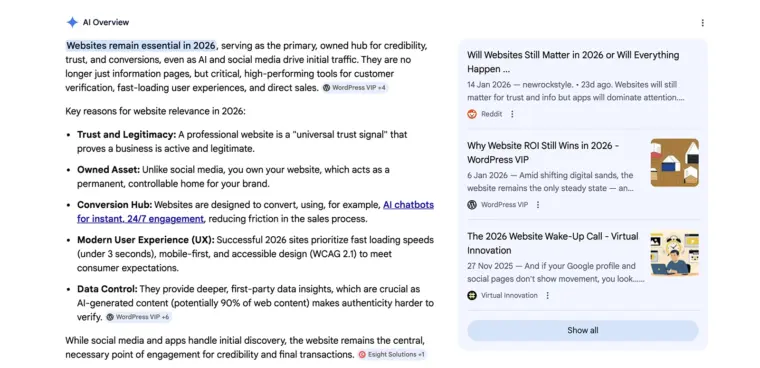
Due to AI Overviews now commonly referred to as ‘Zero Click Search Results” People don’t always click links anymore.

Instead, they see summaries generated from trusted sources.

Screenshot-Of-Ai-Overview-In-Google-Answering-If-Websites-In-2026-Are-Still-Relevant

That means businesses need to create content that:

  • answers real questions
  • builds authority over time
  • and supports buyers at every stage of their journey.

Not more content for the sake of noise.

Better content that removes doubt.

The goal isn’t to push people toward a sale.

It’s to help the right people feel ready.

Conclusion; Passing the Real Test

In 2024, and 2025, the question was:

“Is your website technically strong enough?”

In 2026, the real question is:

“Does your website genuinely help people? Which means means they can trust you faster?”

Performance, SEO, mobile experience, and security still matter.

But the websites getting top marks today do one extra thing:

They lead with clarity.

They educate openly.

And they build trust across every channel; not just on their homepage.

If your website helps buyers feel informed, confident, and understood before they reach out, you’re not just passing.

You’re leading.

Website Cost NZ: What You Really Need to Know

Building a website isn’t just a box to tick. It’s a business investment. But what are the influencers on website cost NZ? The answer depends on several factors—some obvious, others less so.

In this guide, we break down the real costs behind web design in NZ. From one-pagers to custom-built eCommerce sites, you’ll get a clear view of what affects price, what’s worth investing in, and what to avoid.

Why Website Costs Vary in NZ

Not all websites are created equal… And neither are their price tags.

The truth is there are so many factors that can influence website design costs. Here’s what can push your website cost in NZ up or down:

  • Size and complexity – More pages and features = more time = higher cost.
  • Design approach – Custom UX/UI design costs more than using a theme.
  • Functionality – Booking systems, online shops, or custom forms all add to the bill.
  • Content – If you need copywriting or images, factor that in too.
  • Who builds it – A pro agency costs more than your mate from uni.

Think of your site like building a house. The structure, finish, and who builds it all affect the final price.

Common Website Types and What They Cost

Here’s a rough guide to website costs in NZ based on your business needs:

Website TypeBest ForTypical Cost (NZD)
One-page websiteStartups, portfolios$1,000 – $3,000
Brochure-style siteTradies, small businesses$3,000 – $6,000
Multi-page websiteGrowing businesses$5,000 – $10,000
eCommerce siteOnline stores$7,000 – $20,000+
Custom web app/siteHigh-spec functionality$15,000 – $50,000+

Prices vary depending on scope. More pages and features = more cost.

Key Cost Drivers to Be Aware Of

Here’s where the dollars stack up:

  • Design complexity
  • Number of pages
  • Mobile responsiveness
  • SEO setup
  • Custom features (e.g. bookings, logins)

Know what’s essential. Don’t burn budget on features that don’t support your goals.

Why You Shouldn’t Buy a One-Off Website Anymore

Here’s the hard truth: traditional website projects, where you pay once, get a site, and walk away, are broken.

Why? Because static websites don’t evolve. You launch them… and they just sit there. No updates or ongoing improvement. And generally, no performance tracking either!

The stats speak for themselves… Only 17% of all websites in all the world [wide web] are actively maintained.. And, in a world that moves at digital light speed, that’s a missed opportunity.

A better approach? Growth-Driven Design (GDD). It flips the model on its head. You start smart, launch fast, and iterate based on real data.

Traditional Website ❌Growth-Driven Design ✅
Big upfront costSmaller startup cost, then scale
Set and forgetRegular updates and testing
Built on assumptionsBuilt using real performance
No accountabilityOngoing support + insights

So when weighing website cost in NZ, ask yourself: what’s the real cost of launching a site and never improving it?

With GDD, you stay relevant, optimise results, and turn your website into a lead-generating machine—not just a fancy business card.

Traditonal-Website-Design-Is-Broken-Cta

One-Page Website Cost NZ

These sites are lean, fast, and straight to the point—great for simple messages or startups.

Cost depends on:

  • Whether you use a theme or go custom
  • How much content is involved
  • Any animations or fancy effects

Average one-page website cost in NZ: $1,000 to $3,000. But honestly, unless it’s a Growth-Driven Launchpad site, you’re wasting your time and money!

Multi-Page & eCommerce Websites

Need more content or want to sell online? Expect a higher build cost.

Multi-page sites suit businesses with lots of info—services, FAQs, blogs, locations, etc.

eCommerce websites need:

  • Payment gateways
  • Product setup
  • Shipping rules
  • Security certificates

These take time and cost more—but they’re worth it if you sell online.

Ongoing Costs: What You’ll Keep Paying For

It’s not just about building a site—you’ll need to keep it running, secure, and updated.

Cost TypeWhat It CoversCost Range (NZD)
DomainYour website address$30 – $50/year
HostingStorage and server space$150 – $500/year
SSL CertificateSecurity and trust$0 – $199/year
Basic MaintenanceBackups, updates, security$99 – $350/month

Budgeting for these avoids nasty surprises later.

Image-Button-To-Read-Website-Maintenance-Ebook

Custom vs Template: Which One Should You Choose?

Custom website design gives you a unique brand experience—but it costs more and takes longer.

Template sites are quicker and cheaper but may feel generic.

OptionProsCons
CustomUnique, flexible, scalableHigher cost, longer build
TemplateFast, budget-friendlyLimited customisation

Match your choice to your goals and your budget.

DIY Website Builders vs Hiring a Pro

.Platforms like Wix or Squarespace are cheap and cheerful, but come with limits. (These limitations are why we don’t work with Wix or Build websites with Squarespace).

Pros:

  • Cheap upfront
  • Easy to use

Cons:

  • Poor SEO
  • Limited functionality
  • Not built for scale

Hiring a pro gives you strategy, polish, and long-term results.

How to Get an Accurate Website Cost Quote in NZ

To avoid surprises:

  1. Define your scope – What do you want the site to do?
  2. List must-haves vs nice-to-haves
  3. Request quotes from multiple providers
  4. Ask what’s included – content, revisions, SEO, support?
  5. Clarify ongoing costs

More detail = better quote accuracy.

Tips to Maximise Your Web Design Budget

  • Start small, scale smart – Launch a solid base and improve over time.
  • Focus on value – Don’t overinvest in bells and whistles.
  • Think long-term – A good site should support you for years.
  • Budget for updates – Websites are never “done.”

You don’t need to overspend—just spend wisely.

Image-Cta-How-Much-Revenue-Can-My-Website-Generate

Website Cost NZ FAQs

How much does a website cost in NZ?
Realistically website cost in NZ can be anywhere from $1K to $ 20K+. Whilst ther are exceptions, the sweet spot for most growing businesses for a launchpad website is $5K–$10K.

Can I lower the cost?
Yes, use a template, reduce the number of pages, or write your own content.

Is SEO included?
Not always. Especially for cheap websites…Ask upfront. A site that looks great but can’t be found won’t do you much good. SEO is key to being found online. And if you are replacing an old site, make sure you’re getting your content and SEO migrated properly. That’s even more important if you are replacing domain names or changing page structure. Poor Website migration can harm your SEO and visibility within weeks, if not days. Trust me, I’ve seen it first hand!

Final Thoughts on Website Cost in NZ

If you want a site that works with your business, not just for it, plan ahead, budget smart, and avoid the trap of the one-and-done model.

Done right, your website should be an evolving tool that grows alongside your business and delivers real results.

A smart investment now beats a redesign every two years. Don’t just build a website… Build your ongoing digital competitive advantage.

Cta-Image-For-A-Free-Instant-Website-Audit-For-Growth-Driven-Web-Design

Top Website Design Trends in Christchurch for 2025

If you want to succeed online, in Christchurch, understanding website trends in in 2025 are crucial. In today’s digital age, your website is a critical factor for business success. It’s more than just aesthetics; it’s about creating an engaging user experience. In fact, it’s the The 24/7 Employee You Never Knew You Needed

In Christchurch, a city known for its innovation and creativity, this is particularly true. Businesses here understand the importance of staying ahead of the curve.

This article explores the top website design trends in Christchurch. It delves into the latest strategies and techniques that are shaping the digital landscape.

From growth-driven design to mobile-friendly websites, we’ll discuss what’s hot in the web design world. We’ll also highlight the role of a Christchurch website design company in implementing these trends.

Whether you’re a marketing manager, a startup founder, or a CEO, this article is for you. It’s time to harness the power of innovative web design and propel your business to new heights in the digital economy.

So read on, as we navigate the exciting world of website design in Christchurch.

The Rise of Growth-Driven Design in Christchurch

Growth-driven design is transforming how websites are developed in Christchurch. It’s a method that focuses on data and continuous improvement.

Traditional design can be slow and risky. Growth-driven design is agile and flexible, minimizing these risks.

This approach starts with a launchpad site, which evolves based on user data. Businesses can react swiftly to market changes.

In Christchurch, companies are embracing this dynamic model. They see the value it brings in adapting to user needs.

The emphasis is on testing and learning, ensuring digital platforms remain effective and relevant.

Traditonal-Website-Design-Is-Broken-Cta

Why Responsive and Mobile-Friendly Websites are a Must

In today’s digital landscape, mobile internet usage is skyrocketing. More users are browsing on their phones than ever before.

A responsive website adjusts seamlessly across devices. This adaptability enhances user satisfaction and engagement.

Mobile-friendly designs improve SEO rankings. Google favors sites that provide a smooth experience on all devices.

Businesses in Christchurch are recognizing this shift. They understand that reaching customers means optimizing for mobile.

An unresponsive site risks alienating potential clients. In contrast, a responsive design ensures accessibility and strengthens brand credibility.

A memorable user experience (UX) is vital for website success. Incorporating current design trends can significantly enhance UX.

Modern design trends captivate users and boost engagement. They often include elements that improve usability and aesthetics.

Common trends driving UX innovation today are:

  • Minimalistic layouts that simplify navigation.
  • Bold typography that ensures readability and draws attention.
  • Dynamic elements like animations that maintain user interest.

These trends make browsing intuitive and enjoyable. They also help convey brand messages clearly and effectively.

Adopting these trends in Christchurch web design sets businesses apart. It shows they value user satisfaction and modern appeal.

Minimalism and Bold Typography

Minimalism in Christchurch web design trends focuses on simplicity. It reduces clutter and enhances content visibility.

Bold typography is striking and impactful. It guides users and highlights key information.

Together, these elements create a clean, efficient experience. They facilitate quick comprehension and easy navigation.

Immersive Full-Screen Video Backgrounds

Video backgrounds are increasingly popular in web design. They create an engaging and immersive visitor experience.

These backgrounds capture attention instantly. They convey stories and emotions more powerfully than static images.

For Christchurch web design, trends in 2025 will continue to include full-screen videos add depth. They enhance storytelling and build a strong brand connection.

SEO Optimization: A Cornerstone of Web Design

SEO is essential for website visibility. It ensures your site ranks well on search engines.

A well-optimized website reaches more potential customers. It drives organic traffic and boosts online presence.

Effective SEO begins with strategic keyword placement. Using terms like “website design Christchurch” is critical.

Additionally, a good SEO strategy involves metadata optimization. This includes crafting compelling title tags and descriptions.

In Christchurch, keeping up with trends in SEO are also the key to your website staying competitive. It’s an integral part of a successful digital strategy.

The Impact of Website Speed and Performance

Website speed is vital for retaining users. Slow load times frustrate visitors and increase bounce rates.

Fast websites enhance user satisfaction. This directly influences retention and conversion rates.

A high-performing website builds trust. Users are more likely to engage with fast and seamless platforms.

Optimizing speed involves reducing image sizes. It also includes leveraging browser caching and minimizing code.

In Christchurch, businesses should prioritize speed and performance. This ensures they stay competitive and meet user expectations.

Leveraging AI and Chatbots for Enhanced Customer Service

Artificial intelligence has revolutionized customer interactions. AI-powered chatbots offer immediate support, improving user satisfaction.

Chatbots provide 24/7 assistance. This availability ensures customer queries are resolved at any time.

By automating responses, businesses in Christchurch can handle more queries efficiently. This optimization reduces wait times.

AI-driven solutions personalize user experiences. They use data to tailor support, meeting customer needs better.

Integrating AI and chatbots into websites enhances customer service. This modern approach boosts engagement and builds stronger customer relationships. Here’s 5 reasons why you need a chatbot on your website

Personalized Content: Engaging Your Audience Effectively

In today’s digital landscape, personalization is key. Tailoring content to individual preferences enhances user engagement significantly.

By analyzing user behavior, websites can deliver relevant content. This approach keeps visitors interested and returning.

Personalized experiences foster deeper connections. Businesses in Christchurch can use this strategy to create loyal customer relationships, driving success.

Clear Calls-to-Action: Guiding User Behavior

A well-designed website must include clear calls-to-action (CTAs). CTAs guide users and help achieve your site’s goals.

Effective CTAs are visible and compelling. They encourage users to take desired actions, enhancing conversion rates.

For businesses in Christchurch, strategic CTAs can significantly impact engagement and business growth.

Analytics are vital for informed web design decisions. They provide insights into user behavior and preferences.

By analyzing data, you can optimize your website for better performance. By measuring how users interact with your website it will allow you to continually improve their experience. This leads to improved user satisfaction and higher conversions.

For Christchurch businesses, leveraging analytics is key to aligning web design with business objectives. This ensures continuous growth.

Continuous Improvement: Staying Ahead in Web Design

Web design is not static; it demands regular updates and innovations. Staying ahead means embracing change and evolution.

Christchurch businesses should prioritise ongoing improvements to maintain a competitive edge. This approach aligns with market shifts and user expectations. That means, winning online is not just about the website itself. It includes Google Ads, Social Media Ads And as mentioned already, SEO.

Consistent updates ensure that your website remains relevant and effective. This fosters enhanced user engagement and sustained growth.

Partnering with a Local Website Design Company in Christchurch

Collaborating with a website design company in Christchurch brings numerous advantages. Local agencies offer valuable insights into regional trends and consumer preferences.

These companies can provide personalized service, tailoring solutions to your specific business needs. This approach fosters a strong partnership.

Choosing a Christchurch web design company ensures expertise that aligns with your vision. Such alignment is vital for digital success.

Choosing the Right Web Development Company in NZ in 2025

At Back9 Creative we make no secret of our firm belief that In today’s digital age, a company’s online presence is paramount. So Custom Web Design, coupled with the right Web Development can not be understated. It’s the cornerstone of brand visibility, customer engagement, and business growth.

Choosing the best web development company (for your company) is a critical decision. It can make or break your digital strategy.

In New Zealand, the digital landscape is evolving rapidly. In 2025, the demand for innovative, growth-driven web solutions will and should be higher than ever.

This article aims to guide you through the process. It will help you understand the importance of aligning your business goals with your digital execution.

We’ll explore key criteria for selecting a web development company in NZ. We’ll also delve into the role of user experience, mobile responsiveness, and continuous improvement in web development.

By the end, you’ll be equipped to make an informed decision. One that will enhance your digital presence and drive your business forward in the digital economy.

Understanding the Digital Economy and Web Development’s Role

The digital economy is now a primary growth driver for businesses worldwide. Its influence spans industries and transforms market dynamics.

Custom Web development plays a pivotal role in this digital transformation. A well-built site is much (much) more than just an online brochure. Your website is the 24/7 Employee you didn’t know you needed

It serves as the heart of customer interaction and business operations. Its functionality and design reflect and enhance your brand’s values.

With every interaction, your website should be aiming to convert visitors into leads, so you can convert them in to loyal customers. This requires more than aesthetics; it demands an integration of seamless technology with strategic insights.

The Impact of Growth-Driven Design on Your Business

Growth-driven design revolutionises how businesses approach web development. It’s an agile process that emphasizes adapting and improving.

Instead of a set-it-and-forget-it mentality, this design focuses on ongoing improvements. This ensures your website evolves with market trends.

The benefits of this approach are tangible. Businesses see increased user engagement and higher conversion rates.

By continually optimizing your site based on real data, you can ensure it aligns with both user needs and business goals. This drives growth and success in the digital landscape.

Traditonal-Website-Design-Is-Broken-Cta

Key Criteria for Selecting a Web Development Company in NZ

Choosing the right web development company is crucial for your digital success. New Zealand offers diverse options, making the decision complex.

To simplify the selection process, focus on critical criteria. First, assess the company’s expertise and experience in your industry.

Examine their portfolio closely. This reveals their style and versatility. Are their past projects aligned with what you envision for your business?

Consider their client testimonials and reviews. Positive feedback indicates reliability and client satisfaction. However, dig deeper into their problem-solving capabilities.

Evaluate their communication skills and transparency. A company that communicates well ensures smoother project execution and fewer misunderstandings.

Review their technical skills and innovative approach. A partner who leverages the latest technology remains competitive and forward-thinking.

Here’s a checklist to guide your evaluation:

  • Industry experience and expertise.
  • Strong portfolio and case studies.
  • Positive client testimonials.
  • Effective communication and project management.
  • Innovation and technical proficiency.

These criteria will help you identify a company that aligns with your vision and business needs.

Aligning Business Goals with Digital Strategy

It’s Digital Marketing 101 – Aligning business goals with digital strategy is crucial. A cohesive digital approach enhances growth and adaptability.

First, you must clearly define your business objectives. What do you aim to achieve online? In other words, what is your websites Job Description? What are it’s KPI’s? This clarity helps to shape your digital strategy. Of course you need to also accept your in 2025 Websites are an ever-evolving growth tool you can’t do without.

Next, assess how digital solutions can support these goals. A web development company can bridge gaps between your vision and execution.

Collaboration is key. Involve stakeholders in the strategy-making process. This ensures everyone understands how digital efforts contribute to the business’s success.

Finally, continuously evaluate your strategy’s effectiveness. Use data insights to measure progress and make informed decisions. Remember, a flexible strategy adapts to the ever-changing digital landscape. Aligning digital actions with core business objectives leads to sustainable growth.

The Importance of Continuous Improvement and Digital ROI

Continuous improvement is crucial in the web development world. It ensures your online assets remain effective and competitive.

Regular updates and refinements optimize user experience. This approach prevents your digital presence from becoming outdated or inefficient.

Understanding digital ROI is equally important. It measures the return on investment from your digital efforts. Analysing ROI helps in identifying successful strategies and areas needing improvement.

A growth-driven design focuses on this iterative improvement process. By constantly adapting, you maximize opportunities for growth. Such an approach not only elevates user satisfaction but also aligns with evolving market demands. Embracing continuous improvement ensures sustained digital success.

The Startup Founder’s Guide to Scalable Web Solutions

Startups face unique challenges in their quest for growth. Scalable web solutions are vital to accommodate expanding needs without hefty overheads.

Custom web development is a strategic asset for startups. It allows for tailored features and scalability that templates often lack.

Agility is also essential. As market demands shift, your digital platforms must swiftly adapt. This flexibility helps startups stay ahead of competitors and respond to new opportunities.

A growth-driven approach enhances scalability. By iterating based on user data, your startup can continuously refine its digital assets. This ensures alignment with both current and future business goals.

CEOs: Staying Competitive with Innovative Web Design

In today’s fast-paced digital landscape, staying competitive is a top priority. A key factor in maintaining this edge is innovative web design.

Web design isn’t just about aesthetics. It’s also about creating functional, engaging, and intuitive platforms. This can significantly enhance user experience and retention rates.

For CEOs, aligning web design with strategic goals is crucial. A dynamic website reflects your brand’s innovation and commitment to excellence.

Emphasizing creativity and technology in web design can set your business apart. A forward-thinking approach ensures your company remains relevant in a rapidly changing market.

The Role of User Experience (UX) and Mobile Responsiveness

In web development, user experience (UX) is paramount. A seamless UX ensures visitors engage positively with your website.

It’s vital that your website is more than just visually appealing. It should also provide intuitive navigation and clear calls to action.

Mobile responsiveness is equally crucial. With increasing mobile usage, a website must perform optimally on all devices.

Adapting to this mobile-first approach enhances accessibility. It also broadens reach and improves overall user satisfaction.

Evaluating a Web Development Company’s Portfolio and Client Testimonials

When choosing a web development company, their portfolio speaks volumes. It showcases the quality and creativity of their past work.

A strong portfolio reflects a company’s expertise. It provides insight into their ability to handle various projects.

Client testimonials add another layer of trust. They offer real-world evidence of a company’s reliability and service quality.

Evaluating both a portfolio and client feedback is crucial. These elements help ensure you make an informed decision about partnering with the right team.

Conclusion: Partnering with the Right Web Development Team

In conclusion, choosing the right web development company is crucial for digital success. A strategic partner aligns with your business goals and vision.

It’s important to consider expertise and innovation. The right team will not only meet your needs but exceed expectations.

Additionally, prioritize a company that embraces growth-driven design. This approach ensures continuous improvement and adaptability in the ever-changing market.

Finally, don’t overlook the value of a team that communicates clearly and works collaboratively. A strong partnership leads to impressive digital results, driving your business forward in 2025 and beyond.

Websites are a Growth-Tool – An Ever-Evolving Employee You Can’t Do Without

In the digital age, your website is more than just an online brochure, or a ‘Shop Window’. It’s an ever-evolving tool, a digital asset! And it should be tirelessly working around the clock to give you an unrivalled competitive edge

That’s because websites are like staff! That’s right. You should think of it as a 24/7 employee. Always ready to serve, adapt, and grow with your business.

This article will delve into the reasons why your website is an indispensable asset. We’ll explore how our Growth-Driven Methodology can ensure it continuously evolves with technology trends, acting as your virtual assistant and a key player in your digital transformation journey.

We’ll also discuss how it amplifies your online marketing efforts, and the role of web development and SEO optimization in its success.

From user experience design to content management systems, we’ll cover the many facets that make your website a dynamic tool.

So, let’s dive in and discover why your website is the ever-evolving employee you can’t do without.

Traditonal-Website-Design-Is-Broken-Cta

Introduction

The Role of Technology in Modern Business

Technology has revolutionized how we conduct business. Constant advancements offer new tools to enhance efficiency and reach. Every company now competes in a digital marketplace where staying relevant is critical.

Businesses must keep pace with technology trends to maintain a competitive edge. From digital transformation to online marketing, every aspect of business is influenced by technology. For many, a strong online presence is no longer optional but essential.

Web development and user experience design play vital roles in making businesses thrive. As a digital gateway, your website serves as the face of your brand. It’s where customers turn to find information, make purchases, or engage with your services. Your digital platform often determines customer impressions. Mastering these technologies can set your business apart in today’s fast-paced world.

Conceptualizing Websites as Digital Employees

Think of your website as more than just code. It’s like a digital employee, available any time, performing vital tasks tirelessly. Unlike human employees, your website never takes a break. It operates 24/7, making it a constant representative of your brand.

This digital employee is adaptable, capable of evolving with your needs. It provides customer service, processes transactions, and gathers insights. By acting as a virtual assistant, it improves customer interactions and operational efficiency. Investing in this “employee” enhances your business potential, driving success in a digital age.

Continuous Online Presence

Virtual Assistant Abilities

Websites often serve as virtual assistants, transforming how businesses engage with customers. They answer questions, guide users, and solve issues without any rest. Integrating chatbots and AI can elevate this interaction, offering timely responses.

These digital helpers can make recommendations based on past behavior. They can provide customers with personalized experiences tailored to their unique needs. This customization fosters trust and improves satisfaction, resulting in loyal customers.

Consider these features that enhance virtual assistant capabilities:

  • Instant messaging: Promptly addresses customer concerns.
  • Automated scheduling: Simplifies appointment bookings.
  • Product recommendations: Offers suggestions for enhanced personalization.

By adding these features, businesses provide effective support, boosting operational capacity. This seamless interaction ensures users have a positive experience on your site. Your website becomes a crucial partner, managing tasks that free up human resources.

24/7 Availability and Accessibility

Websites work around the clock, offering unparalleled accessibility. This availability ensures that potential and existing customers can engage whenever they choose. Unlike traditional business models, websites eliminate time zone barriers.

A constant online presence means your services are always visible and reachable. Customers can explore your offerings after hours, driving sales even when your physical business is closed. This boosts opportunities for engagement and conversion.

Key benefits of 24/7 availability include:

  • Uninterrupted customer engagement: Connect with users any time.
  • Global reach: Extend services beyond local barriers.
  • Real-time updates: Share information promptly when needed.

Websites not only enhance accessibility but also support your brand’s growth. They allow you to tap into markets previously beyond reach. This increases opportunities for revenue growth and establishes a loyal customer base, no matter where or when.

Mastering Online Marketing

Website as a Marketing Strategy Hub

To really see website growth, you need to change the way you see the the website. A website functions as the central hub for online marketing efforts. It’s not just there as an online reference point. It brings together different marketing strategies to maximize reach and effectiveness. Every piece of your digital marketing strategy benefits from the presence of a well-crafted website.

Websites can align brand messages across various channels. They integrate email marketing campaigns, social media outreach, and blog content into a cohesive plan. This synergy ensures that your message is consistent and reaches the desired audience effectively.

To leverage your website as a marketing hub, it’s essential to integrate:

  • Landing pages: Dedicated pages for campaigns with specific goals.
  • Content marketing: Establishing authority through valuable insights.
  • Email opt-ins: Encouraging subscriptions to nurture leads.
  • CTA’s: These are call to actions – and should be relevant to the user and the page where they appear.

By centralising marketing efforts on a website, growth is an inevitable by product. Businesses can streamline processes and improve outcomes. This integration fosters a unified brand presence, encouraging stronger customer connections. As a result, your website becomes not just an online presence but a powerful tool for growth.

SEO Optimization Techniques

SEO (Search Engine Optimisation) is crucial for enhancing website visibility. Effective SEO techniques ensure that your site ranks high on search engines. This visibility is essential for attracting and retaining the right audience.

SEO optimisation involves multiple strategies. Keyword research identifies terms potential customers use, driving targeted traffic to your site. On-page SEO improves the structure, content, and layout, aligning with search engine guidelines.

Consider implementing these SEO techniques:

  • Meta tags: Optimise titles and descriptions for better search engine recognition.
  • Backlinking: Build credibility through quality links.
  • Mobile responsiveness: Cater to users on all devices.

Optimizing your website for search engines ensures it reaches the intended audience. This not only boosts traffic but also enhances user engagement and conversion rates. Thus, SEO serves as an invaluable tool, turning your website into a lead-generating powerhouse.

Navigating Digital Transformation

In today’s fast-paced environment, staying relevant means embracing new technology trends. As industries evolve, so must businesses, and this transformation often begins with their websites. Digital transformation integrates these advancements into everyday operations, facilitating growth and competitive advantage.

Websites are key players in this transformation. They allow businesses to implement and showcase technological innovations. From incorporating machine learning algorithms to introducing AI-driven customer support, websites become laboratories for testing new ideas.

The integration of cutting-edge technology helps businesses remain current and competitive. It empowers them to deliver services that align with evolving consumer expectations and technological shifts. This agility in adapting to trends ensures businesses are not just surviving but thriving in a digital world that continually demands evolution.

Adaptive Web Design for Future-Proofing

Adaptive web design is a critical component of future-proofing your website. As devices and platforms proliferate, ensuring that your website is accessible and functional across all of them is crucial. This design approach offers a tailored experience, automatically adjusting to the user’s device.

Implementing adaptive design anticipates technological changes. This foresight helps your website transition smoothly with each new technological wave, thus safeguarding your investment against obsolescence. Whether a visitor is on a smartphone, tablet, or desktop, adaptive design ensures seamless interaction.

Adaptive design makes usability a priority while preparing for unforeseen advancements. This proactive stance not only enriches user experience but also guarantees that your site remains relevant and effective. Consequently, your website becomes more than a digital presence; it’s a nimble entity ready to meet future demands.

Customization and Content Management

Leveraging Content Management Systems

Content management systems (CMS) are vital for any modern website. They enable businesses to manage digital content with ease and efficiency. With a CMS, you can update your website, publish new content, and edit existing material quickly.

CMS platforms offer flexible tools tailored for users with varying levels of technical knowledge. This inclusivity means even those without coding skills can maintain a dynamic online presence. As a result, updates that once required specialized skills can now be done in-house.

Beyond updating content, a robust CMS enhances collaboration among teams. It facilitates streamlined content approval workflows, ensuring timely updates. This capability not only boosts productivity but also ensures your content remains fresh and relevant to your audience.

Tailoring Content to Target Audiences

Understanding your audience is crucial in content creation. Tailoring content ensures it resonates with the specific interests and needs of different visitor segments. A well-managed website can analyze visitor data to inform this customization process.

Customized content fosters deeper engagement. It allows you to connect with audiences on a personal level, enhancing their overall experience. By addressing specific needs and preferences, businesses can build stronger relationships and drive consumer loyalty.

Moreover, tailoring content helps your marketing messages stand out. In a world inundated with information, personalized content cuts through the noise, capturing attention. This approach not only enhances user engagement but also boosts conversion rates, ensuring your marketing strategy is effective.

Streamlining Operations with Automation

For sometime, Automation has been revolutionising how businesses operate. When integrated into your website, marketing automation streamlines repetitive tasks, freeing up valuable time and resources. It facilitates everything from data entry to customer interactions, improving efficiency dramatically.

Automated systems can manage routine inquiries through chatbots, offering immediate responses to customers as well as nurture leads until they are ready to buy. This virtual assistant capability not only enhances customer satisfaction but also ensures constant service availability without human intervention.

Besides customer interactions, automation improves internal processes. It reduces the manual workload, allowing employees to focus on high-priority projects that require creativity and critical thinking. Ultimately, by embracing automation, businesses can optimize operations and focus on growth.

Elevating the User Experience

A positive user experience (UX) is paramount in retaining website visitors. User experience design focuses on creating intuitive, engaging, and seamless interactions. It prioritizes user needs, guiding the design of every element for easy navigation and accessibility.

An intuitive design enhances user satisfaction, reducing frustration and improving engagement. It ensures visitors find information quickly, encouraging longer browsing times. This accessibility is particularly vital in achieving conversion goals, driving sales, and building customer loyalty.

Creating compelling UX requires continuous refinement. By leveraging analytics and user feedback, businesses can identify and implement improvements. Consistent enhancements not only boost satisfaction but also keep your website competitive in a fast-evolving digital landscape.

Websites as Dynamic Business Tools

Websites have evolved beyond static pages; they are dynamic business tools integral to operations. They support diverse functions, from customer outreach to conducting e-commerce transactions efficiently. By hosting a range of functionalities, websites become multi-faceted platforms for business growth.

These dynamic tools offer more than marketing capabilities. They facilitate data collection, providing insights into customer behavior and preferences. This information is crucial for refining strategies and tailoring offerings to better suit market needs.

Moreover, websites empower businesses to react to industry changes swiftly. With the ability to integrate new technologies and features, they support ongoing innovation. This adaptability ensures that businesses remain agile, responsive, and prepared for future challenges and opportunities.

Enhancing User Experience

Importance of User Experience Design

User experience design is central to a website’s growth and success. It shapes how visitors perceive and interact with your site. A well-designed user experience can make the difference between a casual visitor and a loyal customer.

Good UX design prioritises simplicity and clarity, removing barriers to access. It ensures that every element on the page serves a purpose, guiding users naturally toward desired actions. This focus on utility and elegance makes the website not just a destination but an engaging journey.

Moreover, UX design affects brand perception. A seamless and satisfying experience reflects positively on the brand, instilling trust and confidence. In today’s competitive market, having a user-friendly website is no longer optional—it’s a strategic imperative for businesses aiming to thrive.

Creating Seamless Interactions

Seamless interactions are the heartbeat of effective user experience design. They eliminate friction, making each visit to your site smooth and enjoyable. Key to achieving this is an intuitive interface, where users can navigate with ease and confidence.

Design elements like logical navigation, clear calls-to-action, and rapid load times contribute to these seamless interactions. Additionally, incorporating responsive design ensures that your website performs consistently well across various devices and screen sizes.

Beyond design fundamentals, innovation plays a role in shaping seamless experiences. By leveraging technologies such as AI and automation, websites can personalize interactions, anticipating user needs. This level of interactivity not only engages users but also builds a meaningful connection, encouraging return visits and fostering loyalty.

Performance Metrics and Accountability

Measuring Success of Website Growth Through Analytics

Analytics offer invaluable insights into your website’s growth and performance. They reveal how visitors interact with your content and which areas need improvement. By leveraging analytics, you can make data-driven decisions that enhance effectiveness.

Key metrics to track include:

  • Traffic Source: Identifies where visitors are coming from, helping you optimize marketing channels.
  • Bounce Rate: Monitors the percentage of visitors leaving without interaction, indicating potential user experience issues.
  • Conversion Rate: Measures the effectiveness of turning visitors into customers, providing insight into the sales funnel.

These metrics enable you to refine strategies, ensuring your site adapts to user behaviors. Analytics not only guide immediate improvements but also foster long-term growth. By understanding these patterns, businesses can evolve their digital presence, staying ahead in a competitive market.

ROI and Economic Benefits for Website Growth

Understanding the return on investment (ROI) of your website is crucial. It serves as a measure of the economic benefits gained from web development and online presence. A well-maintained site is not just an expense; it’s a value-generating asset.

A significant economic benefit of a website is cost savings. By automating processes like sales and customer service, a website can reduce operational costs. Additionally, online marketing through a website can achieve higher reach at lower costs compared to traditional marketing.

Furthermore, a website opens up new revenue streams. Through e-commerce, ads, and affiliate marketing, it can continuously generate income. The clear ROI from these activities underscores the importance of investing in web development. Ultimately, an optimized website contributes to the financial stability and growth of the business.

Conclusion

The Indispensable Nature of the Digital Employee

In today’s digital age, a website functions as an invaluable digital employee. Its 24/7 availability, combined with adaptability, makes it indispensable. It executes tasks ranging from customer service to sales, consistently enhancing your brand’s reach. Websites integrate seamlessly with evolving technology trends and amplify marketing efforts. This digital tool provides not only support but also insight, continually adapting to your business needs. The capacity of websites to automate tasks and manage content makes them more than a tool—they are essential team members. Investing in this digital asset ensures your business remains competitive and agile in a fast-paced environment.

Future Prospects of Web Development

Web development holds exciting prospects for businesses poised for growth. Innovations like AI integration and enhanced user interfaces promise more intuitive interactions. These advances in adaptive web design ensure that websites remain future-proof, catering to diverse device types and user preferences. Emerging technology trends will see website growth becoming even more intelligent and responsive. The integration of virtual reality and voice search capabilities will redefine user experience. Staying attuned to these developments ensures your digital presence remains robust and competitive. With continued advancements, web development will continue to be at the forefront of digital transformation, delivering ever-increasing value to businesses worldwide.