The CRM of the Crop

Everyone knows getting the cream is better than getting the… Not cream.

And for databases, that cream is a Client Relationship Management system, which is literally CRM. Programs like Excel are great for organising data into columns and rows so you can find it later, but what about when you want to pull out specific bits like which customers live in Winton and have a first name starting with J? Okay, that may be too specific, but a CRM like Hubspot, can help you segment your database into useful groups. That helps you send the messages to the right people at the right time.

What is CRM?

Cream with fewer letters. It’s also a piece of software that helps you build a comprehensive customer database. A good CRM does more than just store names and phone numbers. There are many benefits to building a good customer database. You can make separate lists based on what type of customer someone is. Are they a subscriber who’s a big spender who camps out on your front door every time you have a new product so they can be the first to have it? What about ones that only resurface for big sales? You can connect your lists to buyer personas to reach them in the way that best suits them.


Big CRMy Bytes of Data

If you’re hungry for data on your potential customers, a CRM will give you more bytes than you can crunch. Wondering who opened your last email? There’s data on that, hard data that your best friend who “reads all your emails” can’t deny. Data like that is useful on an individual level, but it can also help see what type of messages get a better response.

Take this as an example; you wrote several emails and decided to do A/B testing—an option with CRMs where you can test two versions of a message—and then look at the detailed results a week later. Instantly, you see the one titled “Buy a new white shirt, get a pizza to dirty it up” had an open rate of 75% and dozens of people clicked your “Free pizza please” button at the bottom. And your other email, “Buy one new white shirt, get a second at double price”, also had a decent open rate of 50%… With nearly everyone clicking on that little unsubscribe link at the bottom.

“Wow, maybe I should give people stuff instead of charging them extra!” You say afterwards when you analyse the results. It’s brilliant ideas like that you can get through the use of CRM data.

CRM your opponents in the sales game

Effective Inbound marketing is a marathon, and using CRM is like taking a secret shortcut to finish faster.

While your opponents take the long way—sending dozens of emails and making blogs and social media posts based on trial and error with a lot of guesswork—you can skip some of those steps and figure out what’s working faster, letting you CRM your opponents by getting to the same point quicker and with less effort and fatigue. Be the CRM of your crop by rising to the top and see how a CRM can help you now!
Customer Reviews: The Positives and Negatives

You are what (Reviews Say) You Do

Until the internet gained popularity, it was difficult to accurately research the quality of products. Some publications had professional reviewers, but besides that and word of mouth, there wasn’t much to go off of. But now, anyone and everyone can be a reviewer. That means anyone can accidentally harm businesses they love through online ratings too. And not just for deciding which ice cream scoop gets the roundest, most consistent scoop. Customers can review businesses too—and what they say can make all the difference. This means customer reviews should definitely be a part of your Marketing Strategy


Positive reviews are a crucial metric

According to recent data, over 90% of customers people check reviews before making a purchase or deciding which business to use. And while scores typically fall on a five-star scale, there’s really only two regions; 1-3 stars are bad, 4-5 are good. Fall under 4 stars, and most people start to get nervous and look towards competitors. Get under 3, and you’d better be an essential service with no competitors or a franchise of a major corporation that already has brand recognition. Yes, they can be that important.

But as a smaller or local business, you likely won’t get such luxuries. Upset or angry customers are also three times more likely to write a review than someone who had a positive experience. So, if you have a small business that could greatly benefit from positive reviews, how do you help them come in while reducing the effect of negative experiences?


Method 1: Respond quickly

Despite your best efforts, there’s always going to be someone who gets upset with you for some reason. And if they’re emotional and upset, there’s a good chance they’re exaggerating—or even posting for the wrong company with a similar name. Responding quickly and offering to make the situation right can mitigate these reviews and might even make the reviewer reconsider updating the rating.

Turning on notifications when a new review is posted is probably the easiest method of preparation. Once you get the notification, plan your response and act calm and professional. And remember, you negative reviews often show you where you can improve! Your response can be a chance to address any wrongdoing on your part, or if there’s nothing that can be fixed, show others that you are friendly and reasonable.


Method 2: Ask for reviews

Asking for reviews can be effective, even though it might seem a bit pushy. If you use a database like a CRM, with a little foresight you can keep track of people who had positive experiences. Sending an email them, asking them to share their experience means you have low risk of getting a negative review. In fact, it provides an opportunity to earn some positive ones.

If you prefer old-school methods, you can try asking in person. Or giving a business card or a handout that has a link to your review page. Keep in mind that without any kind of follow up, people forget. The easier you can make it for them, the more likely it will work.


Keep your reviews on your site!

By putting a widget that pulls reviews onto your site, you immediately establish credibility. Even if you don’t have a 5-start overall rating, that’s okay; some marketing experts even claim having some negative reviews is better than all positive because it makes you seem more authentic. So embrace the negatives and turn them into a positive using them to your advantage—but don’t go out looking for them!

Websites Are Like Staff

Websites are like staff: An investment, not a cost!

Imagine if as a business owner, that you could hire and train the ideal, staff member for your business, a perfect customer service rep, marketer and salesperson. All rolled in to one! They would comprehend everything about your products and understand just what prospective customers need to know so that they’ll decide to choose you over a competitor. Over time, this employee would become an incredible asset to your company, and one you couldn’t live without, wouldn’t they?

Now imagine that you’re going to hire this person. How would you do it? Would you hire the first person who walked through the door that mentioned the word “sales” on their resume without checking into their experience, work ethic, or skills? Or would find someone who has a stellar record with glowing references and proven experience?

Probably the second one. Right?

The same should go for your website. Simply choosing the first free website builder you come across or the cheapest company that can stitch one together for you without considering its long-term function and workability is like hiring that first person who comes through your door. Sure, it’s possible that they’ll become that ace salesperson you dreamed of, but that’s unlikely. Plus, wouldn’t you interview other candidates first to make sure?

When done properly, your website can be your hardest-working salesperson, one that works around the clock to generate new leads and point customers to the right department. It can provide them with the information they need to buy from you directly, or collect their details for someone to give you a call back during business hours. And it can bring customers to you from all over town—or even around the world.

A &Quot;Working Website&Quot; Picture Pasted On A Cardboard Box

But aren’t professionally designed websites expensive?

Not when you consider the return. And if you think of your website as another employee, you’ll come to find that it’s a pretty amazing deal. It’s like paying a signing bonus for that perfect salesperson, but then practically no salary afterwards; besides the very small occasional maintenance and upkeep costs, they work for free!

A well-designed website, like your star sales team, is an investment, not a cost. By knowing what you’re looking for and how you want it to work for you, it can become a part of your staff. And you’ll wonder how you ever survived without them.

So I should replace my staff?

No, not at all. Your website can’t and shouldn’t replace real staff. Instead, it’s a tool that the team can use to help qualify leads and give a potential client the right information. It’s something people access from the comfort of their home and they can research as deep as they need to in order to make a decision. But like your staff, it will only work well if you’re willing to invest time, effort, and cash into making it perfect.

Get-Free-Website-Audit-Button

Brand vs Logo

Have you ever wondered what the difference between Brand vs Logo? A lot of times, the two terms are used interchangeably. But brand and logo aren’t the same thing, and just because you have a logo doesn’t mean your brand is all good.

Aren’t brand and logo the same thing?

All squares are rectangles. But not all rectangles are squares. And there you go! The same thing applies to brand vs logo. Your logo is a part of your brand, but your brand includes much more than simply the logo.

So then what’s a brand?

A brand is the set of core values and beliefs of your business and what you represent. It’s not only your products and services, but how you treat customers and even employees. So if people walk inside and instead of “Hello”, you say “Welcome to Pizza Pete’s, the Petest Pizza south of Santa’s House”, then your weird greeting is part of your brand.

All brands have beliefs and values, whether they’re written down or not

It might seem silly to write down what you believe as a business, but customers are going to make the judgment for themselves anyway, so why not give them a push in the right direction? You certainly don’t want to be known as “The one that cheats people” because someone spread bad information and you have nothing to counter it!

Back9 - Brand Vs LogoBut beyond that, customers want to know that they’re in good hands. They want to know why you went into businesses. “I saw a discrepancy I could take advantage of to make a lot of money.” Sure, maybe that’s true. But if you were successful, there was still a need that you fulfilled. And you probably learned a lot along the way too. Talk about that!

The logo doesn’t matter then?

No no, that’s not true at all! Just because your brand is more than your logo doesn’t mean the logo doesn’t matter. Your logo is the visual representation of your brand. It’s what people associate with your product or service. If you have a logo that you’re attached to and people can recognise, then great! Avoid major changes with it or you risk having to regain some of your audience.

But what if you’re a new business or your logo is Meh at best? Professional designers put in a lot of hours into designing a logo – from type to colour theory – because of how important it is. Sometimes, a painful amount of hours for something so small. But they look at sizing, colour schemes, symbolism, mood, and a whole lot more. People see it and think of your business, so it’s crucial that it gives off the right impression!

Need help with your logo or brand?

If all of this brand and logo stuff seems a little too much and you’d rather focus on just doing high quality work, we can help. Our dedicated team has specialists for everything from graphic design to writing these blogs, and everyone does what they’re good at! We can help manage your brand and create a new logo that you’ll be sure to love–after all, you have the final say! Get in touch with us today to get started.

What is the buyer’s journey?

As a buyer, do you want to be prospected, or demo’d, or closed? The answer is almost always no. This is because it depends on which stage of the journey you’re in. The buyer’s journey is the series of steps a buyer makes before making a purchase. It is a crucial part of understanding your ideal customer and your inbound strategy. There are 3 stages: Awareness, Consideration, and Decision.

For awareness, these steps add zero value to a buyer. Buyers are looking for additional information about your product that can’t be found online.

As a business owner or a salesperson, you can personalise your sales process to the buyer’s context by understanding the buyer’s journey. Whether you’re selling directly to customers or you’re b2b, in this blog post, we’ll define the buyer’s journey, and show you how to think through it when attracting new prospects – from leads to customers and to being delighted.

Why does the buyer’s journey matter?

The buyer’s journey is the process buyers go through to become aware of, consider and evaluate, and decide to purchase a new product or service.

The journey consists of a three-step process:

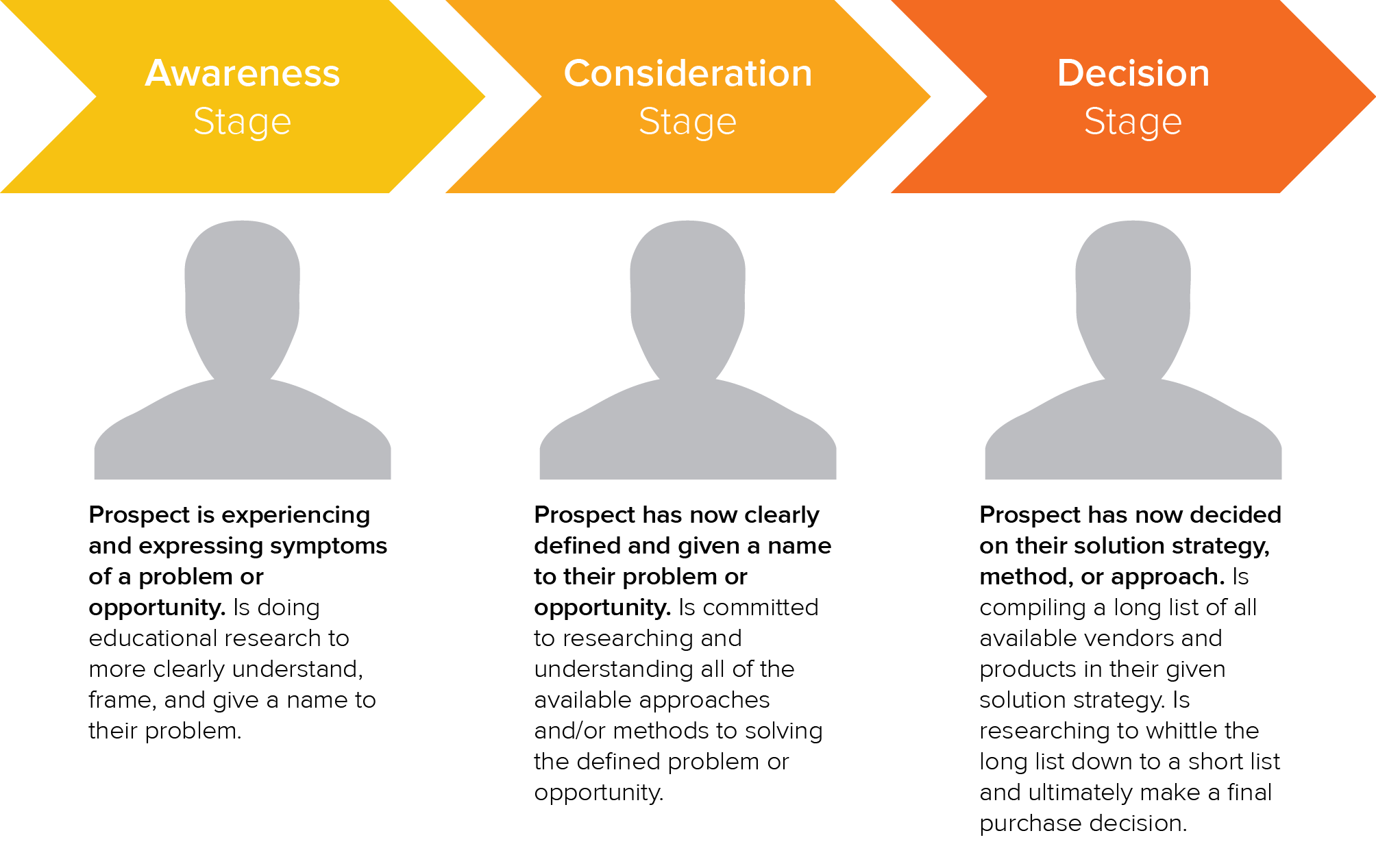
  1. Awareness Stage: The buyer realises they have a problem.
  2. Consideration Stage: The buyer defines their problem and researches options to solve it.
  3. Decision Stage: The buyer chooses a solution.

The graphic below illustrates a sample buyer’s journey for the simple purchasing decision of a doctor visit during an illness.


Buyer'S Journey Stages

How to Define Your Company’s Buyer’s Journey

If you don’t have an intimate understanding of your buyers, conduct a few interviews with customers, prospects, and colleagues to get a sense of the buying journey. Here are some questions you should ask to put together the buyer’s journey for your business.

Awareness Stage

During the Awareness stage, buyers identify their challenge or an opportunity they want to pursue. They also decide whether or not the goal or challenge should be a priority. In order to fully understand the Awareness stage for your buyer, ask yourself:

  1. How do buyers describe their goals or challenges?
  2. How do buyers educate themselves on these goals or challenges?
  3. What are the consequences of inaction by the buyer?
  4. Are there common misconceptions buyers have about addressing the goal or challenge?
  5. How do buyers decide whether the goal or challenge should be prioritized?

Consideration Stage

During the Consideration stage, buyers have clearly defined the goal or challenge and have committed to addressing it. They evaluate the different approaches or methods available to pursue the goal or solve their challenge. Ask yourself:

  1. How do buyers educate themselves on the various categories?
  2. What categories of solutions do buyers investigate?
  3. How do buyers perceive the pros and cons of each category?
  4. How do buyers decide which category is right for them?

Decision Stage

In the Decision stage, buyers have already decided on a solution category. For example, they could write a pro/con list of specific offerings and then decide on the one that best meets their needs. Questions you should ask yourself to define the Decision stage are:

  1. What criteria do buyers use to evaluate the available offerings?
  2. When buyers investigate your company’s offering, what do they like about it compared to alternatives? What concerns do they have with your offering?
  3. Who needs to be involved in the decision? For each person involved, how does their perspective on the decision differ?
  4. Do buyers have expectations around trying the offering before they purchase it?
  5. Outside of purchasing, do buyers need to make additional preparations, such as implementation plans or training strategies?

The answers to these questions will provide a robust foundation for your buyer’s journey. Once you know these answers, you can tailor your content and website to meet your users’ needs. The next step is to create content like blog articles, videos, and images.