Are Websites in 2026 Getting a Passing Grade?

Introduction: The Rules Have Changed

For years, businesses judged their website by how it looked. Then if you’re lucky, came performance scores, mobile optimisation, and search rankings. But right now, are websites in 2026, is this still the case?

Well, today, in 2026, we can confidently tell you, the standard has shifted again.

A website is no longer just a digital brochure.

It’s a credibility engine — the place people, search engines, and now AI systems go to verify whether your business can be trusted.

In the past, strong design and basic SEO were perceived as enough.

In 2026, they’re now! A passing grade requires something deeper:

  • Clear expertise
  • Helpful content
  • Consistent signals of trust
  • And a structure that helps buyers qualify themselves before they ever speak to you.

The question isn’t just:

“Does your website work?”

It’s:

“Does your website build confidence (and therefore trust) from the start and before the first conversation?”

Are Websites in 2026 Getting a Passing Grade?

The average website still sits around the middle of the pack.

Many look modern.

Some may load faster.

But most still struggle with one thing:

They talk about themselves more than they help the buyer make a decision.

The biggest gap isn’t technical anymore.

It’s trust.

And that gap is growing as AI surfaces answers directly inside search results — meaning people often decide who they trust before they even visit a site.

The Four Metrics Still Matter, But They Mean Something New

1. Website Performance; Speed Builds Confidence

Performance is still about load times and efficiency.

But in 2026, speed isn’t just technical.

It’s psychological.

Fast websites feel more credible.
Slow websites feel uncertain.

Users expect pages to load instantly.
AI crawlers and search engines also favour clean, efficient architecture because it’s easier to understand.

A fast site signals clarity.

And clarity reduces doubt.

2. SEO; Visibility Is Now About Credibility

SEO used to be about rankings.

Now it’s about presence.

Your content might appear:

  • Inside AI summaries
  • In featured answers
  • Across social snippets
  • Or embedded in conversational search results

This means optimisation isn’t just technical anymore.

It’s educational.

Businesses that openly answer real questions — pricing, problems, comparisons, expectations — are easier for search engines and AI systems to trust.

The goal isn’t just traffic.

It’s becoming the source people rely on when they’re trying to understand their options.

3. Mobile; Friction Is the New Failure

Mobile design used to be about responsiveness.

Now it’s about flow.

If a visitor can’t quickly:

  • understand what you do
  • find helpful information
  • or feel guided toward a decision

they leave.

The best mobile experiences don’t overwhelm people.

They guide them.

Clear structure reduces hesitation — and hesitation is often what stops leads from moving forward.

4. Security; Trust Starts Before the First Click

Security has become a baseline expectation.

SSL certificates, updated libraries, and reliable hosting are no longer “nice to have”.

They are proof of professionalism.

Modern browsers warn users before they enter insecure sites.

And AI systems increasingly evaluate trust signals behind the scenes.

If your foundation isn’t secure, everything else becomes harder.

The Hidden Website Metric: Trust Momentum

Here’s what’s changed the most since the early 2020s.

Websites used to be destinations.

Now they are checkpoints.

People arrive after:

  • seeing content
  • hearing about you
  • reading reviews
  • or interacting with AI answers

By the time someone lands on your website, they are already forming an opinion.

Businesses that earn higher grades today do something differently:

They reduce uncertainty.

Instead of hiding information, they make decisions easier by being clear about:

  • who they help
  • what the process looks like
  • what to expect
  • and whether they are the right fit.

This approach builds trust long before a sales conversation begins.

What a Passing Grade Looks Like for Websites in 2026

A strong website now balances two things:

Technical Excellence

  • Fast loading
  • Clean structure
  • Secure architecture
  • Mobile-first experience

Trust Signals

  • Helpful educational content
  • Honest explanations
  • Clear expectations
  • Consistent messaging across channels

When these work together, something powerful happens:

Visitors don’t just browse.

They move forward with confidence.

Why Content Matters for websites in 2026: Now More Than Ever

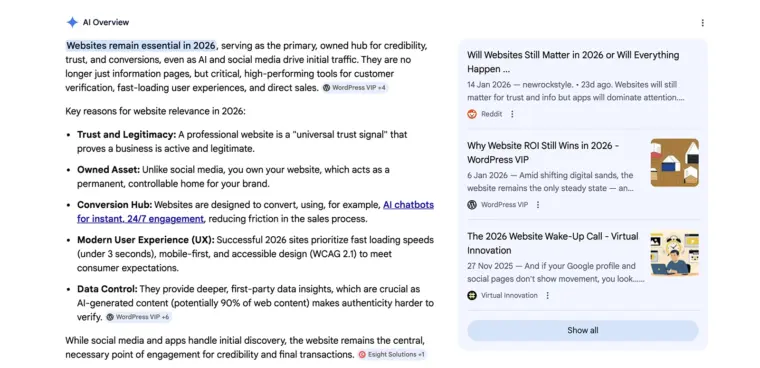
AI-driven search has changed discovery.

Due to AI Overviews now commonly referred to as ‘Zero Click Search Results” People don’t always click links anymore.

Instead, they see summaries generated from trusted sources.

Screenshot-Of-Ai-Overview-In-Google-Answering-If-Websites-In-2026-Are-Still-Relevant

That means businesses need to create content that:

  • answers real questions
  • builds authority over time
  • and supports buyers at every stage of their journey.

Not more content for the sake of noise.

Better content that removes doubt.

The goal isn’t to push people toward a sale.

It’s to help the right people feel ready.

Conclusion — Passing the Real Test

In 2024, and 2025, the question was:

“Is your website technically strong enough?”

In 2026, the real question is:

“Does your website genuinely help people? Which means means they can trust you faster?”

Performance, SEO, mobile experience, and security still matter.

But the websites getting top marks today do one extra thing:

They lead with clarity.

They educate openly.

And they build trust across every channel; not just on their homepage.

If your website helps buyers feel informed, confident, and understood before they reach out, you’re not just passing.

You’re leading.

The Back9 Way: How We Build Digital That Grows Over Time

Most organisations find that building a website or digital system feels harder than it needs to be. Instead of clarity, it often creates friction, confusion, or just a lot of noise.

At Back9, we start with a simple belief:

As a leading Growth Driven Design Agency, we believe in creating seamless digital experiences that drive success.

Technology should help people do their work better, not get in the way.

That belief shapes everything we do.

Being a Growth Driven Design Agency, our focus is on enhancing user experience and driving engagement. To help and nurture potential customers to help them see if they are a fit. Then guide the, into a sale, or sale conversation

We exist to help organisations help people better. Sometimes that means making things easier for customers. Other times it means giving staff better tools or creating systems that serve a wider community. Either way, digital should reduce effort, not add to it.

When it’s done properly, it should make everything else easier.

Why Digital Projects So Often Fall Short

One of the biggest reasons digital projects fail is because they’re treated as one-off events.

A website gets designed, built, launched, and then left alone. A system goes live and becomes “good enough”. From there, people hope it performs, but rarely measure whether it actually does.

Over time, small problems compound. Content goes stale. User needs change. Business priorities shift. What once felt modern slowly becomes a liability.

This isn’t a failure of intent. It’s a failure of approach.

A Different Way of Working

Why Choose a Growth Driven Design Agency?

As a dedicated Growth Driven Design Agency, we ensure our strategies are data-driven and results-oriented.

We take an end-to-end approach to digital.

This is why partnering with a Growth Driven Design Agency can transform your digital presence.

That means we don’t just focus on the launch. We focus on what happens after.

As a Growth Driven Design Agency, we prioritise sustainable growth over quick fixes.

We design and build digital systems properly, then measure how they’re actually used. We look at what’s working, what isn’t, and where friction shows up. From there, we improve things continuously based on real data, not assumptions.

This approach is called Growth-Driven Design.

Working with a Growth Driven Design Agency means embracing an iterative improvement process.

Instead of guessing, we build, learn, and iterate. We make deliberate improvements over time, guided by evidence rather than opinions. The goal isn’t speed for its own sake. It’s progress that compounds.

Our Growth Driven Design Agency is committed to delivering measurable outcomes and enhancing user satisfaction.

Doing it properly beats doing it fast. And steady improvement beats a big, flashy launch every time.

We are proud to be a Growth Driven Design Agency that champions innovation and customer-centric solutions.

What This Delivers in Practice

Joining forces with a Growth Driven Design Agency can lead to unprecedented growth and success.

Working this way changes what digital becomes for an organisation.

Instead of something you maintain out of obligation, it becomes a genuine business asset.

We help growth-minded organisations turn their websites, software, and digital systems into tools that drive real, measurable results. Not just traffic or aesthetics, but outcomes that matter.

When digital is designed to improve with use rather than degrade over time, trust builds naturally. People find what they need. Processes run smoother. Decisions become easier to make.

A good digital experience isn’t loud. It’s dependable. And that dependability is what creates confidence.

Let’s explore how a Growth Driven Design Agency can elevate your business to new heights.

Who This Approach Is For

We’re not a quick-fix shop, and we’re not interested in shortcuts or hacks.

We work best with growth-minded business owners, marketing teams, and not-for-profits who are prepared to take a long-term view. Organisations that understand digital is an ongoing investment, not a box to tick.

If you’re looking for a partner to help you build something that grows in value over time — rather than something that slowly becomes outdated — then this approach is likely a good fit.

A Simple Next Step

Our goal isn’t to convince you.

It’s to help you find the right path forward.

If this way of thinking about digital resonates, we’re always happy to have a proper conversation about where you’re heading and whether we can help.

Imagine. Design. Execute. Amplify.

Banner-With-Blue-Gradient-Background-An-Image-Of-A-Calendar-And-A-Cta-To-Book-A-Meeitng-With-A-Button

Web Design That Grows With You

Traditional websites are designed to sit still. In web design, yours shouldn’t be.

In 2025, if your website isn’t growing alongside your business, it’s costing you—leads, sales, and trust. At Back9 Creative, we don’t just build websites. We engineer digital platforms that evolve, adapt, and deliver long-term results.

This page breaks down our approach to web design—built around Growth-Driven Design (GDD)—and why it’s the smarter choice for future-focused businesses across New Zealand.

Why Traditional Web Design Doesn’t Work Anymore

Let’s be blunt—traditional web design is broken.

The old-school model looks like this:

  • Spend months building a website.
  • Go live.
  • Leave it untouched until it’s out of date (or broken).
  • Repeat in 3–5 years.

That process might have flown in 2012. Not now.

Why? Because:

  • It’s slow to launch.
  • It’s based on assumptions—not real user data.
  • It doesn’t evolve as your business changes.
  • And it turns your website into a static brochure, not a living sales tool.

Instead of investing in a one-off project that quickly loses relevance, leading businesses are shifting to a smarter, agile model. That’s Why Growth-Driven Design is replacing Traditional Web Design.

What Is Growth-Driven Design?

Growth-Driven Design (GDD) flips the script on traditional web design.

It’s an agile, data-led approach to building and continuously improving your website, so it becomes your best-performing salesperson over time. Because websites are like staff, always growing, training and improving. They are an investment. But the good ones can be hard to find.

How it works:

  1. Launch Fast with a Strategy-Driven Site
    We build a “Launchpad” site based on real goals, user personas, and journey mapping. It’s fast, focused, and ready to go live in weeks—not months.
  2. Iterate and Improve Based on Real Data
    Instead of guessing, we track user behaviour, analyse performance, and roll out monthly updates that move the needle.
  3. Align with Business Goals
    Every change is based on what delivers results—more traffic, better conversions, stronger engagement.

Our Web Design Process (Imagine → Design → Execute → Amplify)

At Back9, we use our custom-built IDEA Framework to turn vision into results:

1. Imagine

We start with clarity—mapping your goals, ideal customer journey, and competitive edge.

2. Design

This is where function meets form. Our UX/UI design team brings strategy to life with on-brand visuals and smart user experiences.

3. Execute

We build fast, mobile-first, SEO-ready websites using modern, secure frameworks. Every line of code is crafted to perform.

4. Amplify

After launch, the work doesn’t stop. It begins. We optimise, track, test, and tweak—turning good into great.

Website Design Projects We’ve Delivered in NZ

We’ve designed and delivered GDD-powered websites across Aotearoa for growth-driven companies, including:

Other works in Progress at the time of writing:

Each project started with strategy and finished with results—and they’re all still improving today.

Why Back9 Creative Is NZ’s Strategic Web Design Partner

Most agencies can build a website. Few can help it grow with your business.

Here’s why businesses choose us:

  • We don’t guess—we test. Every change is backed by data, not opinion.
  • We’re one of NZ’s only agencies specialising in Growth-Driven Design.
  • You get a team, not a freelancer—strategists, designers, developers and marketers all under one company.
  • You deal with real people who give a damn. When you call, you talk to someone who knows your name.

We’re based in Invercargill with boots on the ground in Christchurch, but we work with clients from all over New Zealand.

Get a Quote for Web Design in NZ

Wondering how much Growth-Driven Design Costs? Are you Ready for a website that does more than just exist?

Whether you’re based in Auckland, Wellington, Christchurch, or anywhere in between; our team can help design, build, and grow a website that actually works for you.

👉 Let’s talk. We’ll walk you through the right path, traditional vs GDD, and provide a no-BS quote with clear deliverables.

10 Common Mistakes in MVP Software Development

Minimum Viable Product (MVP) development is a brilliant way to get your product to market faster. It reduces risk, saves money, and gives you the chance to learn quickly from real users. But just like any smart approach, it’s easy to trip up if you don’t go in with a clear plan. Here’s 10 Common Mistakes in MVP Software Development.

At Back9, we’ve seen businesses get excited about the MVP model—only to hit a wall due to a few common missteps. These mistakes can delay growth, chew through budget, or worse—create a product no one wants.

In this article, we’ll break down the most frequent MVP pitfalls and, more importantly, how to avoid them. Whether you’re a founder, product manager, or marketing lead, these insights can help keep your MVP on track.

1. Confusing “Minimum” with “Mediocre”

Let’s be clear—minimum viable does not mean low quality. It’s easy to misinterpret the term and underdeliver. Some teams cut corners, thinking MVP just means the cheapest or fastest version possible.

But an MVP still needs to solve a real problem for real users. It has to function well enough to gather useful feedback and provide value.

Instead of asking “What can we strip out?”, ask “What’s the smallest thing we can build that people will care about?”

It’s one of the Mistakes in MVP Software. Getting that balance right is key.

2. Building Without a Clear Problem

This one’s more common than you’d think. And one of the most common Mistakes in MVP Software development we see. A lot of MVPs get built based on assumptions, internal ideas, or tech trends—without enough real-world validation.

If your MVP doesn’t solve a pain point your users actually experience, it’s unlikely to gain traction.

Start by talking to your audience. Use surveys, interviews, and even forums to learn what frustrates them. That insight will help shape a product that’s grounded in genuine need.

Always build for a problem, not just a feature set.

3. Overloading the MVP with Features

It’s tempting to try and impress users by adding too much, too soon. But overstuffing an MVP is a trap.

Why? Because every additional feature means more design, dev time, testing, and potential bugs. It also dilutes your focus.

A bloated MVP confuses users and makes it harder to measure what actually works. Keep it lean. Prioritise core functionality—what’s essential to test your idea?

Focus on doing one thing really well. You can always build more later.

4. Skipping UX and UI Design

Just because it’s an MVP doesn’t mean it can look or feel clunky. Poor user experience is a fast way to lose early adopters.

Your product doesn’t need to be pixel-perfect, but it does need to be usable and intuitive. Clean design builds trust. Even small UX details—like clear buttons or an easy onboarding flow—can make or break first impressions.

A great MVP balances functionality with usability. Don’t leave design as an afterthought.

5. Ignoring Feedback (or Collecting the Wrong Kind)

The whole point of launching an MVP is to learn. But that only works if you actively seek—and act on—feedback.

Some teams either don’t collect feedback at all, or they ask the wrong questions. Vague comments like “It’s good” or “Needs work” won’t help you improve.

Instead, ask focused questions:

  • What did you try to do, and did it work?
  • What confused or frustrated you?
  • What feature do you wish it had?

Track usage metrics too. Tools like Hotjar, Microsoft Clarity, or GA4 can help reveal what users actually do—not just what they say.

6. Treating the MVP Like a Final Product

Another big mistake? Thinking the MVP is the end goal.

It’s not. It’s the start of a longer journey.

If you treat your MVP like the finished product, you may fall into the trap of polishing features instead of learning. Or you might avoid making necessary changes for fear of “breaking” what you’ve already built.

Keep the mindset flexible. The MVP should evolve based on data, not personal attachment.

7. Failing to Define Success

You’ve built and launched your MVP—great! But how do you know if it’s working?

Too many MVPs launch without a clear set of success metrics. Without defined goals, it’s impossible to know if you’re heading in the right direction.

Set benchmarks early. These could include:

  • Number of signups or purchases
  • Activation rate (how many people actually use the product)
  • Retention after 7 or 30 days
  • Feedback quality or NPS

Tracking these indicators helps inform what to change, what to keep, and when to move on to the next phase.

8. Not Communicating Internally

Building an MVP often happens fast—and sometimes, too fast for teams to stay in sync.

When goals aren’t clear internally, teams pull in different directions. Marketing might push features that dev hasn’t finished. Sales could promise things the product doesn’t support yet.

Regular check-ins, a shared roadmap, and alignment on what “done” looks like will save everyone time and energy.

Also, be honest about what’s not included yet. Set realistic expectations with both your team and your users.

9. Skipping the Launch Strategy

You’ve got your MVP ready. But now what?

Some businesses put everything into building the MVP and forget about how they’ll launch it. The best product in the world still needs a proper intro.

Even a soft launch should be planned. Identify early adopters, create an onboarding experience, and make it easy for users to give feedback.

If no one uses your MVP, it’s just a prototype—no matter how good it is.

10. Giving Up Too Early

Not every MVP takes off straight away. That’s normal. In fact, some of the most successful products today started with a messy, underwhelming first version.

The key is iteration. Use the data, tweak your approach, and keep improving.

An MVP is only valuable if you keep going after launch. Don’t expect instant success. Expect to learn, adapt, and grow.

Final Thoughts

Building an MVP is one of the smartest moves a business can make—but only if it’s done right.

Avoiding these common mistakes can save you time, budget, and headaches. It’ll also give your product a better shot at success. Remember: MVPs are about learning fast, staying lean, and evolving with purpose.

If you’re working on an MVP or thinking about launching one, keep it focused. Make it useful. And most importantly, stay curious. But most importantly, avoid these 10 Common Mistakes in MVP Software Development!

Got a project you’re exploring? Let’s talk—Back9 is here to help you bring smart digital ideas to life.

Essential Principles of Effective Web Redesign

At Back9 we often tell people, successful website redesign is not just about aesthetics; it’s about aligning your website with your strategic goals and ensuring it meets the needs of your users. In this article, we’ll explore the essential principles of effective website redesign, helping you transform your site into a powerful tool for business growth.

Below we’ll address the following 3 things (and maybe more):

  • How to identify the need for a redesign to begin with
  • The importance of (in this day and age) embracing a growth-driven design approach
  • How to prioritise user experience.

Additionally, we’ll look into the significance of crafting quality content and leveraging data analytics to guide your redesign efforts.

Understanding the Need for Website Redesign

Before deciding on a redesign journey, it’s crucial to understand why a redesign is necessary.

  • Is your website outdated, cluttered, or
  • Is it difficult to navigate?
  • Are you experiencing high bounce rates or low conversion rates?

Identifying the pain points of your current website will guide your redesign efforts and ensure you address the most pressing issues. By recognising these challenges early on, you can set a clear path for improvement and avoid repeating past mistakes.

A website redesign can also be prompted by changes in your business objectives, target audience, or industry standards. For instance, if you’ve expanded your product line or entered a new market, your website must reflect these changes to remain competitive. Similarly, advancements in technology and shifts in consumer behaviour necessitate regular updates to your online presence. Understanding these drivers will help you make informed decisions during the redesign process.

Assessing Your Current Website

Start by performing a comprehensive audit of your existing website. Evaluate its performance, design, user experience, and content. Tools like Google Analytics can provide valuable insights into user behaviour, while heat maps can reveal how visitors interact with your site. This data will serve as a baseline to measure the success of your redesign efforts. Conducting a thorough assessment will also help you identify specific areas that require improvement, such as page load times, mobile responsiveness, or outdated content.

Cta-Image-For-A-Free-Instant-Website-Audit-For-Growth-Driven-Web-Design

In addition to quantitative data, gather qualitative feedback from your users. It’s a great idea to conduct surveys or interviews to understand their pain points, preferences, and suggestions for improvement. This user feedback is invaluable in shaping a redesign that truly meets the needs of your audience. Furthermore, benchmarking your website against competitors can provide additional insights into industry trends and best practices.

Setting Clear Objectives

Once you’ve identified the issues with your current site, define clear objectives for your redesign. Are you aiming to improve user experience, increase engagement, or boost sales? Setting specific, measurable goals will help you stay focused and track your progress. Establishing these objectives early in the process ensures that every design decision is aligned with your broader business strategy.

Your objectives should be realistic and aligned with your available resources. Consider the time, budget, and expertise required to achieve your goals. It’s also important to prioritize your objectives based on their potential impact on your business. For example, improving mobile responsiveness might be a top priority if a significant portion of your traffic comes from mobile users.

Embracing Growth-Driven Design

It’s now 2025, and time to accept that Traditional web design is broken! And that’s primarily due to the fact a website will never be perfect. It will never be ‘finished’.

Traditional web design often involves a complete overhaul of the website every few years, which can be time-consuming and costly. Growth-Driven Design (GDD) offers a more agile approach, focusing on continuous improvement based on data and user feedback. This iterative process allows businesses to adapt quickly to changing market conditions and user needs, ensuring that their website remains relevant and effective.

Not only does GDD Maximise success online, it emphasises a strategic, user-centric approach to web design. By continuously analysing user data and feedback, you can make informed decisions about which areas of your website need improvement. This approach not only reduces the risk associated with traditional redesigns but also ensures that your website evolves in line with your business objectives and user expectations.

Traditonal-Website-Design-Is-Broken-Cta

The Growth-Driven Design Methodology

GDD is a three-phase process: strategy, launch pad, and continuous improvement.

  1. Strategy:
    In this phase, you establish your goals, user personas, and key performance indicators (KPIs). This foundation guides your redesign efforts, ensuring every decision aligns with your strategic objectives. A well-defined strategy provides clarity and direction, helping you prioritize tasks and allocate resources effectively.
  2. Launch Pad:
    Rather than a full redesign, you create a “launch pad” website—a functional, improved version of your site that can be built quickly. This site serves as a starting point for ongoing improvements. The launch pad site allows you to test new ideas and gather user feedback, facilitating a more informed approach to continuous improvement.
  3. Continuous Improvement:
    With your launch pad site live, you enter the continuous improvement phase. Using data and user feedback, you make iterative enhancements to your website, prioritising the changes that have the most significant impact on your goals. This phase emphasises agility and responsiveness, allowing you to adapt to new challenges and opportunities as they arise.

Benefits of Growth-Driven Design

GDD reduces the risks associated with traditional redesigns by focusing on data-driven decisions and ongoing optimisation. This approach allows you to adapt to changing user needs and market trends, ensuring your website remains relevant and effective. Additionally, GDD fosters a culture of continuous learning and improvement within your organisation, empowering your team to stay ahead of the curve.

Another key benefit of GDD is its cost-effectiveness. By avoiding the pitfalls of a complete redesign, you can allocate resources more efficiently and achieve better results over time. This agile approach also enables you to respond quickly to feedback and implement changes that enhance user experience and drive business growth.

Prioritising User Experience

User experience (UX) is at the core of any successful web redesign. A website that is difficult to navigate or slow to load can frustrate users and drive them away. Prioritising UX ensures that your site is intuitive, accessible, and engaging. By focusing on the needs and preferences of your users, you can create a website that not only attracts visitors but also encourages them to stay and explore.

A positive user experience is essential for building trust and credibility with your audience. When users have a seamless and enjoyable interaction with your website, they are more likely to engage with your content, make purchases, and return in the future. Therefore, investing in UX design is a critical component of any successful web redesign strategy.

Designing for Your Audience

Understanding your target audience is essential for creating a user-friendly website. Develop detailed user or buyer personas that represent your ideal customers, and use these personas to guide your design decisions. Consider factors such as age, preferences, and digital habits to ensure your site meets the needs of your users. By tailoring your design to the specific characteristics of your audience, you can create a more personalised and relevant experience.

In addition to demographic information, consider the motivations and goals of your users. What problems are they trying to solve? What information are they seeking? By addressing these questions, you can design a website that provides real value and meets the expectations of your audience. Regularly updating your user personas based on feedback and analytics will help you stay aligned with changing user needs.

Simplifying Navigation

Clear, intuitive navigation is critical for a positive user experience. Use a clean, organised menu structure that allows users to find what they’re looking for with minimal effort. Consider incorporating breadcrumbs and internal links to improve navigation and help users explore your site. A well-designed navigation system not only enhances usability but also encourages users to spend more time on your site.

In addition to traditional navigation elements, explore innovative approaches such as mega menus, sticky headers, and dynamic search features. These elements can enhance the user experience by providing quick access to information and guiding users to relevant content. Testing different navigation options with real users can help you identify the most effective solutions for your audience.

Enhancing Accessibility

An accessible website ensures that all users, including those with disabilities, can navigate and interact with your site. Follow web accessibility guidelines, such as the Web Content Accessibility Guidelines (WCAG), to make your site inclusive and compliant. Accessibility is not only a legal requirement in many regions but also a reflection of your commitment to providing an equitable online experience for all users.

Considering incorporating features such as alt text for images, keyboard navigation, and screen reader compatibility to improve accessibility is not enough anymore… It’s becoming essential. Additionally, ensure that your website’s design is responsive and functions well on a variety of devices and screen sizes. By prioritising accessibility, you can reach a broader audience and demonstrate your commitment to inclusivity.

Website Redesign: Crafting Quality Content

No doubt you’ve heard it before – But here it is again Content is king. And in the context of a website redesign, it’s crucial to create content that resonates with your audience and supports your business goals. High-quality content can drive traffic, improve SEO, and establish your brand as a trusted authority in your industry. Therefore, investing in content creation and optimisation is a critical aspect of any successful web redesign.

Your content strategy should be informed by your business objectives, user personas, and industry trends. By aligning your content with these factors, you can create a cohesive and effective online presence that supports your broader marketing goals. Regularly updating and refreshing your content will also help you stay relevant and maintain user engagement.

Aligning Content with Strategy

Your content should align with your overall strategy and support your objectives. Whether you’re focusing on brand awareness, lead generation, or customer retention, tailor your content to meet these goals. Consider creating a content calendar that outlines your topics, formats, and publication schedule, ensuring that your content efforts are consistent and strategic.

Collaborate with stakeholders across your organisation to ensure that your content aligns with broader business initiatives. By integrating content into your overall marketing strategy, you can create a unified and powerful message that resonates with your audience. Additionally, regularly reviewing and refining your content strategy based on analytics and user feedback will help you stay aligned with changing business goals.

Creating Engaging, Valuable Content

High-quality content should be informative, engaging, and tailored to the needs of your audience. Use a mix of text, images, videos, and infographics to keep users engaged and convey information effectively. Remember, content is not just about promoting your products or services; it’s about providing value to your audience. By offering relevant, helpful, and entertaining content, you can build trust and loyalty with your users.

Consider leveraging storytelling techniques to create compelling narratives that resonate with your audience. By connecting with users on an emotional level, you can foster deeper engagement and inspire action. Additionally, incorporating interactive elements such as quizzes, polls, and user-generated content can enhance the user experience and encourage participation.

Leveraging Data and Analytics

Data-driven decision-making is key to a successful web redesign. By leveraging analytics, you can gain insights into user behaviour, identify areas for improvement, and measure the success of your redesign efforts. This data-driven approach enables you to make informed decisions and optimise your website for better performance and user satisfaction.

Analytics tools provide valuable insights into user interactions, traffic patterns, and conversion metrics. By regularly monitoring and analyzing this data, you can identify trends and opportunities for improvement. Additionally, setting up custom reports and dashboards can help you track your progress and stay aligned with your redesign objectives.

Tracking Key Performance Indicators (KPIs)

Identify the KPIs that align with your website redesign objectives, such as conversion rates, bounce rates, and average session duration. Use tools like Google Analytics to track these metrics and assess the impact of your redesign. Regularly reviewing your KPIs will help you measure the success of your redesign efforts and identify areas for further optimisation.

In addition to quantitative metrics, consider gathering qualitative data through user surveys and feedback forms. This information can provide valuable insights into user satisfaction and areas for improvement that may not be captured by traditional analytics tools. By combining quantitative and qualitative data, you can gain a comprehensive understanding of your website’s performance and user experience.

Conducting A/B Testing

A/B testing allows you to experiment with different design elements and determine what works best for your audience. Test variations of your website’s layout, content, and calls-to-action to optimize your site for conversions. By systematically testing and iterating on different design options, you can identify the most effective solutions for your audience and achieve your redesign objectives.

A/B testing can be applied to various aspects of your website, including headlines, images, button placements, and color schemes. By continuously experimenting and refining your design, you can enhance user experience and drive better results. Additionally, documenting your testing process and results will help you build a knowledge base that informs future redesign efforts.

Conclusion

A successful web redesign goes beyond aesthetics; it’s about creating a strategic, user-centric website that supports your business goals. By embracing Growth-Driven Design, prioritising user experience, crafting compelling content, and leveraging data, you can transform your website into a powerful tool for growth. This comprehensive approach ensures that your website remains relevant, effective, and aligned with your business objectives.

Remember, a website like a staff member, a 24/7 employee you didn’t know you needed. This means it’s not a static entity—it’s a dynamic platform that should evolve with your business and the needs of your users. By focusing on continuous improvement, you can ensure your website remains effective and relevant in an ever-changing digital landscape. This commitment to ongoing optimisation will help you stay competitive, meet user expectations, and drive long-term success.


Measuring Digital Success in Growth Driven Design Projects

Growth Driven Website Design (GDD) is transforming the way we approach web design at Back9 Creative. It’s a smarter, agile methodology that minimises risks and drives optimal growth.

But how do you measure digital success in GDD projects?

This is a question that many clients we talk to about Growth-Driven Design grapple with. This is primarily duet to GDD being a highly iterative process. It is fluid and involves continuous learning and improvement. And that’s something that many business owners are not familiar with. Traditionally, when you get something designed is conceptualised, approved and one and done. This is not the case with the Growth Driven Methodology.

In this article, we’ll look at key performance indicators (KPIs) relevant to GDD. Addiiotnally we’ll touch on the role of user data and feedback. And of course the importance of regular analysis and reporting.

By the end, you’ll hopefully have a clear understanding of how to measure and communicate the success of your GDD projects. Let’s get started.

Understanding Growth Driven Design (GDD)

Growth Driven Design (GDD) offers a revolutionary approach to web design. Unlike traditional methods, it focuses on agility and continual growth. GDD prioritizes user experience and data-driven decisions over assumptions.

This method involves launching a “launch pad” website. This site is functional and allows for iterative improvements over time. By constantly analyzing user behavior, GDD ensures that updates are based on concrete data, enhancing the site’s effectiveness. This way, GDD reduces risk and optimizes results, catering to real user needs.

The Iterative Process of GDD

The iterative process in GDD revolves around continuous improvement. Rather than a one-time overhaul, GDD makes incremental changes.

These changes rely heavily on feedback and data analysis. This process begins with a set of hypotheses about how improvements will enhance performance. Changes are then tested in cycles called “sprints.” Each sprint helps uncover new insights, leading to further refinements. This agile method ensures sustained growth and relevance over time.

Setting Measurable Goals

Setting clear, measurable goals is vital in Growth Driven Design. This step aligns the entire project towards definite outcomes.

These goals should be specific, quantifiable, and time-bound, such as increasing user engagement by 20% in three months. Measurable goals guide the testing and learning phases, ensuring each sprint moves toward achieving them. By doing so, you can adjust strategies based on tangible results, driving growth efficiently and effectively.

Key Performance Indicators (KPIs) for GDD

In Growth Driven Design (GDD), Key Performance Indicators (KPIs) are essential in measuring success. These metrics offer insights into how well a site performs and identify areas for improvement. By setting KPIs, you can track progress and stay aligned with your goals.

Some critical KPIs in GDD include:

  • Traffic: This measures the number of visitors your site attracts.
  • User Engagement: How users interact with your site.
  • Conversion Rates: The percentage of visitors completing desired actions.
  • SEO: Search engine ranking impacts organic traffic.

By regularly reviewing these indicators, your team can make informed decisions. This ensures that your design efforts lead to measurable outcomes and drive growth. Analyzing KPIs not only boosts performance but also improves user satisfaction. This results in a more effective growth strategy over time.

Traffic and User Engagement

Traffic is the lifeblood of any website. In GDD, this KPI is pivotal in tracking visitor numbers. A steady increase in traffic suggests effective design and marketing efforts.

User engagement goes a step further. It measures how users interact with your site. In particular this is where UX/UI design is so important. Metrics such as time spent on page and bounce rates are critical. But what is even more crucial is interpreting why someone may or may not click on a certain button, image or other element. High engagement typically indicates valuable content and a user-friendly interface.

Conversion Rates and Lead Generation

Conversion rates quantify how effectively your site persuades visitors to take action. These actions will vary depending on your goals. However, they can include making a purchase or filling out a form. A high conversion rate is a clear indicator of success. Again, this reiterates the importance even the basics of UX/UI design. A website must be designed to convert because if it sucks, it won’t! It can also be a great opportunity to employ A/B Testing, (as discussed further below) for measuring digital success.

In addition, Lead generation complements this by tracking new prospects. Effective GDD strategies often enhance these metrics. By optimising user pathways (conversion paths), you’ll likely bolster both engagement and conversions, ultimately leading to growth.

SEO and Organic Search Visibility

SEO is a cornerstone of Growth Driven Design. It influences how easily users find your site via search engines. Good SEO practices increase organic search visibility and drive traffic.

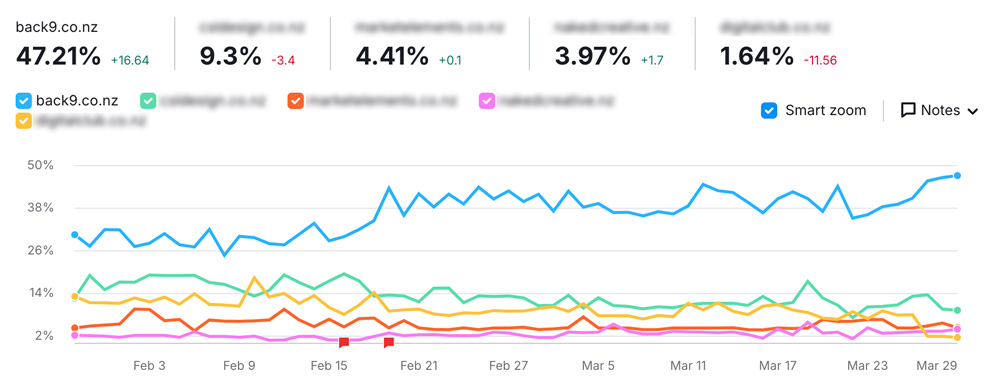
Screenshot-Of-Back9-Creatives-Seo-Rankings-For-Measuring-Digital-Success
Example of Back9 Creative Search Ranking vs. competitors: Sun 30th March 2025

Monitoring your search engine rankings provides essential insights. Rankings influence how your content appears to potential visitors. A focus on SEO within GDD ensures your site remains competitive and visible to your target audience. This enhances your overall growth strategy and effectiveness.

Measuring Digital Success by Utilising User Data and Feedback

User data and feedback are invaluable in Growth Driven Design. They offer a window into user behavior and preferences. Analyzing this data helps refine design choices and improve user experience.

Feedback loops allow you to gather insights directly from users. This continuous input helps validate design hypotheses. It also drives the iterative process that is central to GDD.

By leveraging user data, teams can align their efforts with actual user needs. This fosters a more responsive design approach. As a result, your website continuously adapts to better serve its audience, enhancing overall performance.

Analytics Tools and Data-Driven Decisions

Analytics tools are the backbone of data-driven decision-making in GDD. These tools collect and analyze user interaction data. They highlight what works and what needs improvement.

Insights derived from analytics help prioritise design actions. Data-driven decisions ensure that every change contributes to growth. By aligning efforts with data, teams can create more effective, user-centered designs.

User Feedback Loops and A/B Testing

User feedback loops are crucial for collecting qualitative insights. They offer direct user input on what they like or dislike. This real-time feedback guides iterative improvements in design.

A/B testing, on the other hand, quantifies these insights. It compares user responses to different design versions. This testing method validates changes with statistical significance. Together, feedback loops and A/B testing form a powerful duo in refining user experience, driving measurable improvements in GDD projects.

Reporting and Analysis for GDD

Effective reporting is vital for Growth Driven Design projects. It ensures transparency and accountability. Regular analysis helps teams stay aligned with set goals.

It’s essential to evaluate key metrics continually. This allows for real-time adjustments that drive success. Frequent reporting keeps the project trajectory clear and focused.

A structured reporting framework aids in capturing insights efficiently. This framework should highlight successes and pinpoint areas for improvement. Providing such clarity accelerates the growth-driven process.

Regular Analysis and Reporting

Consistency in analysis is key to a successful GDD project. Regularly reviewing performance metrics highlights actionable trends. This proactive stance prevents issues from escalating.

Implementing scheduled reporting cycles ensures timely updates. These cycles should incorporate data from various touchpoints. Regular updates maintain momentum and strategic focus in GDD projects.

Communicating Results to Stakeholders

Clear communication of results builds trust with stakeholders. It ensures everyone involved understands project progress. Tailored reports can effectively convey relevant insights.

Use visuals to simplify complex data when reporting to stakeholders. This makes information accessible and engaging. An informed stakeholder group supports better decision-making and project alignment in GDD.

Back9-Website-Banner-Cta-Image-Asking-How-Growth-Driven-Design-Ready-You-Are

Overcoming Challenges in Measuring GDD Success

Measuring digital success in Growth Driven Design can be complex. Challenges often arise from setting relevant metrics and obtaining accurate data. Misaligned expectations can also hinder progress.

To tackle these challenges, GDD teams should adopt flexible, data-driven strategies. Regularly revisiting goals ensures continued alignment with business objectives. This approach allows agile adjustments.

Another aspect is integrating diverse feedback from different team members. This encourages a culture of collaboration and insight-sharing. Such an environment fosters effective problem-solving and enhances the likelihood of GDD success.

Balancing Short-Term Wins and Long-Term Goals

Finding the right balance is important in GDD projects. Short-term wins generate immediate value and motivation. However, without strategic foresight, they may lead to shortsighted decisions.

Long-term goals align efforts with broader business objectives. Prioritizing these goals alongside quick wins ensures sustainable growth. This balance secures both immediate and future benefits.

Scaling GDD Practices and Maintaining Innovation

Scaling GDD practices involves adapting processes as projects evolve. As teams grow, maintaining the original innovation spark can be challenging. It’s essential to keep creativity alive while expanding.

Implementing scalable frameworks allows GDD to adapt to larger contexts. Encouraging a culture of continuous improvement and innovation is vital. This ensures that growth is both sustainable and inventive.

Conclusion: The Continuous Improvement Cycle

Growth Driven Design is all about perpetual evolution. It emphasises ongoing refinement and adaptation to market changes. This dynamic approach ensures that digital solutions stay relevant and impactful.

The continuous improvement cycle in GDD allows teams to learn and pivot quickly. It supports the integration of fresh insights, optimising user experiences over time. By focusing on iterative improvements, GDD aligns closely with strategic goals and can also work well within a set budget.

Checklist for Evaluating GDD Project Success

Assessing the success of a GDD project requires careful evaluation. A structured checklist can guide this process, ensuring comprehensive analysis. Here are key points to consider:

  • Define clear, measurable objectives.
  • Track key performance indicators (KPIs).
  • Gather and act on user feedback.
  • Ensure regular progress reports.
  • Align results with overall business strategy.

This checklist helps in systematically measuring digital success in terms of GDD outcomes, fostering transparency and accountability.

Cta-Image-For-A-Free-Instant-Website-Audit-For-Growth-Driven-Web-Design