
With keywords, the right words are key!

How does Google work? Officially, there’s a highly-secret algorithm that’s constantly being updated by some of the greatest minds in the world. This algorithm can interpret text written from people of all backgrounds and show relevant results related to their query. Unofficially, it seems like it can be completely random. After all, a search for “best search engine” doesn’t go straight to the Google home page. Instead, it leads to a list of articles. One of the top results is “14 Great Search Engines You Can Use Instead of Google.”

If you have a smaller business, it might seem like an insurmountable challenge to get found on the first page. This is especially true in a competitive industry. But by building a good website and getting links, a lot of the work is already done. However, remember the primary way that people use Google is by searching with keywords.


What exactly are keywords and how do I use them?

A keyword is a word or phrase that describes an idea or topic… Which means practically every word. Nowadays, Google can connect some unusual phrasing with a broader meaning. It can also piece together shorthand search terms that people write because we’re lazy. “Best deliver pizza where” isn’t really saying anything. But Google understands what you really mean. They will translate it to something like “Where is the best pizza near me that offers delivery?”. It returns results rated 4 stars or higher in the same town the person searched from. 

A keyword is “A word or phrase that you want your website to show up for when someone searches in Google.” So if you paint houses and maintain lawns, “Painter” and “landscaper” would be target keywords. You’d probably also like “exterior painting” “house painter” “Lawn cutting” “Trim lawns”. And as many variants as you can think of.

Although Google is getting better, the algorithm isn’t foolproof, and the best way to maximise your chances of hitting keyword variations is to include as many as possible naturally throughout the text. It’s obvious not only to Google, but to readers when keywords are stuffed in unnaturally, which can break trust with your users and increase the chance that they’ll look to a competitor instead. Here’s an example: If “Marketing Invercargill” was my keyword, stuffing the keyword would look something like this, “We’re the best Marketing Invercargill agency because unlike other Marketing Invercargill companies, our Marketing Invercargill focuses on Marketing Invercargill design, Marketing Invercargill quality, and other Marketing Invercargill elements.” And yes, these sorts of sites were common (including bolding the target keyword) and some still exist to this day.

Use keywords naturally but sparingly on your site

For many businesses, the website is the way that they differentiate themselves from others offering the same service, through a combination of good site design and useful information about their goods or services. A lot of your information will be shown through landing pages, a single page on your website that someone arrives at from a Google search about a topic related to their search term. So how can you make sure that a landing page gets up high on Google in the first place?

Keyword guidelines

There are a few guidelines you can use when writing a page that can better your chances of ranking well. Some of these are:

  • Try to mention your target keyword as soon as possible, but make sure to do it within the first 100 words.
  • Longer posts tend to rank better. Part of the reason is because they simply have more words, so there’s a better chance that related terms will show up and that the article will have better topical authority. Try to write at least 250 words on a page if possible.
  • Along with making better quality writing, using synonyms in place of the keyword will help with SEO and can help you hit more variations. “Pizza” “Circular meat pie with cheese on tomato sauce” and “Best food” are really referring to the same thing (Okay, the last one is only mostly true). For ideas of what keyword variations you can use for any topic, try using Google’s Keyword Planner.
  • Link to sites with high domain authority that support your claims if you can. If it makes sense within the page, linking to other pages on your site can also be helpful.
  • Use proper Header hierarchy (H1, H2, H3 tags) and try to use the target keyword in at least one of those headers. Using headers helps break content down into pieces that are easier to read and can also improve SEO when done right.

Don’t forget your title tags and meta descriptions

Title tags and meta descriptions are bits of information that we all come across online frequently, but if you aren’t familiar with the terms you may not know how important they are.

A meta description is a basic summary of your page and something you do through your CMS (WordPress, Squarespace, etc.). When you do a Google search, you’ll see that under the blue title and green URL address is a few lines of text explaining the page. This text is pulled straight from the meta description, so it’s important to make it accurate, informative, and useful—and all you have is about as many characters as a Twitter post. And don’t forget to include the target keyword!

If that doesn’t seem like much to describe an entire page or blog article, the title tag gets even fewer. At 50-60 characters, the title tag tells search engines the topic of the page, what the page is all about. It’s also the text that appears in the tab at the top of the page, as well as what comes up in blue on a Google search, meaning it matters to visitors as well.

How should you format title tags?

You should format title tags like this:

Primary keyword – Secondary Keyword (if appropriate) | Brand Name

Which for this post, would look something like this:

Keywords – Search Engine Optimisation | Back9 Creative Studio

(That straight down line is a separator you can make with Shift+\

If you don’t want to worry about getting it right, the Yoast SEO plugin will make them for you. The free version will be enough for this purpose and it’s safe to use as millions of websites have it installed. We add to all of our websites so that it can make title tags for us on all our pages.

Keywords seem important… And complicated!

Using keywords appropriately isn’t as straightforward as choosing a phrase and sticking it all over a page… At least not anymore. Now, it requires using the keyword itself as well as variations of it naturally throughout the text of a page. Quality is a huge factor as well. Nearly all marketers and SEO experts agree that it’s not the quantity of content that matters, but the quality of content. That’s a good platitude, but what exactly is quality content? We’ve written about it extensively on our blog post about quality content to help you create pages that are Google-approved and ready to top the search engine charts. By taking the time and effort to use keywords the right way on your site pages, you can attract prospects and customers to your brand easier. Or of course, you could always let the expert team at Back9 do it for you!

Where’s my new website?

So you’ve built a brand new website, made it pretty, and filled it full of great content and information about your business. Then, you go and type it into Google to see it live. And… Nothing. You can’t find it. Your site couldn’t hide better if it was the child of Where’s Wally and Carmen Sandiego. Don’t worry–you aren’t alone! In this article we’ll cover some reasons why you might not be able to find your new website.

How-Long-Does-Seo-Take-To-See-Results

A new website takes time to index

Indexing is the process of adding a website to Google’s database. If Google doesn’t know the site exists, they can’t show it to people. This process takes time, so you might not be able to find your website from a Google search for a little while. Google also ranks new sites lower than existing sites, so it could be that your site isn’t high enough in the results yet. The rankings will naturally improve over time as long as you follow SEO best practices.

You can still find your site directly

Thankfully, if you’re having trouble finding your new site through a Google search, you can still access it by typing in the full URL directly. Often, you’re also able to type that URL into Google and get your site to show up that way, although that isn’t much use to someone who’s looking for it. In the meantime, you can wait–or invest into Google ads to at least show up as an ad in the search results.

Why is there even a wait at all?

One reason why your brand new site won’t show up instantly is because of the sheer number of websites and pages that exist. There is an estimated 1.5 billion websites that currently exist and over 1 quadrillion individual pages. That’s more than 10 times the amount of all the money that exists in the world! A million isn’t even a drop in the bucket when you’re dealing with quadrillions, though a million dollars would still be nice to have!

Search engines like Google process this sheer volume of sites through crawling and indexing. “Crawling” is when a web “spider” goes through websites searching for new information–like the existence of your new site. Once Google’s itsy bitsy spider finds your site, the site is indexed, or read over to make sure that the site has quality content and the information the crawler is looking for. If you’ve registered your site in Google Webmaster, you can request it to be indexed manually, but it will still take some time to appear in the results, especially when it’s brand new.

Isn’t there a way to speed up the process somehow?

While you can’t really do anything to speed up the indexing process, there is something you can do to make your site appear sometimes in the search results while you wait. Get an AdWords account and run some ads on Google. AdWords is still a good idea when your site is indexed as it has shown to be an effective tool for increasing revenue when done well, but it can be a huge boost to those first few weeks when you aren’t showing up in searches.

However, the ads can drain your budget quickly if you’re unfamiliar with the platform and don’t know how to use it’s many tools. Google offers free training you can go through to learn the basics, or you can always get the help of our knowledgeable team to manage the accounts on your behalf! We also have a certified Google Ads team here at Back9. Find out more on our article 9 Key Reasons to use Google Ads, or get in touch today!


SEO vs. SEM: The Ultimate Showdown

Quick, in a fight between SEO and SEM – who would win? Are you going to put all your money on the reigning champ? Or do you think the rising star will steal the title match? Choosing the wrong option can make it so that you don’t get the best possible results for your business. So before placing that wager, it might be helpful to know a little bit about the contenders.

SEO – The Veteran

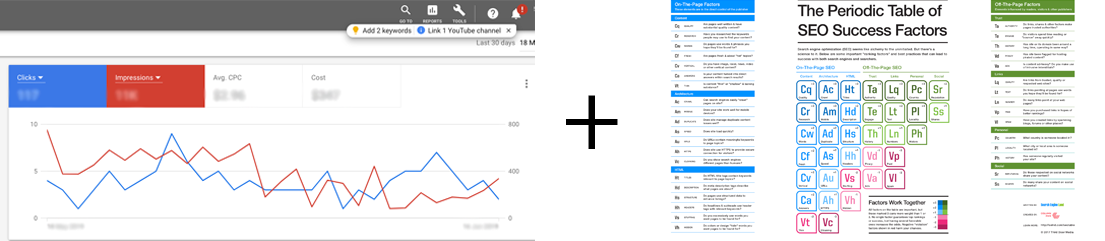
SEO has been around for a long time, enough that it usually doesn’t bother using its full name. Search Engine Optimisation is a series of best practices that search engines such as Bing and Google use to decide who goes on the first page and who goes on page 1,546,242. And as the name suggests, the closer you rank to Number 1, the better. But how does your site get that coveted spot through SEO? If you remember how complicated the periodic table was in Chemistry, the folks over at Search Engine Land created one about SEO with a whopping 35 factors.

Search Engine Land Seo Factors Periodic Table (50%)

Each of these factors is taken into account when a user types in a simple search, such as “Best pizza in the world”. If you type that in and see a whole bunch of local places pop up. Then you might be shocked to find several results that are right down the street. The best pizza in the world, right down the road, and you never even knew!

Well, that’s because along with the factors from the periodic table of SEO, some search engines such as Google track various user metrics as well. These include factors such as:

  • The type of the device the person searched from.
  • The location they want to search for.
  • And their current location while doing that search.

This is why the Maps results tend to show what’s nearby instead of places on the other side of the world. That’s because few people are probably willing to hop on a plane for lunch, no matter how good the pizza.

An endurance fighter

SEO prefers to wear down and outlast its opponent, which is why many new sites won’t start ranking immediately. Proper SEO is more of a marathon than a sprint. Hurrying to the goal will only tire you out. And if your business is like most companies, you plan on being around for the long haul. Of course, that means that you’ll want to plan for SEO to work accordingly. Important factors such as creating useful content take time to analyse. Moreover, search engines like Google need data to know if your blog “The Best Blog Ever in This and All Other Realities” lives up to its name or if that’s only true for you.

Because SEO doesn’t go for the one-hit knockout, companies that promise the top spot on Google for your keywords can’t be taken at their word. If they aren’t outright lying, they may use Black Hat SEO—the performance-enhancing drug of the digital world—that may potentially have short-term results but come with hefty penalties when Google the referee finds out. This is why established marketing companies let clients know upfront to treat SEO as an investment. Often, this means rebuilding your website, making new content, and getting positive reviews, things that can’t be done overnight. All of this makes for a better-performing long-term site. Both for search engines and for the customer, which is why SEO is so important and shouldn’t be ignored.


SEO may not attack quickly, but it doesn’t go down easy either.


SEM – The Newbie

SEM, short for Search Engine Marketing, works a little bit differently than SEO. Instead of focusing on building organic results through long-term investment, SEM works on a faster scale through paid advertising to feature as a top result. Like SEO, there are several factors that go into proper SEM that ultimately decide if your campaign will be successful. It’s more than simply paying more than everyone else. Otherwise, we would probably have a lot more scammers using SEM to spread viruses!


A precision fighter

Google Ads is easily the most popular SEM method because of its enormous range of options—and because Google is used for searches worldwide over 80% of the time. Google ads can be extremely broad or extremely specific, from targeting users all around the world to a specific group that lives within a few kilometres of a specific location. This range of options is incredibly useful… If you have any idea which ones you should be using.

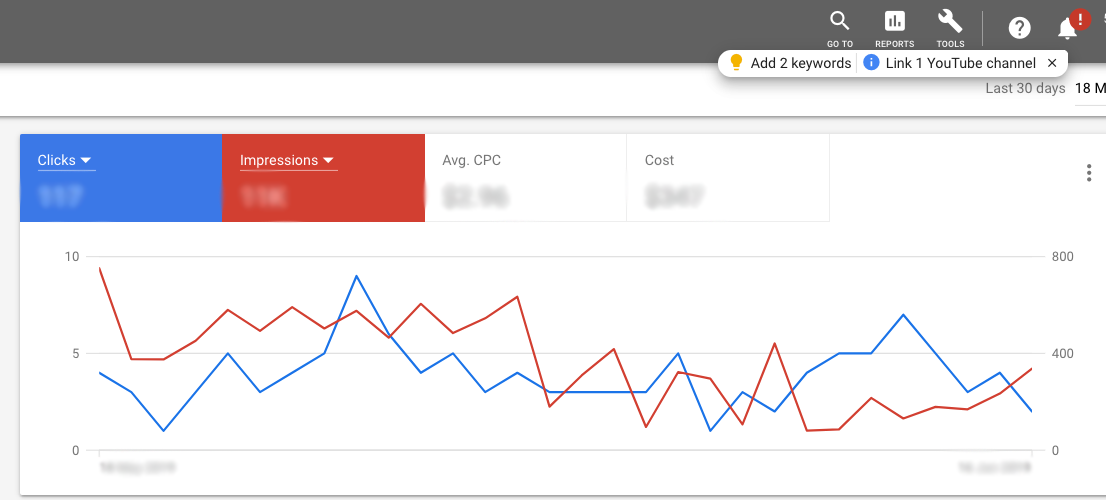
Google Ads Interface

Many people have heard of PPC or pay-per-click advertising, but AdWords can work in many other methods as well. Along with PPC, there are options for CPA (Cost per acquisition such as a call or buying from the website), CPV (Cost per view), and many more. There is even the option of doing call-only ads that can also work as a stand-in for businesses that don’t have a website. These create ads that have a brief message and a link to call the business directly from the search results.


Google Ads uses an Ad Rank score to determine which position your ad will show; or if it will show at all. Ad quality and the quality of your landing page—the page the user goes to on your site after clicking the ad—and the bid amount all go into ad rank. Better quality ads and landing pages mean you can have your ad shown with a lower amount, but also means if you want faster results you can opt for a higher bid while you work on your website.


SEM zeroes in on a weakness with precision and hits hard to get the results it wants fast.

So who wins?

It’s the age-old battle of strength vs. speed, power vs. endurance. None is inherently better than the other. Do which one will work better for you depends on your goals and timeline. Imagine if they could work together instead… But who says they can’t?

The tag team: The Digital Dynamic Duo!

A combination of SEO and SEM methods tends to have the best overall results. However, putting both powerhouses in your corner costs more upfront but has a much greater chance of a high return on investment. SEO helps your site to be found on organic searches and makes it more accessible and useful to users. SEM helps your site by targeting a subset of users through advertising that can put you at the top of search results. By betting on both, you maximise your chances of winning the fight.

Seo + Sem

Can’t I just learn the marketing techniques and do it myself?

If you’re thinking of jumping in the ring yourself, then well done! However, keep in mind that there is a lot to learn and digital marketing is a full-time job in and of itself. It’s like learning a foreign language. Once you get the basics down you might feel like you have a handle on it. That’s until you talk with the native speakers and realise you have much more to learn. Only in this language, the rules are constantly changing. Several times a year, Google makes major changes to its algorithms. And some of the old rules get KO’d overnight.


That’s why many local businesses choose to work with a professional digital marketing company— Like us! Get in touch now if you want some help from the pros. Keeping up with the latest changes and best practices is what the best SEO companies in New Zealand do best. And that can leave you to focus on what you do best – Running your business!

Most businesses that leave the marketing to the pros find they have more time to do what they love, which often makes everyone come out a winner in the long run – instead of getting knocked down in every round – if not knocked out in the first.