Who is the best Marketing Company in Southland?

Updated Wednesday 4th December 2024

When it comes to any business in any industry, not all businesses are created equal. The same can be said for Design and Marketing Companies. With that said, how do we define the best?

Business is not a finite thing, in fact, if business were a game, it would be an infinite one. There is no official way to measure who is better. Or is there? We have business awards, design awards, and a number of other ways to measure who is best in business, but these are still finite things within the infinite.

The best way to decide is by reframing the question – or adding to the end of it – Ask not “Who is the best Marketing Company?” but “Who is the Best Marketing Company for me? And my business?”

Truthfully, there is no one-size-fits-all company in any industry–which will be the best for you depends on your needs and circumstances. What’s your criteria for partnering with an agency?

One of the most important parts of teaming up with a company is working with people who believe what you believe. You can usually feel that in your gut. And from my experience, I would say trust your instinct!

Based on Google search results, below are five of the most visible design and digital marketing companies that do business in Invercargill, New Zealand.

Well, it’s us… Back9 Creative!

There’s no way of disputing it when you’re ranking number one on google for Best Marketing Southland! Especially when you have a featured Snippet!
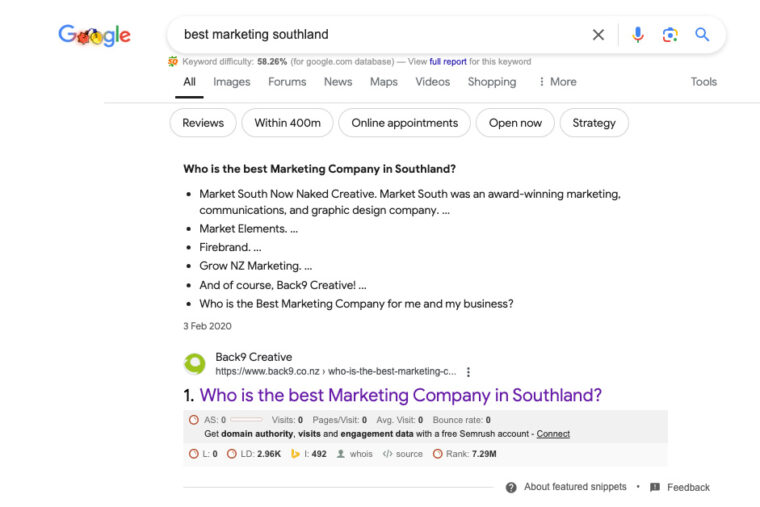
Screenshot-From-Google-Search-For-Best-Marketing-Southland

At Back9 we’re a trusted agency in the digital marketing landscape of Invercargill, Back9 Creative was started back in 2011 by Phil & Alli Robinson. With the rise of digital technologies, they believed that without the huge budgets of global brands, the ‘traditional’ outbound way of ‘interruptive’ selling and marketing was no longer as effective.

As design-driven agency with a focus on Web Design, Custom Apps and Search Engine Marketing, Back9’s goal is to help is to help ambitious businesses grow and succeed by tapping into new technologies and new ways of thinking.

Market South Now Naked Creative

Market South was an award-winning marketing, communications, and graphic design company. A recent rebrand to Naked Creative, they still appear to be a full-service studio. This can include Branding, Web Design, Advertising Campaigns, Strategy, Copywriting, PR, Print, and more.

Market South was passionate about creating kick-ass brands and campaigns that drive sales and help their clients make more money! The new Naked approach is stripped back. Honest. Authentic. Naked Creative believes “Quite simply, our job is to sell more things, to more people, more often and at higher prices.” 

As well as a full-suite of marketing and advertising services, they produce and own a range of products and publications focused on promoting Invercargill and the greater Southland region under their brand The Locals. Owner and Director Carla Forbes is a well-known Southland business personality and has held a number of roles on boards including the Southland Chamber of Commerce, where she was president. Forbes has also been the face of a number of local campaigns including, Stand up for SIT and The NZAS Tiwai Point Fight for Fairness campaign.

Market Elements

Market Elements offer Google Ads, Social Media Marketing, SEO and Web Design services. They have been providing marketing support and integrated marketing campaigns for small and small-medium businesses since 2010.

Market Elements say “It’s all about the relationship and the results for us. Most of our clients ask us to work with them well beyond their initial project, as they value the fact that we’re local and offer professional, independent advice and services”.

With team members collaborating from multiple locations, Market Elements do not appear to have a home base. However this can probably work to their advantage too. Lower overheads can mean more cost-effective pricing.

If you are a small or medium business then Market Elements are well worth touching base with to see if they can help you grow your business.

Digital Club

Digital Club, based in Invercargill, Southland, is a leading digital marketing agency dedicated to helping businesses of all sizes achieve their online marketing goals. Their comprehensive services include responsive website design, tailored SEO strategies, and targeted advertising on platforms like Facebook, Instagram, and Google. With a mission to turn business aspirations into achievements, Digital Club focuses on guiding young entrepreneurs, revitalising existing businesses, and partnering with startups. Their transparent communication and client-centric approach ensure that each business receives personalised solutions to enhance its online presence and drive growth

Grow NZ Marketing

Grow NZ has recently shown up in Google for the Search query: Best Marketing Southland. They specifically say on their Landing page “We’re your Otago – Southland based marketing partner. Let’s work together to grow your business with strategic and savvy marketing”.

They may have over 20 years of successful experience with profitable marketing and to be fair they have managed to rank in Southland for this query. However the title in the google search result clearly says Bay of Plenty.

Grow-Nz-Marketing-Google-Search-Result

A quick search of the website shows they claim to have multiple locations and to be fair in the realms of digital marketing you don’t need to be in the same town these days – Or country… The question you need to ask yourself is. If this business is claiming to be based in Southland (and Otago) why do they not have an address here? And that being the case, how honest are they. If you don’t have a problem with businesses making misleading claims, then they may well be worth chatting to. If honesty and integrity are important to you, then you may want t give them a miss. Your call.

Who is the Best Marketing Company for me and my business?

So which design and digital marketing company that is based in Invercargill, is the best for you and your business? Well… That really depends on what you’re looking for.

At Back9 we strive to be the best digital marketing agency in Invercargill. Firebrand, Grow NZ and Market South aka Naked Creative, all aim to offer a full-service. From managing social media to building a brand new website they say they can do it. Netbranding and Market Elements appear to be more focused on the web side of things. That makes them good options if you are looking to go full digital and don’t need traditional marketing campaigns.

If you’re looking to partner with an agency for your marketing endeavours, it’s worth taking time to do the research! Check out each of these businesses and other Invercargill-based design and marketing companies. Look over their services and see if their style and tone match what you want for your own business. See how well their own efforts work. How well does their website rank? Do you like what they have done and what others are saying about them? At the end of the day, as marketing agencies, we all say we are experts. We all say that we can help your business succeed. Ultimately, the Best Marketing Company will be the one you feel most comfortable approaching. One thing is for certain, Taking time to find that right fit and work with credible, reliable businesses can save time and trouble later on. So it’s worth the effort!

How To Choose A Marketing Agency

Lead Generation: How Do I Turn Strangers Into Leads?

If you’re looking for practical tips to help you get more leads, download our new eBook. The Beginner’s Guide to Generating Inbound Leads for free by completing the form at the bottom of the page!

How do I turn strangers into leads?

One of the biggest advantages of the digital age is that it’s easier than ever for companies to learn more about customers to give them what they want. But it’s also made it so that you get a lot more virtual “window shoppers”. People will stop by your website for a quick look to see what you have without buying anything. These people will usually have some interest in what you have. But for many, once they leave they’re gone for good. Unlike a physical store, there’s no one to stop and ask if they’ve found everything they’re looking for.

Or is there?

Lead capture and lead generation are designed to do just that. To generate more leads, you have to offer these people. Something of value – or at least perceived value. The journey to capturing the information and turning a site visitor into a lead is known as a conversion path. Simply put this is the path your visitor will take in order for you to capture their infomation. Then they become a lead.

How do you get information from page visitors?

Some websites get thousands if not hundreds of thousands of visitors each day. Most people won’t end up buying or booking anything right away, but if they’re in the research phase of the Buyer’s Journey, it can be helpful to make sure they don’t forget about you. But how can you get any information from someone just visiting?

This is where lead capture comes in. Lead capture is any method you use to get information about potential leads. It can be done in several methods. One way is to use a form on the sidebar with an offer or a quick contact form. Another way is a popup form that appears when someone visits a page and then goes to leave. It only appears when they go to hit the x or the back button at the top of the screen and asks a quick question like if they want to be subscribed for newsletters or emails with exclusive sales.


Captured but not captive

Effective lead capture isn’t the same as those websites that put a giant form over the page when you’re in the middle of reading it. “Oh cool, 6 reasons images are important…” And then in the middle of that sentence your screen is filled with a giant picture asking for your information, and then another popup on top of that one trying to connect to your Facebook account… And it shows your name.

Sure, this sort of intrusive interruption gives a better chance of getting a name than having no form at all, but it’s also much more likely to get frustrated users to never come back… Or to get a whole bunch of Henry Sewell’s with bogus email addresses. Blocking off the information visitors want and holding them captive and forcing them to click out of your whole-screen form or ad is a great way to make sure they hit the X on your site for good.


Build interest through Lead Generation Campaigns

Lead capture is a great way to get information about customers who visit your site, but how do you get them there in the first place? That’s where lead generation campaigns come in. A lead generation campaign is any method to get people interested in your company or a specific product or service. And there are limitless things you could try.

But all of them come back to providing something of value to people. And that doesn’t necessarily have to cost you a small fortune. Software makers for instance will give out free trials, usually for one or two weeks or a Trial Version that has limited features so that people can test it out before deciding to purchase or commit to a paid subscription. It doesn’t have to be giving out a full wardrobe or a month-long cruise in a luxury yacht, but it does need to be enticing enough for people to put in some effort or give out their contact details.


Get those creative juices flowing for lead generation!

It’s important to offer something of value for a lead generation campaign. But that doesn’t mean it has to be boring. You can team up with other companies and offer free tickets to events to people who like and comment on a Facebook post. You can build a giant prize wheel and let anyone who comes into your shop give it a spin for a chance to win 15% off or a company-branded water bottle. Or you could even give a free jar of your mum’s famous Chilli Powder Marmite with a $50-dollar purchase.

With lead generation campaigns, you have a chance to showcase your brand’s personality. And they’re a fantastic way to have a little bit of fun. However, be sure to be conscious of your brand positioning—the way that you want your brand to be perceived—especially when doing a campaign a little out of the ordinary. This will be the first exposure to your brand for many people, and you want to make sure they understand your company and what you stand for.


How do I get help with lead capture and lead generation?

If you’re having trouble creating effective lead capture methods or coming up with creative lead generation campaigns, our eBook The Beginner’s Guide to Generating Inbound Leads has helpful tips for attracting leads, creating useful offers, and tips on lead generation campaigns. Download it now for free by filling out the form below!

Or if you’d rather try handing off lead generation to the pros, our team at Back9 is happy to give it a go for you. We’ve had a lot of fun, creative, and effective campaigns in the past, and we love coming up with new ideas!

How much does a good logo cost? [VIDEO]

Logo Cost will vary, but what should it be?

How much will your logo cost? This is one of the most common questions we get here at Back9 Creative. The short answer is, it depends on a lot of factors.

So what about the long answer? What does it depend on? Some of the variables that can change your final logo cost include:

  • Your industry,
  • Brand colours (if you’ve established them),
  • Your current online presence,
  • Your existing logo (if you have one),
  • The size of your business,
  • The amount of revenue you bring through,
  • The logo styles you like,
  • Whether or not you have font styles in mind,
  • How many draft concepts you’d like to pick through,
  • How particular you are—how often you go back to the designer with changes,
  • Your business values and the feelings you want your logo to inspire
  • And more!

At the low end, you can expect to pay about $2000 for a logo. That price can increase depending on the specific variables involved. In this article, we’ll aim to give you an idea of the process for creating a logo. Furthermore, we’ll explain the things that we look at during the process, and why it costs what it does.

Why do logos cost what they do?

In the design industry, logos are perhaps the most important part of your Brand Identity–the collective way to identify your brand that includes your logo, your business style, your values, and even what you and your team wear–because the logo is literally the way that many people will recognise a brand. Connecting a quality product to a brand establishes an emotional attachment. In turn, can lead to loyalty. And loyal customers can even become promoters who tell others how great you are. Customers connect that image to your products, services, and what you stand for. This can be extremely important if you have a name that’s similar to someone else’s—especially if you’re in the same industry.

Some companies design their business models entirely around riding the coattails of another successful business. They’ll create a similar name in the same industry and can even swipe some customers from their competitor merely through mistaken identity; someone thought they were going to the other place instead. A memorable logo that stands out greatly reduces this chance.

No matter what graphic design agency you choose to go with, any reputable business will carefully create your logo using design and colour science combined with your own input to make a logo that is memorable, relatable, and something you’ll be proud to call your own.

Can’t I just make my logo myself?

If you trust in your artistic ability and only plan to use your logo for a few small, limited projects, there’s no reason why you can’t. But if you want to treat it as an investment and use it as the face of your company for the long haul, we highly recommend working with a skilled and experienced graphic designer.

Visual communication, which includes digital graphic design, is a prestigious field in many NZ universities that requires several years of study. Designers learn not only about the fundamentals of art and imagery, but also various pieces of complex software for digital production. An important part is being able to move from abstract ideas to completed projects that make use of colour theory, human psychology, and much more. When you use a professional designer, you get a lot more than a little picture!

While the exact steps can vary, generally, the logo creation process will follow this general outline:

Ideation

The first part of the process involves coming up with ideas for the logo.

  1. The designer compiles the research and information you give them. As this logo is for your company, it needs to be something you can stand behind. The more information you can provide about your business, the better. For example, who your target audience is, your values and your style, all go into the design. The more information your designer has, the better they will be able to craft a solid brief. The quality of the understanding will lead to better concepts.
  2. Information you provide is supplemented by further research. Remember that logo design isn’t just about art… It’s science too! Your designer will look at industry trends. They’ll be taking notes and saving that information to use later to ensure they stick to the brief!
  3. The designer comes up with ideas and makes rough sketches. It’s not uncommon for more than 100 sketches to be made. These might be hand-drawn with slight variations so the designer can try out a lot of different options and see what ideas work and what don’t. Many of these concept groups will be discarded entirely as the final, best options are narrowed down.

Logo concepts made up

  1. Drafts are narrowed down to a few top choices. A few of the designs will stand out among the rest. Here at Back9, we typically try to get it down to 3 final concepts to work with, but it could be more or less depending on what we’re working with.
  2. A detailed version of each top concept is created. One version of each of the concepts is fleshed out in further detail. If you don’t have a tagline already, the logos may include a couple of ideas if adding a tagline is an important part of the design.
  3. You review these conceptual versions with the designer. Remember that this is your logo, so choose the version that fits your business, target market and personality best. Most of the time, at least one of the versions will stand out. If none do for some reason, your designer will find out your thoughts and why none appeal to you. It’s important to go over the designs in detail, so that you’ll be satisfied with the final product. The designer will take note of your thoughts for revisions. Your designer might have a favourite, but will try to stay impartial during this process so you pick the one that’s right for you.
  4. Revisions There may be a couple of rounds of revisions where the designer meets with you, you give feedback, and that feedback is used to create a new version. Keep in mind that the revision process is a collaborative effort; your designer will be using all of the best practices they’ve learned through their studies and experience to give you an effective, versatile logo. The goal is to find something that everyone is happy with, which may or may not take a few phases of back and forth to narrow down.
  1. The logo is finalised. Once everyone is happy with the logo, it gets finalised and saved out in a few versions such as a version to use for Print and another for Digital. You might also get a few slightly different versions of your logo so that it works in more situations in both print and digital, like one you can use as a profile picture for a Facebook Business page and one ideal for signage and flyers.
  2. Replacing your old logo with the new. This final step is only done if you a) already have an existing logo in use and b) don’t know how to replace the logo yourself (such as replacing it in the backend of your website). It’s crucial to have consistency across platforms, so replacing every possible instance of your logo with the updated version is very important. If you use the logo on signage and print materials, you’ll also need to replace those with the updated version.

As you can see, there’s a lot of time and effort that goes into creating your logo, but by doing all these steps you’ll get a logo that you’ll be happy with and gives off the right impression of you and your business.

Why would my company’s revenue change the logo cost?

If you read that list above closely, you may have noticed that a couple of factors that determine the cost of your logo are how much money your business makes. But why would that make a difference? Why don’t all logos cost in the same general range?

The main reason is that a larger, more prolific business will likely have a bigger budget. The other reasons are that they tend to have a larger more comprehensive review team and tend to need more variations. And if the business is replacing an existing logo, it will have more versions across print and digital that need to be replaced.

Marketing budget and review time

So how does a bigger budget and more review time change the process? Larger businesses tend to have more people that need to agree on the final version. And the more people that get involved, the harder it is to come to an agreement! More people means more than the standard number of concepts, and multiple developed versions for each one. Overall, many of the main steps will be the same. However, the designer can invest more time in each step; more time spent on research, more iterations can be made, and you can have more fleshed out versions to choose from.

Consequently, this also means that larger businesses also require a longer timeframe than smaller businesses. Sometimes the design has to be approved by multiple levels before being finalised.

A bigger investment with more risk

The bigger and more established the business is, the more important it is to make sure the logo is right. A national or multinational brand has its logo on all kinds of merchandise and branding, and replacing it everywhere is a monumental task. Think about all the work that would go into McDonald’s replacing their logo. With over 30,000 restaurants throughout 120 countries, the logo is on storefronts, food, products, commercials, websites, and so on. With the millions of dollars, it would cost to replace the existing logo, they’d definitely want to make sure they got it right!

This is why logo cost should be proportional to the amount of risk for the company and how many mediums will be using a logo and how many versions it needs:

  1. Print
  2. Social media
  3. Website
  4. Signage
  5. And more…

Each version has to be developed for these requirements. Alternative colours can also be important depending on where the logo will be used.

If the logo uses a black font for instance, it could be completely invisible on a black background! Wider distribution for the logo means more of these versions are needed, which require time, research, and testing to make, ultimately meaning a higher cost for the logo.

How much do corporations pay for their logos?

Generally, the bigger the company, the more money they put into logo design. Take Invercargill City, for example. In 2017, they rebranded with a new logo. The cost for the design and consultation was around $80,000! Then around $70,000 more going towards replacing the old logo and adding the new one to permanent infrastructures and new signage. So the total investment was around $150,000 for the rebrand in total.

For multinational corporations, that cost is even higher. Petrol pumper BP was estimated to have spent $211 million USD (300 million NZD) on their most recent green, yellow, and white logo. That’s as much as the GDP of the entire country of Kiribati in 2019. As much as an entire country. And that’s only the 2nd most expensive logo. Symantec spent a staggering 1.28 billion dollars for branding and logo acquisition!

Symantec Logo

No, we don’t expect you to spend as much money as an entire country on your logo. This is why we say that logo cost is proportional to business size, revenue, and outreach. It’s important to remember everything that goes into making a logo. It’s complex and time-consuming to do it properly.  Instead of comprising on important parts of the logo design process, some agencies will let you pay in installments. At Back9 Creative, we include a logo as part of our package for a new start-up. That package starts at $350+GST a month with a 6-month commitment. Monthly payments are an option at Back9 not only for your logo, but for website design and web development too. This can mean a more cohesive look across your brand. And that will ultimately be an investment in your brand’s equity in the long run.

Your logo is a worthwhile investment

As the face of your business 24/7, your logo is one of the core assets of your business.  As such it should be researched and developed by a professional designer. Because of the hours of work that goes into getting the logo just right, costs start in the low thousands. But considering that it’s the way people recognise your brand, it’s an investment to get it done right. And it will almost certainly pay you back its cost and much more.

Need a new or redesigned logo for your business? Let’s Chat…

3 reasons you need to invest in a custom website


A Custom Website Design is made to fit your needs!

Websites are a lot like shoes – there’s a lot of options out there... And like shoes, one Size and Style does not fit everyone. 

Most people with a little bit of tech nous these days can figure out or teach themselves how to create a free (or cheap) templated website – well I use the term create loosely and sure, some template sites may have some variation in style, but essentially they’re a one-size fits all solution.

We simply don’t believe in trying to shoehorn anyone into a solution that doesn’t fit their long-term strategic marketing goals.

Whilst you could ask the question “Have Wix, Squarespace and Shopify killed Custom Web Development?”. We believe the answer is clear. Cheap – or free – ‘will do for now’ solutions ultimately won’t last and could cost you a lot more in the long run.

Continue reading “3 reasons you need to invest in a custom website”