Why Can’t People Find my New Website?

After all the blood, sweat, and digital tears, your website is done.  Yet when you tell people about it, they can’t find it–sometimes even when they type your business name directly into Google. A common misconception many people have is that once their new website goes up people will flock to it like seagulls to your lunch at the beach. But getting results can take a bit of time. Even with the seagulls, if you toss food to one, it will take a little bit for others to notice and come over to see you. And the same is true for your website.

If you aren’t familiar with digital marketing, it can be confusing why a great-looking, easy-to-use site gets lost in cyberspace.  Why is that? And is there anything you can do to speed up the process and what is a realistic timeframe to see SEO results?

How-Long-Does-Seo-Take-To-See-Results

My new website went live a week ago, where are the results?

As big and omnipresent as Google seems to be, they have their limitations. In 2020, there are over 1.5 billion live websites and 17 quadrillion pages online. It takes a lot of resources to get through all of that!

Think of your new site like a small, amazing restaurant at the outskirts of town. When the place first opens, it probably won’t get too many visitors. But then a few people might visit out of curiosity. If they like it, they might come back. And if they love it, they’ll probably tell their friends. Then those friends will spread the word until eventually, you can’t find a table without a reservation. With enough business, that restaurant may even have to move to a more centralised location where it becomes well known for its value and quality.

With new websites, Google takes a lot of things into account before it will put a site high in the search results. Sometimes this can take a while as it decides that the content on the site is useful and relevant to visitors. For example, if an unusually high amount people come to the site and leave quickly without visiting another page–known as a “bounce”–then the site will be less likely to be at the top of search results. But that means the opposite is true as well; sites that prove they provide value to visitors are more likely to be rewarded for the effort and hard work they put into giving a strong user experience.

Was your site built with SEO in mind?

SEO stands for Search Engine Optimisation, a series of over 200 factors Google uses to decide who ranks high.

When done right, websites can be like staff and can help you bring customers at any time. Like if some night owl wants to look into buying a boat at 4:00 AM on Christmas Day and you sell boats, your site will do the work for you when nearly all of the world is asleep. Your new website can do a lot of good!

However, for this to happen, the site needs to be built and developed with SEO in mind. It’s a lot more difficult to backtrack and try to add it afterwards. This is because the site structure–the way users get to pages and the way pages link to each other–needs to be done appropriately for best results with SEO. If the site structure is wrong, it’s a lot of work to rebuild the site the right way. It’s worth the effort to get it right the first time!

Luckily, Google has general guidelines about how to help them find your pages. Some of these include:

  • Making sure that every page is linked to by at least one other page.
  • Limiting links on a single page to “a few thousand at most”.
  • Adding a sitemap–a list with links to every page on your site.
  • Using proper server setup and a robots.txt file.

How long will it take before people find my site?

There’s no straight answer for how long it will take for your site to appear on Google. In general, it will take between several days and a few weeks to show up. You might be able to speed up the process by submitting the site to Google Search Console. Doing this improves the chances that your site will be crawled–checked over by Google–but is unlikely to speed up the process. Following the suggested guidelines and requesting Google to crawl it is your best bet. Even still, the timeframe will be several days to a few weeks.

What if several weeks pass and I still can’t find my new website?

If you wait through the time frame and still aren’t finding your site, it’s most likely missing something important. Does the site follow Google’s Guidelines? Was it set up with SEO in mind? If you think it was, double-check everything to make sure. If you’re unsure or don’t know how, the team here at Back9 can help. We have years of experience building and maintaining websites and know just what to look for. Give us a ring or stop by today to find out how we can help you.

How does Google’s BERT Update affect site rankings?

In late October 2019, a major shift happened with the way that Google comprehends search phrases known as the BERT Update. Google is constantly making updates, to the point that Google’s Gary Illyes tweeted that they make 3 updates a day on average. Most of the time, these are small, unnoticeable changes, but every once in awhile there’s a major shift that drastically shakes up the search results like new ways pages are crawled or new innovations like the featured snippet. BERT is one of these big updates.

BERT  stands for Bidirectional Encoder Representations from Transformers–which sounds like they really wanted a specific acronym–an algorithm designed to better understand search terms. With the new update, approximately 1 in 10 searches were affected, and search engine results pages will have massive changes. This means that some pages that were ranking well fell sharply, while others rose. Is there anything you can do to make sure your site is helped instead of hurt by BERT?

What did the BERT update do?

The primary goal of BERT was for Google searches to understand “longer, more conversational queries or searches where prepositions like ‘for’ and ‘to’ matter a lot to the meaning”. So what does that mean? As an example, if I was an American looking to move to New Zealand, I might search for “America move to New Zealand visa needed”.  Previously, Google wouldn’t know how to understand “to” in the sentence so results would be a mix of articles about visa options for Kiwis going to America  or visa options for Americans coming to New Zealand. Two very different sets of results. After the update, the results will only be the second option.

This is great news for the end user. While shorter, concise keyword searches like “best pizza” aren’t likely to change, longer searches like “Where can I find the closest doctor for a sprained ankle” may have new results. For these longer terms, search results will be more relevant and it will take less time to discover the right keywords or phrase order for people to find what they want. Everyone will start seeing better, more accurate results. It also means that many pages that are currently ranking high might not be anymore.

How can I optimise my content for BERT?

The simple answer? You don’t. Google’s goal has always been to provide the best, most useful search results to its users. Ideally, there would be no keyword confusion and your search would return several different helpful results you could go through to find the information that you want. BERT helps by having a better understanding of natural, conversational language and nuance. This means that Google will be better at understanding individual words in your search and how they relate to each other.

BERT and voice searches

Voice search as fluctuated in popularity over time, but is now steadily gaining popularity due to advancements in technology like SIRI, Google Voice Assistant, and Amazon Alexa. While BERT is still in the early days of release, changes to voice search are expected to be significant. The goal of BERT is to understand conversational language, and many people talk to their voice assistants more conversationally and in longer sentences; sentences that can now be understood better with the BERT update. This means voice search results should be more relevant and accurate now.

How does BERT affect business websites?

Overall, BERT is a great advancement for users. But what about your business? Do you need to change the content on your site? You might need to change your written content because of BERT; it depends on the way that you wrote it in the first place. The best practice is to write your content for humans, not to try and trick Google. Writing content because it’s helpful for users is basically future-proofing it against algorithm updates, especially if you write for the user and manage to rank well.

Writing for search engines, on the other hand, is an ever-changing game. Some people find exploits that trick Google by manipulating page layouts or by using other types of black hat SEO. And while these might seem to work short term, a major change to the search algorithm can cause all of those unhelpful, strangely-formatted pages to drop off the top results completely.

How can I improve my keyword rankings?

If you had some keywords drop in the results and you wrote the pages to be helpful, don’t panic right away! Take a look at your analytics and see if those pages were converting like they should. If you were getting high-traffic but few conversions or a high bounce rate, it could be because of terms that brought up your page that weren’t actually relevant. You might end up with fewer visitors, but those that come should be of higher quality.

If this isn’t the case, take a close look at your content and to see if it’s actually high-quality and helpful with those keywords in mind. The easiest way is to go straight to the source and look at Google’s EAT Guidelines for high-quality content. By following those guidelines the best you can, you’re more likely to have content that will rank well with BERT and future updates.

So how can you make BERT more likely to help than hurt your rankings? Make sure your content is high-quality and well-researched. Follow appropriate SEO guidelines. And write for humans! Of course, you could always contact the experts for blogs, copywriting, and other writing for your website and let us handle it for you and keep track of this and future updates. Get in touch now to get started.

When it comes to content, how can quality be quantified?

If you’ve ever read any marketing or SEO tips from experts, you’ll find that they nearly all of them say the same thing about written content: quality is the most important aspect. High-quality content ranks better than low-quality (obviously). And if you have to choose between quality and quantity, quality Trumps every time.

Of course, for the longest time, no one bothered to define what “high-quality” actually meant. Gibberish text full of random words strung together without punctuation was low quality. Everyone agrees on that. But what about the other side? What makes something high-quality?

What does “high-quality” mean to Google?

Quality writing is subjective. What one person deems high-quality, someone else might think is a flaming pile of sheep dung squished into a screen. Think of it like movies; some people like to watch all the big blockbusters, while others think the only good movies are foreign films that air only in small French villages for a single night.

But quality to Google is something specific.

Google says your website should provide value to visitors, whether that be through videos, resources, blog posts, or simply a way to reserve a table or order from your store. Quality written content can be difficult to gauge, but one way to help with this is through checking a few basic things on every page:

  • Have no broken links, hidden links, or hidden text (same colour as the background, for instance)
  • Don’t create multiple pages on a site with essentially the same content e.g. Home Renovations Southland and Home Renovations Invercargill where only the region name is changed.
  • Avoid having pages with little or no original content, such as pages copied verbatim from another website. You also don’t want pages with only a sentence or two.
  • Include your most important keyword in both the title and meta description.
  • Don’t use content made automatically through content robots
  • Do a spelling check for typos and read over content for grammar errors.
  • Write at an appropriate reading level for the target audience


Quality is about good EATing

Always being hungry for more, Google developed over 100 pages of quality guidelines in May 2019 when they had individuals start checking top search results and give them a quality rating, something they likely will attempt to automate in the next few years. Their new rating system is measured through Expertise, Authoritativeness, and Trustworthiness (EAT) guidelines. Since content is supposed to be useful and make visitors want to devour more, it should be something they can EAT and digest. So, the owner of a plumbing company with accolades, multiple certifications, and 40 years of work experience would be weighted higher than someone who once unstuck a wad of paper towels from their clogged toilet.

How can you check your EAT score?

Currently, this means that the only way to accurately judge quality by Google’s standards is to have your site pages reviewed manually through the Search Quality Rating Program… Which is unlikely to happen. However, by knowing what they’re looking for, you can be ahead of the curve once they figure out how to implement these guidelines into their search algorithm. A few best practices you can do now include:

  • Make sure that your pages have a clear purpose. A page that describes your goods and services in detail is helpful. One on your company site that has pictures of goats and talks about the 2011 Cricket World Cup Final may not be so clear.
  • Research and write content that comes from experience or is important in your field. Information should be true and accurate.
  • If the page is meant to be informative, it should provide something different than what’s already available elsewhere. It’s okay to take some elements from other pages and combine them together. But don’t take a page and copy it in slightly different wording. Although, summaries of long or complicated content can be very helpful too.
  • Have an updated About page that explains your experience and credentials? With the new EAT guidelines, information on who people are and why they have authority on a topic will likely become more important.
  • Understanding how to write a blog article for your website is important. Use keywords appropriately. Make sure that your title and description will bring users to a page that’s relevant to their search. If they search for “Best painters Invercargill” and click on a company page that seems to be about painting, but the content is all about making pavlova, then it’s deceptive and can cause a sharp drop in rankings if the discrepancy is found.

Now’s a good time to dust off those English skills

With Google’s Search Quality Rating program in the works, content quality is going to become more important than ever before. While the guidelines of high-quality content might seem over-complicated and difficult, they boil down to taking the time to write useful information that is honest, relevant, accurate, and free of spelling and grammar errors.


With keywords, the right words are key!

How does Google work? Officially, there’s a highly-secret algorithm that’s constantly being updated by some of the greatest minds in the world. This algorithm can interpret text written from people of all backgrounds and show relevant results related to their query. Unofficially, it seems like it can be completely random. After all, a search for “best search engine” doesn’t go straight to the Google home page. Instead, it leads to a list of articles. One of the top results is “14 Great Search Engines You Can Use Instead of Google.”

If you have a smaller business, it might seem like an insurmountable challenge to get found on the first page. This is especially true in a competitive industry. But by building a good website and getting links, a lot of the work is already done. However, remember the primary way that people use Google is by searching with keywords.


What exactly are keywords and how do I use them?

A keyword is a word or phrase that describes an idea or topic… Which means practically every word. Nowadays, Google can connect some unusual phrasing with a broader meaning. It can also piece together shorthand search terms that people write because we’re lazy. “Best deliver pizza where” isn’t really saying anything. But Google understands what you really mean. They will translate it to something like “Where is the best pizza near me that offers delivery?”. It returns results rated 4 stars or higher in the same town the person searched from. 

A keyword is “A word or phrase that you want your website to show up for when someone searches in Google.” So if you paint houses and maintain lawns, “Painter” and “landscaper” would be target keywords. You’d probably also like “exterior painting” “house painter” “Lawn cutting” “Trim lawns”. And as many variants as you can think of.

Although Google is getting better, the algorithm isn’t foolproof, and the best way to maximise your chances of hitting keyword variations is to include as many as possible naturally throughout the text. It’s obvious not only to Google, but to readers when keywords are stuffed in unnaturally, which can break trust with your users and increase the chance that they’ll look to a competitor instead. Here’s an example: If “Marketing Invercargill” was my keyword, stuffing the keyword would look something like this, “We’re the best Marketing Invercargill agency because unlike other Marketing Invercargill companies, our Marketing Invercargill focuses on Marketing Invercargill design, Marketing Invercargill quality, and other Marketing Invercargill elements.” And yes, these sorts of sites were common (including bolding the target keyword) and some still exist to this day.

Use keywords naturally but sparingly on your site

For many businesses, the website is the way that they differentiate themselves from others offering the same service, through a combination of good site design and useful information about their goods or services. A lot of your information will be shown through landing pages, a single page on your website that someone arrives at from a Google search about a topic related to their search term. So how can you make sure that a landing page gets up high on Google in the first place?

Keyword guidelines

There are a few guidelines you can use when writing a page that can better your chances of ranking well. Some of these are:

  • Try to mention your target keyword as soon as possible, but make sure to do it within the first 100 words.
  • Longer posts tend to rank better. Part of the reason is because they simply have more words, so there’s a better chance that related terms will show up and that the article will have better topical authority. Try to write at least 250 words on a page if possible.
  • Along with making better quality writing, using synonyms in place of the keyword will help with SEO and can help you hit more variations. “Pizza” “Circular meat pie with cheese on tomato sauce” and “Best food” are really referring to the same thing (Okay, the last one is only mostly true). For ideas of what keyword variations you can use for any topic, try using Google’s Keyword Planner.
  • Link to sites with high domain authority that support your claims if you can. If it makes sense within the page, linking to other pages on your site can also be helpful.
  • Use proper Header hierarchy (H1, H2, H3 tags) and try to use the target keyword in at least one of those headers. Using headers helps break content down into pieces that are easier to read and can also improve SEO when done right.

Don’t forget your title tags and meta descriptions

Title tags and meta descriptions are bits of information that we all come across online frequently, but if you aren’t familiar with the terms you may not know how important they are.

A meta description is a basic summary of your page and something you do through your CMS (WordPress, Squarespace, etc.). When you do a Google search, you’ll see that under the blue title and green URL address is a few lines of text explaining the page. This text is pulled straight from the meta description, so it’s important to make it accurate, informative, and useful—and all you have is about as many characters as a Twitter post. And don’t forget to include the target keyword!

If that doesn’t seem like much to describe an entire page or blog article, the title tag gets even fewer. At 50-60 characters, the title tag tells search engines the topic of the page, what the page is all about. It’s also the text that appears in the tab at the top of the page, as well as what comes up in blue on a Google search, meaning it matters to visitors as well.

How should you format title tags?

You should format title tags like this:

Primary keyword – Secondary Keyword (if appropriate) | Brand Name

Which for this post, would look something like this:

Keywords – Search Engine Optimisation | Back9 Creative Studio

(That straight down line is a separator you can make with Shift+\

If you don’t want to worry about getting it right, the Yoast SEO plugin will make them for you. The free version will be enough for this purpose and it’s safe to use as millions of websites have it installed. We add to all of our websites so that it can make title tags for us on all our pages.

Keywords seem important… And complicated!

Using keywords appropriately isn’t as straightforward as choosing a phrase and sticking it all over a page… At least not anymore. Now, it requires using the keyword itself as well as variations of it naturally throughout the text of a page. Quality is a huge factor as well. Nearly all marketers and SEO experts agree that it’s not the quantity of content that matters, but the quality of content. That’s a good platitude, but what exactly is quality content? We’ve written about it extensively on our blog post about quality content to help you create pages that are Google-approved and ready to top the search engine charts. By taking the time and effort to use keywords the right way on your site pages, you can attract prospects and customers to your brand easier. Or of course, you could always let the expert team at Back9 do it for you!

What Ranking Factors is Google Looking for in 2022?

*Updated June 2022 for 2022 Ranking factors

With literally billions of searches done each day, Google is doing pretty well for itself. And with approximately 85% of the search engine market, other search engines are dwarves against the GIANT. It’s no surprise that the slang for finding information online is to Google it (Yahoo It! Nope, sorry Yahoo). In fact, Google has become such a big deal that there are Search Engine Optimisation companies dedicated solely to getting you to rank well on the search engine, some of which use… Unscrupulous means to force results–that almost always turn out to be short-term.

As full-service marketers, we understand that digital and other forms of marketing should work together in order to cover as much ground as possible. A lot of people understand the importance of traditional marketing–a good logo, proper signage, print advertising, that sort of thing–and also understand that being found on the 1st page of Google for competitive search terms is the Holy Grail of Digital Marketing. However, getting that coveted spot takes more work than simply putting up a quick page with a few blurbs and maybe a picture. There are actually around 200 different factors Google looks at to determine who goes at which place! With so many factors, and literally billions of websites, how can you possibly push your way to the top?

Core Web Vitals

The newest change to happen in 2021 that’s currently in the works is Core Web Vitals. This is taking website design and usability to the next level by rewarding good designs and user experience. It’s not just about having a workable site anymore; now, your site needs to be good in order to score high for Core Web Vitals.

This is where those “Get top spot on Google” companies that manipulate the algorithm will start to hurt. Sites that don’t have a solid structure, easy usability, and informative, useful content will start to drop in the rankings. Google says you should start expecting these to be a factor starting May 2021. Find out more about Core Web Vitals in our article, Google’s May Algorithm Update is a Game Changer!

High-quality content

Google’s ultimate goal is to send people to the most relevant results. As the algorithm gets more advanced, (One Google engineer thinks its chatbot is already sentient) the AI will be better at parsing content for indicators that it answers the query the person asks. Over time, better, higher-quality content has started to the top of the search results, and that trend is only going to continue.

What is good content?

Good content is information that is useful and relevant to the user. But what exactly is “good content”? Thankfully, we don’t have to guess. Google has guidelines on how to quantify “quality” content. Some basic things to include are making sure your page has a clear purpose, the information is accurate, and it should be unique to anything else on the internet. With billions of pages online, having something completely unique can be tricky.

If you’re concerned, a good way to check is a plagiarism tool that compares your text to the web (that thing professors use to make sure you don’t cheat).  There are several paid versions out there, but Small SEO tools have a free plagiarism checker for texts up to 1000 words you can use if you don’t mind ads.

Knowing is half the battle

Google is notorious for being secretive about how its algorithm works. Over time, people have run tests to understand some of the factors they look for and came up with that 200 number, with various degrees of confidence for specific variables. Of course, some factors are more important than others, and it’s these elements that we address first as an experienced digital marketing team.

Website Architecture

Getting your website architecture set up the right way is important for more reasons than being found in the search results. Websites should follow a clear and easy-to-understand hierarchy that’s intuitive to anyone visiting the site. An example is to have a navigation bar with your Home page, About Page, Contact Page, and Services, with Services having its own set of subdirectories. This makes it so that once you’re successful having individual pages found in search results, users can navigate to other parts of your website that catch their interest with ease.

Topic Authority

Topics are the things you post about on your website. And the more you post about a specific topic, the more Google gets the hint that you know about that topic… Or at least, that you talk about it often. So if you have a site talking about Pizza Styles of the World and talk about Chicago-style Deep Dish pizza in 50 different articles, Google will start to recognise you as an authority on the topic and you’ll likely see rankings increases.

On the contrary, you won’t get that boost if your Pizza Styles of the World site talks about Xbox Series X vs PS5, Little known facts of the All Blacks, and How to Run your Car on Milk Instead of Petrol with one or two pizza articles mixed in. Try to stick to specific topics and you’re more likely to see positive results in Google.

Keywords

In 2021, keywords are still among the most important ranking factors that Google searches for. As the algorithm has gotten more advanced, keyword match is much broader than it used to be even a few years ago, unless people “use quotes” for an exact keyword match. Keywords range from broad–Pizza, for instance–to very specific and local–Best Giant Pizza Invercargill–and one or the other might be better for you depending on the type and scale of your business. Now, Google can understand prepositions too. So the results for “Move to New Zealand” and “Move from New Zealand” will be more accurate instead of mixing in some showing the opposite of what you want.

Keywords are still the way that people search on Google, so it’s very unlikely that the day will come when they aren’t crucial to getting your site to rank. Using a combination of your target keyword–Best Giant Pizza Invercargill–and LSI terms which are other variations of your keyword–XXL Pizza Invercargill–naturally throughout the page shows that you’ve done your research and gives you the opportunity to rank for multiple related terms at once.

Google My Business

Another newcomer for the year that holds a lot of weight is Google My Business. If your company doesn’t have a Google Business Listing, you should get one right away. Not only do hundreds of people be exposed to your business every month, your connected website will also get a boost in Google’s rankings. It’s worth the time to set up your profile properly! Since this is a Google product, it’s not surprising they want to push it more. You can learn more about these listings and how to optimise them in our article, Why should you have a Google My Business Listing?

Page Load Speed

Loading speed seems to get more important to Google with each major change. In these days when the average internet speed of the Top 50 countries with the fastest internet exceeds 10 Mbps, people don’t want to wait long for pages to load anymore. In fact, now that the majority of internet users prefer to use mobile devices over desktops, over half of users claim that they will leave a site if it takes over 3 seconds to load. Optimising your site for mobile and prioritising fast page load times is essential for a good user experience, and can impact search results as well.

Links to your page

If a lot of other sites are linking to your site, Google takes that as a sign that you wrote something interesting and useful to other people. These inbound links or “backlinks” are links from other sites to your website. Sometimes, these links come naturally, other times, you have to work for them, such as writing a guest post on someone else’s blog so you can link back to your own site. If you’re able to get a backlink from an authority site such as a government agency, you may even get a massive boost to your rankings!

What about the other 190+ factors?

While the five factors above are critical to your SEO rankings, they also incorporate some of the other 190-some-odd elements that Google looks for to decide search result rankings. Other factors include things like Age of your Site, Content Rank, Keyword Density, Page Tags, Duplicate Content, Site Usability and many, many more. If you want to take a look at the list, check out this Backlinko article for a deep dive. For something a bit more digestible that goes over the general SEO categories, have a read of our ebook All About SEO.

I got an email claiming a company can guarantee me the top spot on Google

Since Google itself is coy and never openly confirms how it ranks sites, be careful of any company that can guarantee a top spot in Google. No reputable agency can make such a guarantee, but will simply do their best to adhere to as many ranking factors as possible for your website.

Some companies use what’s known as black hat techniques to try and trick Google for short term gains. Sometimes, these are successful, but inevitably, Google will find out, leaving you with a penalty and dropping you off the first page deep into the abyss where you’ll have to work hard and long to find your way back up again.

How can I ever make a site worrying about 200 different things?

Fortunately, few, if any of the billions of websites are perfectly optimised for ALL of the things Google is looking for. Even major corporations who have been around for decades have elements they can improve on; it’s the reason websites need updates so often.

So then what should you focus on for your site? Have an intuitive site structure that’s easy to navigate. Write useful, relevant content about specific topics. Make sure to optimise your site for mobile devices and that it loads quickly. And get quality backlinks when possible. Sound like a lot of work? It is, and is the reason why an effective new website can’t be built in a day. Learning to build and maintain a quality website can be a full-time job itself, which is why many businesses work with marketing teams with proven success, so everyone can focus on what they do best.


SEO vs. SEM: The Ultimate Showdown

Quick, in a fight between SEO and SEM – who would win? Are you going to put all your money on the reigning champ? Or do you think the rising star will steal the title match? Choosing the wrong option can make it so that you don’t get the best possible results for your business. So before placing that wager, it might be helpful to know a little bit about the contenders.

SEO – The Veteran

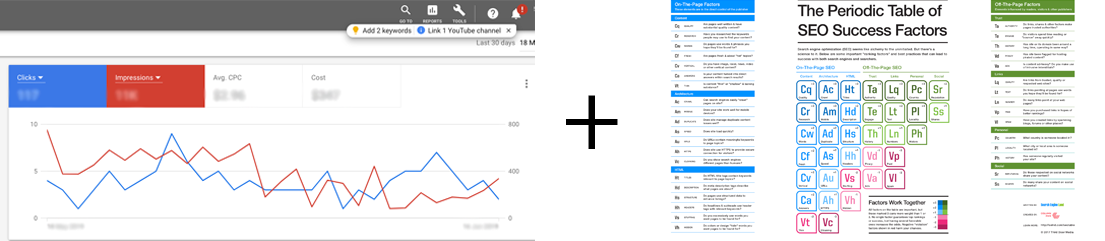
SEO has been around for a long time, enough that it usually doesn’t bother using its full name. Search Engine Optimisation is a series of best practices that search engines such as Bing and Google use to decide who goes on the first page and who goes on page 1,546,242. And as the name suggests, the closer you rank to Number 1, the better. But how does your site get that coveted spot through SEO? If you remember how complicated the periodic table was in Chemistry, the folks over at Search Engine Land created one about SEO with a whopping 35 factors.

Search Engine Land Seo Factors Periodic Table (50%)

Each of these factors is taken into account when a user types in a simple search, such as “Best pizza in the world”. If you type that in and see a whole bunch of local places pop up. Then you might be shocked to find several results that are right down the street. The best pizza in the world, right down the road, and you never even knew!

Well, that’s because along with the factors from the periodic table of SEO, some search engines such as Google track various user metrics as well. These include factors such as:

  • The type of the device the person searched from.
  • The location they want to search for.
  • And their current location while doing that search.

This is why the Maps results tend to show what’s nearby instead of places on the other side of the world. That’s because few people are probably willing to hop on a plane for lunch, no matter how good the pizza.

An endurance fighter

SEO prefers to wear down and outlast its opponent, which is why many new sites won’t start ranking immediately. Proper SEO is more of a marathon than a sprint. Hurrying to the goal will only tire you out. And if your business is like most companies, you plan on being around for the long haul. Of course, that means that you’ll want to plan for SEO to work accordingly. Important factors such as creating useful content take time to analyse. Moreover, search engines like Google need data to know if your blog “The Best Blog Ever in This and All Other Realities” lives up to its name or if that’s only true for you.

Because SEO doesn’t go for the one-hit knockout, companies that promise the top spot on Google for your keywords can’t be taken at their word. If they aren’t outright lying, they may use Black Hat SEO—the performance-enhancing drug of the digital world—that may potentially have short-term results but come with hefty penalties when Google the referee finds out. This is why established marketing companies let clients know upfront to treat SEO as an investment. Often, this means rebuilding your website, making new content, and getting positive reviews, things that can’t be done overnight. All of this makes for a better-performing long-term site. Both for search engines and for the customer, which is why SEO is so important and shouldn’t be ignored.


SEO may not attack quickly, but it doesn’t go down easy either.


SEM – The Newbie

SEM, short for Search Engine Marketing, works a little bit differently than SEO. Instead of focusing on building organic results through long-term investment, SEM works on a faster scale through paid advertising to feature as a top result. Like SEO, there are several factors that go into proper SEM that ultimately decide if your campaign will be successful. It’s more than simply paying more than everyone else. Otherwise, we would probably have a lot more scammers using SEM to spread viruses!


A precision fighter

Google Ads is easily the most popular SEM method because of its enormous range of options—and because Google is used for searches worldwide over 80% of the time. Google ads can be extremely broad or extremely specific, from targeting users all around the world to a specific group that lives within a few kilometres of a specific location. This range of options is incredibly useful… If you have any idea which ones you should be using.

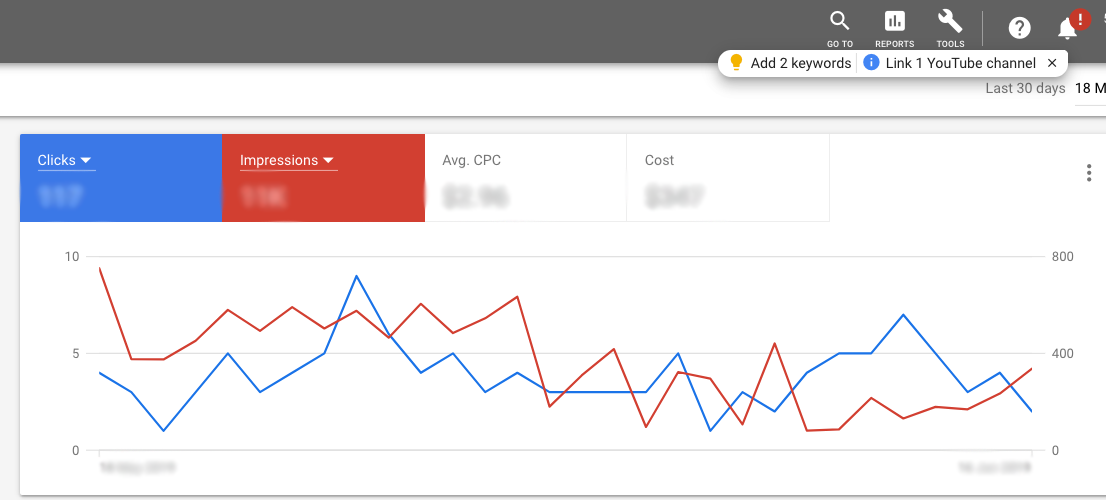
Google Ads Interface

Many people have heard of PPC or pay-per-click advertising, but AdWords can work in many other methods as well. Along with PPC, there are options for CPA (Cost per acquisition such as a call or buying from the website), CPV (Cost per view), and many more. There is even the option of doing call-only ads that can also work as a stand-in for businesses that don’t have a website. These create ads that have a brief message and a link to call the business directly from the search results.


Google Ads uses an Ad Rank score to determine which position your ad will show; or if it will show at all. Ad quality and the quality of your landing page—the page the user goes to on your site after clicking the ad—and the bid amount all go into ad rank. Better quality ads and landing pages mean you can have your ad shown with a lower amount, but also means if you want faster results you can opt for a higher bid while you work on your website.


SEM zeroes in on a weakness with precision and hits hard to get the results it wants fast.

So who wins?

It’s the age-old battle of strength vs. speed, power vs. endurance. None is inherently better than the other. Do which one will work better for you depends on your goals and timeline. Imagine if they could work together instead… But who says they can’t?

The tag team: The Digital Dynamic Duo!

A combination of SEO and SEM methods tends to have the best overall results. However, putting both powerhouses in your corner costs more upfront but has a much greater chance of a high return on investment. SEO helps your site to be found on organic searches and makes it more accessible and useful to users. SEM helps your site by targeting a subset of users through advertising that can put you at the top of search results. By betting on both, you maximise your chances of winning the fight.

Seo + Sem

Can’t I just learn the marketing techniques and do it myself?

If you’re thinking of jumping in the ring yourself, then well done! However, keep in mind that there is a lot to learn and digital marketing is a full-time job in and of itself. It’s like learning a foreign language. Once you get the basics down you might feel like you have a handle on it. That’s until you talk with the native speakers and realise you have much more to learn. Only in this language, the rules are constantly changing. Several times a year, Google makes major changes to its algorithms. And some of the old rules get KO’d overnight.


That’s why many local businesses choose to work with a professional digital marketing company— Like us! Get in touch now if you want some help from the pros. Keeping up with the latest changes and best practices is what the best SEO companies in New Zealand do best. And that can leave you to focus on what you do best – Running your business!

Most businesses that leave the marketing to the pros find they have more time to do what they love, which often makes everyone come out a winner in the long run – instead of getting knocked down in every round – if not knocked out in the first.