The State of Marketing in Invercargill NZ

Updated 24 June 2024

Marketing has always been a vital aspect of any business. It is the process of creating and communicating messages about products, services, and brands to a target audience. With the ever-increasing penetration of technology and the internet, businesses have been moving from traditional marketing to digital marketing. As for businesses marketing in Invercargill, a number of businesses are seeing the shift as an opportunity to boost their marketing strategies.

Let’s explore the state of marketing in Invercargill and how businesses can partner with marketing solutions providers like Back9 Creative to stay ahead in the game.

Dictionary Page Showing 'Marketing' Highlighted With Highlighter Pen

Shifting from Traditional to Digital Marketing:

The world is changing rapidly, and we are seeing an increased use of technology in our daily lives. Many businesses locally (and further afield) have seen this change and those who’ve shifted from traditional marketing methods to digital marketing are starting to flourish. Marketing in Invercargill (and anywhere with a smaller population than a big city like Auckland or Wellington) has always been predominantly word of mouth.

Getting your name out there can take a lot of time and effort but one major advantage for Digital Marketing is that it’s far more measurable than traditional methods. It has a broader reach, greater engagement, and better ROI. Digital marketing is an umbrella term that includes tactics such as social media marketing, SEO (search engine optimization), email marketing, content marketing, digital advertising and many more. Invercargill businesses must adopt these changes in their marketing strategies sooner rather than later to succeed in today’s competitive market.

Advantages of Digital Marketing:

Digital marketing has so many advantages compared to traditional marketing. It is cost-effective, measurable, flexible, and allows for better targeting of specific audiences. A major advantage of digital marketing is that it allows for real-time communication with customers, which can help businesses build personalised and trusted relationships with their customers. Businesses everywhere must take advantage of digital marketing to reach their target audience more effectively.

Finding the Right Invercargill Marketing Business to Partner with:

For businesses looking to make a shift towards digital marketing, it is important to partner with the right marketing solutions provider. The right marketing partner can help businesses create effective marketing campaigns, monitor and analyse results, make adjustments, and provide insight into future marketing strategies. Businesses must look for partners who have a proven track record of delivering results. They must also seek partners who can provide tailored solutions for their unique business needs.

Tailored Marketing Solutions in Invercargill:

Marketing solutions providers can offer tailored solutions to fit different businesses’ unique needs. Some may require more social media marketing, while others may require website design, SEO or email marketing. Marketing solution providers must understand their partners’ businesses. One way Back9 Creative does this is by taking a deep dive, immersing ourselves in the clients business by way of a Digital Marketing Roadmap.
What Makes A Good Marketing Plan Cta

Importance of effective marketing:

Effective marketing is vital for any business to succeed. Marketing creates brand awareness, builds customer relationships, and ultimately drives sales. The right marketing campaign can create a lasting impact on a business’s reputation and its bottom line – every business wants and needs to see results on a marketing investment. Invercargill businesses must incorporate effective digital marketing strategies into their overall business plan to ensure success.

Even if you don’t get it, it’s happening

If you want to increase your marketing in Invercargill, you must adapt to changing marketing trends to stay ahead of the game.

[Digital] Marketing is Simple, but it’s not easy! 90% of the work, you more than likely won’t understand, and that’s OK! Just embrace it. Businesses like us at Back9 Creative are here to help. We’re here to help make the shift successful. Your mission now is to find a partner with the right digital marketing solutions that fit your business. One that can offer tailored solutions for your unique business needs. Effective digital marketing is vital for any business to succeed, and businesses in Invercargill (well, anywhere really) must take advantage of the opportunities provided by digital marketing to stay ahead. So take the leap today. What are you waiting for?

Back9-Creative-Digital-Marketing-Roadmap-Advert

12 Benefits of Working with a Google Partner

At Back9 Creative, we’ve seen it time and time again when people try and set up their own ad accounts. More often than not, they end up spending much more than they want to and see little results. Then inevitably decide that Google Ads don’t work!

Now If you’re a business owner or a marketing manager, you know how important it is to have a strong online presence. You will also know Google Ads can be a great way to reach your target audience and increase your website traffic. However, managing Google Ads campaigns can be time-consuming and complicated, especially if you’re not familiar with Google’s platform. That’s where a Google Partner comes in.

Google Partner Badge
To identify a certified Partner, look for this badge!

In this post, we’ll discuss the advantages of working with an expert versus doing Google Ads yourself.

1. Expertise and Experience

A Google Partner has passed Google’s certification exams and has demonstrated expertise in managing Google Ads campaigns. They have experience working with a variety of businesses and industries, and they know how to optimize campaigns for maximum results.

2. Time-Saving

Managing a Google Ads campaign can be time-consuming, especially if you’re not familiar with the platform. A Google Partner can save you time by managing your campaigns for you. This allows you to focus on other aspects of your business.

3. Cost-Effective

While it may seem counter-intuitive, working with a Google Partner can actually be more cost-effective than doing Google Ads yourself. A Google Partner, will know how to optimise campaigns for maximum ROI, which can ultimately save you money in the long run.

4. Google Partners have Access to Beta Features

Google often releases beta features that are only available to a select group of advertisers. Partners also have access to these beta features, which can give your campaigns a competitive edge.

5. Quality Assurance

Google holds Google Partners to a high standard of quality. Consequently, this means that you can be confident that your campaigns are being managed by a team of professionals who are committed to delivering results.

Customized Solutions

A Google Partner will work with you to develop customized solutions that are tailored to your business’s specific needs. This means that you’ll get a personalized approach that takes into account your unique goals and challenges.

7. Analytics and Reporting:

A Google Partner will provide you with detailed analytics and reporting on your campaigns. This, subsequently allows you to track your progress and make data-driven decisions about future campaigns.

8. Ad Copy and Design

A Google Partner can help you create ad copy and design that resonates with your target audience. Therefore, they know how to create compelling ads that get results.

9. Keyword Research

Keyword research is a critical component of any successful Google Ads campaign. A Google Ads Partner has the tools and expertise to conduct thorough keyword research. As a result, they can identify the best keywords for your campaigns.

10. Ongoing Optimization:

Google Ads campaigns require ongoing optimization in order to deliver maximum results. A Google Partner will continually optimize your campaigns to ensure that you’re getting the best possible results.

11. Support and Guidance

A Google Partner will provide you with support and guidance throughout the entire campaign process. Furthermore, they’ll answer your questions, address your concerns, and provide you with the guidance you need to make informed decisions about your campaigns.

12. Competitive Advantage

Finally, working with a PPC expert can give you a competitive advantage. Your competitors may be managing their Google Ads campaigns themselves, which means that they may not be getting the same level of expertise and support that you’re getting.

When choosing a partner, it’s important to decide if choosing a local business is best? That’s your call really. But either way, working with a Google Partner can provide you with a range of advantages that you simply won’t get if you’re managing your Google Ads campaigns yourself. From expertise and experience to customized solutions and ongoing optimization, a Google Partner can help you achieve your goals and take your business to the next level. So in short, if you’re ready to take your PPC Ads campaigns to the next level, consider working with a Google Partner like us at Back9. So look for the badge on their website. Or check the certified partner page.

Google Ads Audit Image

Keyword Intent: To Succeed at SEO We Must First Understand

Key word Intent you say? Well, in the world wide web of of digital marketing, at Back9 Creative we know that SEO (search engine optimisation) is complicated enough. Add to that the question what the heck is Search Engine Marketing? It’s nothing short of a minefield! We also say with Keywords, the right words are key! Therefore we also recognise that understanding the nuances of something like keyword intent is equally as tricky.

However it can be the key to unlocking a successful strategy. Each search query reflects a user’s intent, whether they seek information, aim to make a purchase, navigate to a specific website, or conduct a transaction. Recognising and catering to these intents can significantly enhance your ability to connect with potential and existing customers. So, let’s delve deeper into what keyword intent is, its significance, and how it can shape your messaging for better engagement.

What is Keyword Intent?

Keyword intent refers to the underlying motive behind a user’s online search query. It encompasses the user’s purpose, whether they intend to gather information, navigate to a particular website, make a purchase, or engage in a transaction. Understanding keyword intent involves deciphering the user’s needs and preferences based on the search terms they use.

Breaking Down Keyword Intent:

1. Informational Intent

When users have an informational intent, they seek answers to questions or want to learn more about a particular topic. Queries typically start with words like “how to,” “what is,” or “best practices.” For instance, a search query like “how to tie a tie” indicates an informational intent.

Informational keywords are search queries used by people who want to learn something.
Here are some informational keyword examples: 

1. Coffee calories
2. National coffee day 
3. What is the difference between cold brew and iced coffee

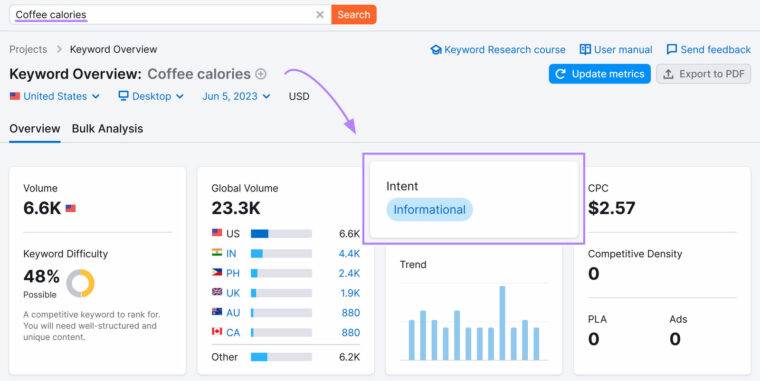
Screen Shot Of Informational Keyword Intent From Semrush

Whilst Informational keywords frequently start with “what,” “why,” “how,” and so on.(they don’t always) take the form of question keywords.
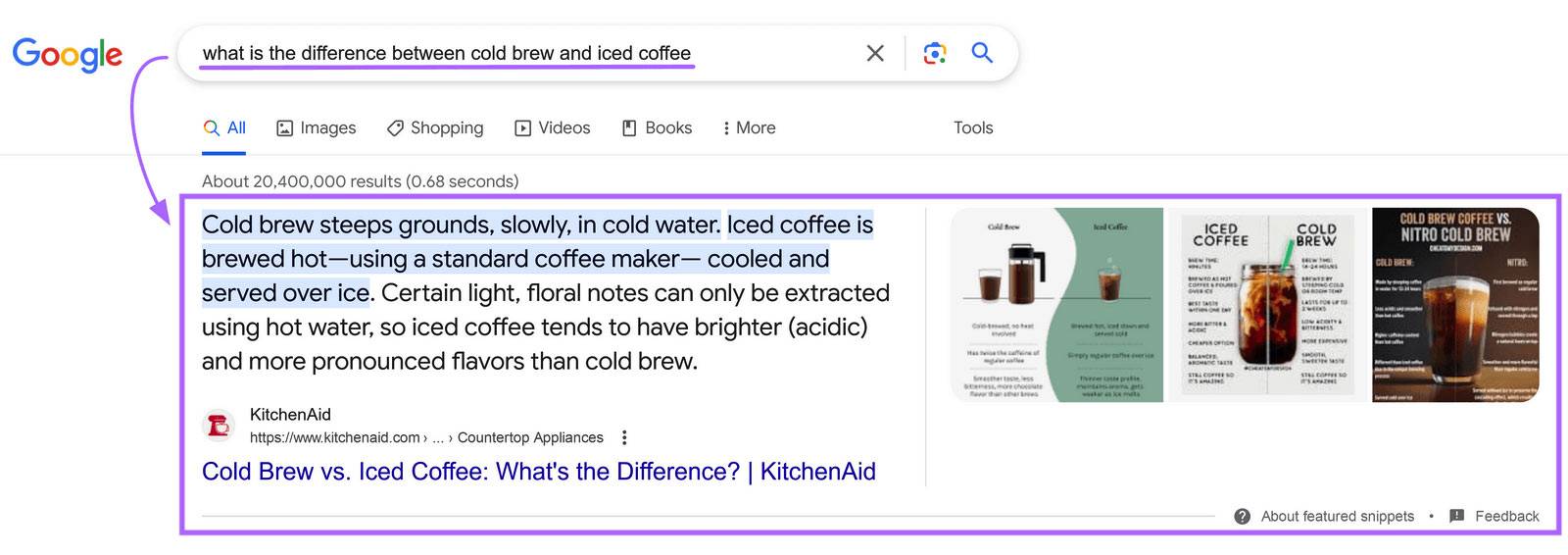
For example, here’s the featured snippet for the informational keyword “what is the difference between cold brew and iced coffee”:

Featured-Snippet-For-The-Informational-Keyword-What-Is-The-Difference-Between-Cold-Brew-And-Iced-Coffee


Informational keywords are usually higher in the marketing funnel. This means that people are earlier in their buying journeys. And less likely to take action (e.g., make a purchase)
As a result, informational content tends to have a lower conversion rate. But it can help you build brand awareness. And become an authority in your niche.

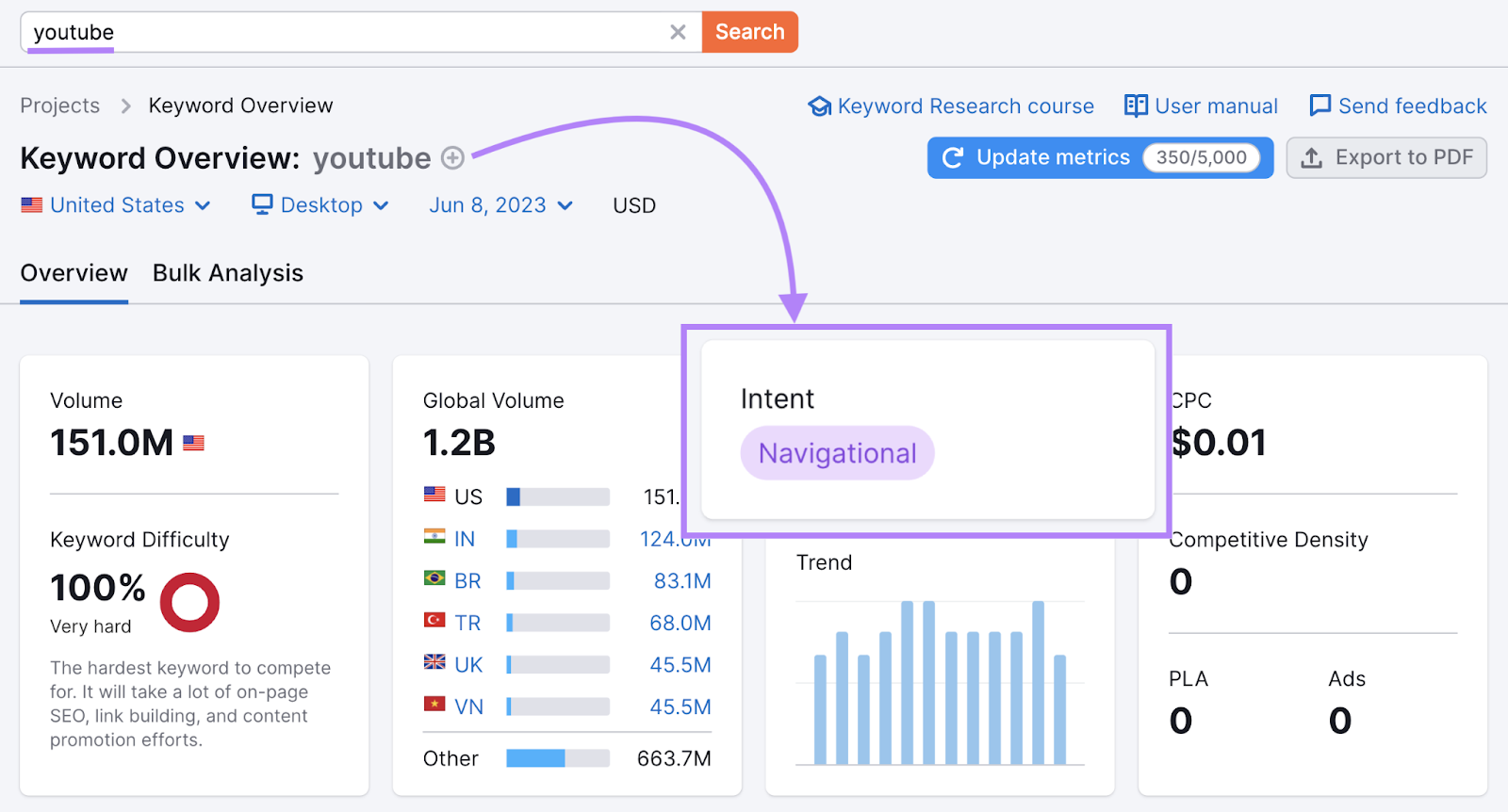
2. Navigational Intent

Navigational intent occurs when users want to locate a specific website or webpage. They already have a destination in mind and use search engines to find the quickest route. These queries often include brand or website names. For example, a search for “Facebook login” demonstrates navigational intent.

earchers use navigational keywords to find a specific site or page.

When someone types a website or brand name into a search engine, they perform a navigational search. 

Here are some navigational keyword examples: 

  • Youtube
  • Semrush blog
  • Where is angelino’s coffee located
&Quot;Youtube&Quot; Keyword Showing Navigational Intent In Keyword Overview Tool From Sem Rush

People behind these searches already know the company or product. And want to find the correct website or physical location to get to their products or services.

These keywords can be helpful sources of organic traffic when the brand or the site are well-known and popular. 

You should naturally rank highly for keywords that contain your brand name.

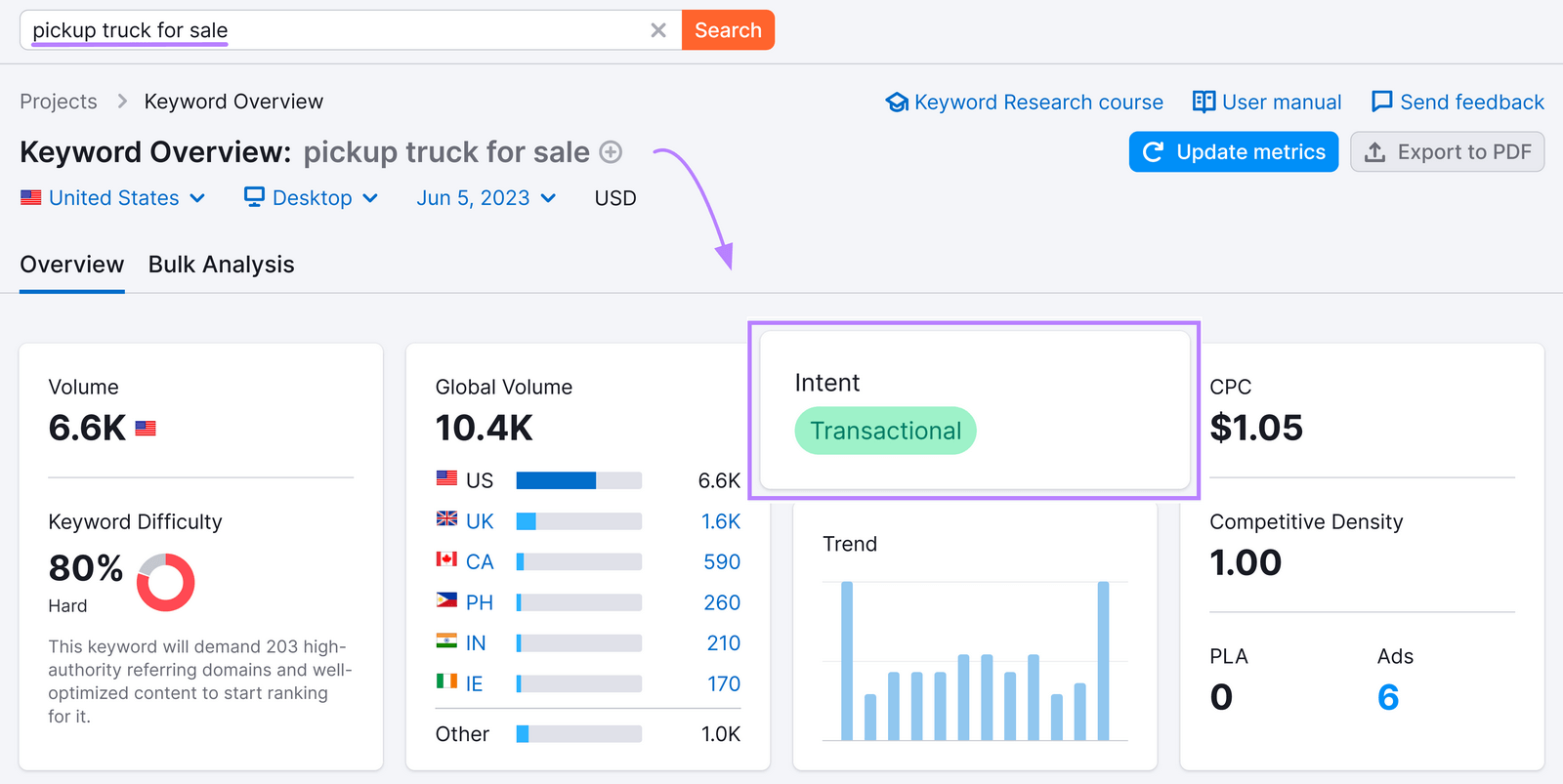
3. Transactional Intent:

Transactional intent signifies that users are ready to make a purchase or engage in a specific action. They may be comparing prices, seeking reviews, or looking for product-specific information. Transactional queries often include words like “buy,” “order,” or “discount.” For instance, “buy iPhone 13 Pro Max” reflects transactional intent.

Transactional keywords are the keywords that show the strongest intent to buy or take imminent action.

These keywords can be targeted with paid ads and highly optimized product pages. Or other landing pages where users can take immediate action on a site. 

Here are some transactional keyword examples:

  • Buy crypto online
  • Sandwich places near me that deliver
  • Pickup truck for sale
&Quot;Pickup Truck For Sale&Quot; Keyword Showing Transactional Intent In Keyword Overview Tool

These searches can happen after someone has already searched for information, made a decision, and is determined to now take a specific action or make a purchase. 

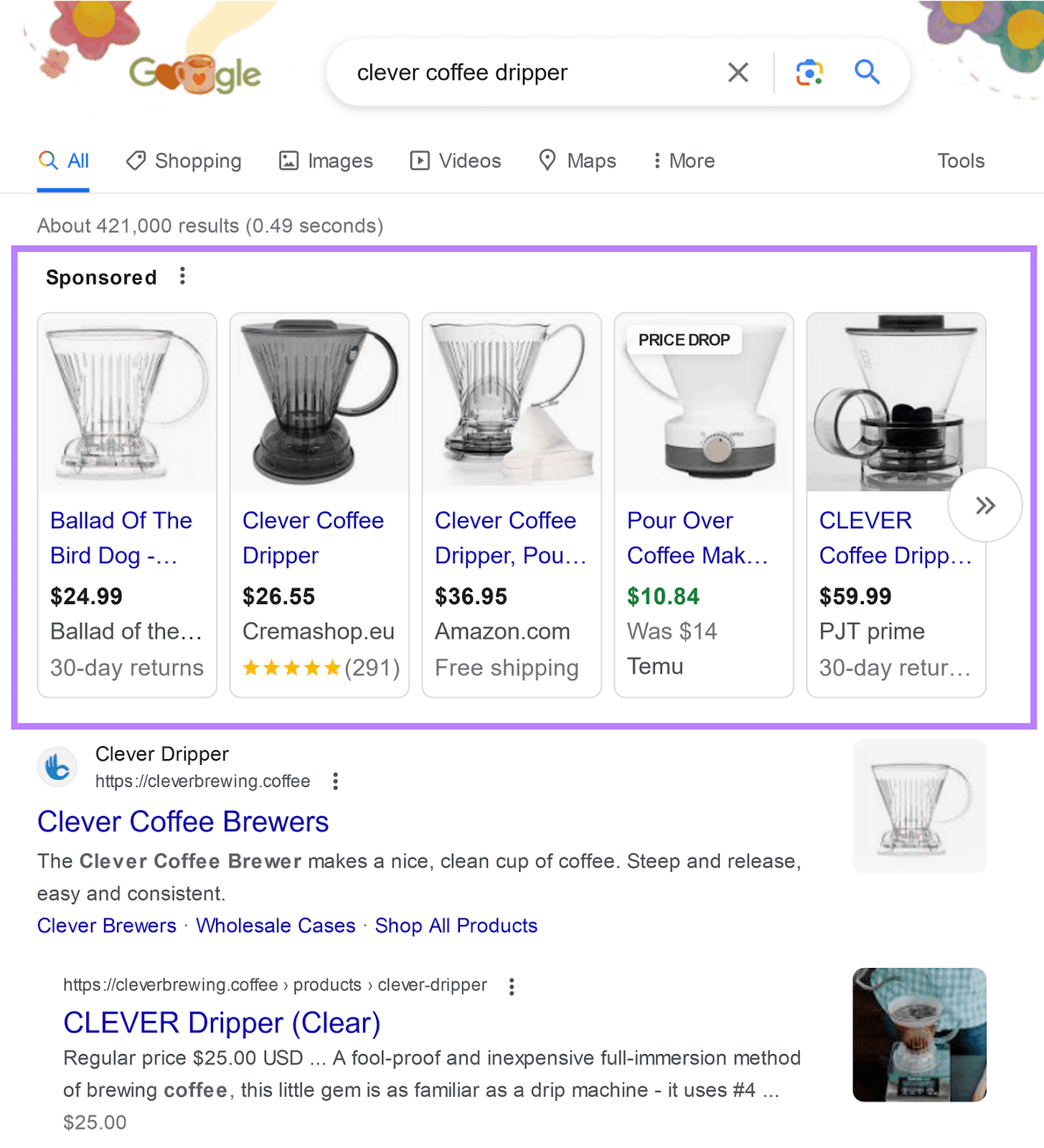
Transactional keywords often feature words like “buy,” “subscribe,” “for sale.” So, their SERPs often have Google Shopping Ads.

Like these:

Google Shopping Ads For &Quot;Clever Coffee Dripper&Quot; Search

Transactional keywords can also be called buyer keywords because they’re most likely to be used by a person at the bottom of the buying funnel. That means these keywords are highly valuable when doing keyword research and planning an SEO or PPC strategy. 

As a general rule, transactional keywords describe a product or service more precisely (“neon blue unisex watch,” for example). More general keywords (e.g., “men’s watches”) fit into the commercial category.

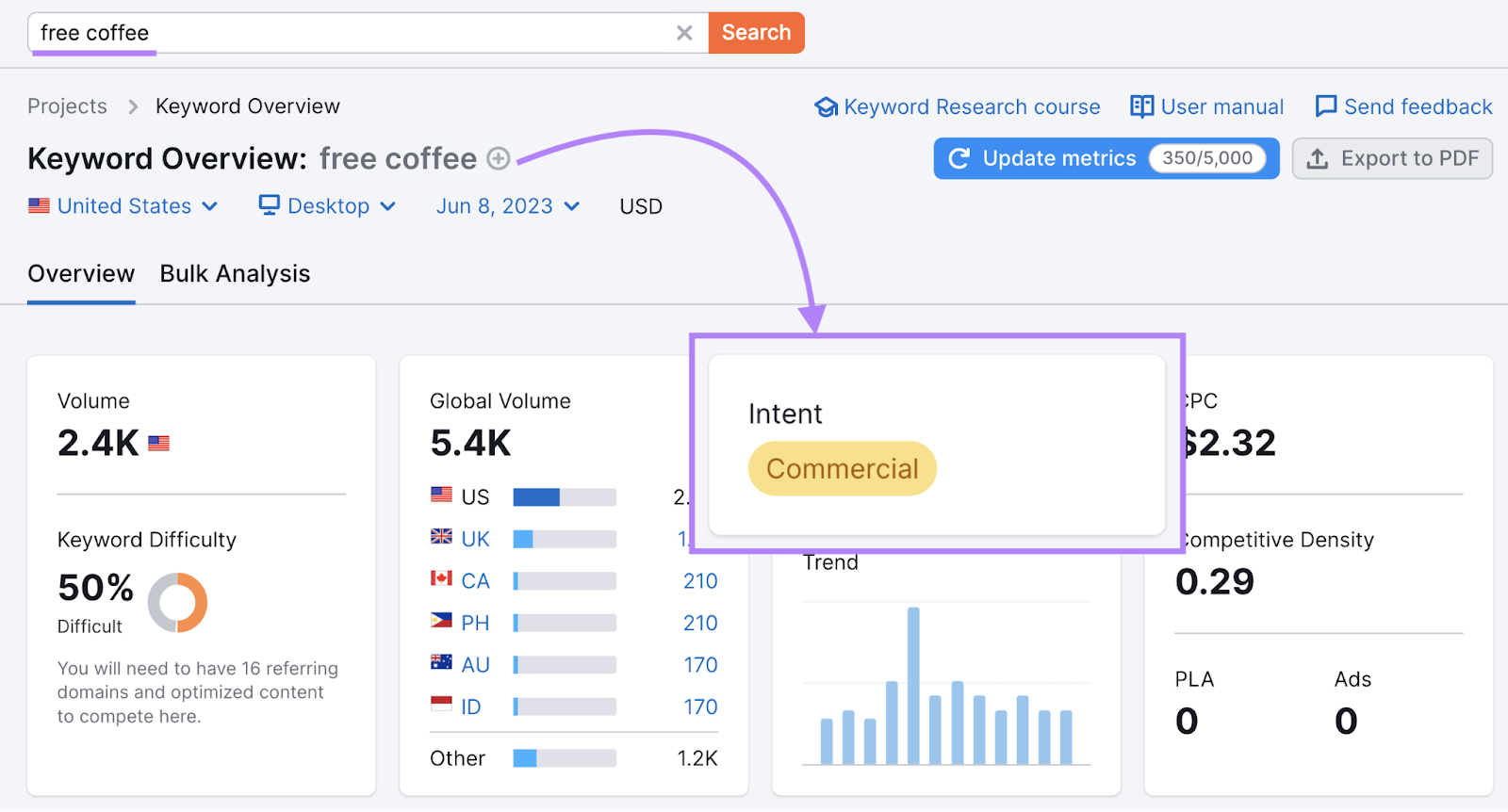
4. Commercial Investigation

(Commercial) Intent: This intent lies between informational and transactional intent. Users with commercial investigation intent are researching products or services with the intention to make a purchase in the near future. They seek comparisons, reviews, and recommendations before making a buying decision. Queries may include terms like “best,” “compare,” or “review.” For instance, a search for “best DSLR cameras” demonstrates commercial investigation intent.

People use commercial keywords to research specific brands, products, or services. They may want to check reviews, compare products, or look for discounts.

You can target these keywords with comparison articles, listicles, reviews, or how-to articles. Depending on the specific keyword.

Here are some commercial keyword examples: 

  • Free coffee
  • Dunkin iced coffee flavors
  • Peet’s coldbrew vs starbucks coldbrew
&Quot;Free Coffee&Quot; Keyword Showing Commercial Intent In Keyword Overview Tool From Semrush

These keywords reveal a person’s intention to buy or take some form of commercial activity in the future. So they can help you to reach high-quality prospects.

Importance of Understanding Keyword Intent:

Tailoring your messaging to match the intent behind users’ search queries is crucial for several reasons:

  • Relevance: By aligning your content with user intent, you ensure that your messaging resonates with their needs and interests, increasing the likelihood of engagement.
  • User Experience: Providing relevant content enhances the overall user experience, leading to higher satisfaction levels and increased trust in your brand.
  • Conversion Optimization: Matching keyword intent with appropriate messaging can drive conversions by guiding users seamlessly through the sales funnel.
  • Competitive Edge: Understanding keyword intent enables you to outmaneuver competitors by delivering more targeted and compelling content to your audience.

Crafting Your Messaging Strategy:

To effectively tailor your messaging based on keyword intent, follow these steps:

  1. Keyword Research: Conduct thorough keyword research to identify the various intents behind relevant search queries related to your industry or niche.
  2. Content Optimization: Create or optimize your content to address the specific needs and intents of your target audience. Use language and tone that resonate with each intent type.
  3. Call-to-Action (CTA) Alignment: Ensure that your CTAs align with the desired action corresponding to the user’s intent. Whether it’s encouraging exploration, guiding a purchase decision, or providing further information, your CTAs should be clear and compelling.
  4. Analytics Monitoring: Continuously monitor and analyze the performance of your messaging strategy. Track metrics such as click-through rates, conversion rates, and engagement levels to gauge effectiveness and make adjustments as needed.

Understanding keyword intent

Understanding keyword intent is just one part of What SEO is all about, but it’s not just about optimising for search engines; it’s about connecting with your audience on a deeper level. By deciphering the intent behind user searches and tailoring your messaging accordingly, you can provide valuable, relevant content that resonates with potential and existing customers. Couple keyword intent analysis with Keyword Competition and Incorporate it into your marketing strategy to enhance engagement, drive conversions, and ultimately, foster long-term customer relationships. If you would like to learn all about seo check out our Ebook below.

Button-Linked-To-Ebook-Find-Out-All-About-Seo

How Much Does Facebook Advertising Cost in New Zealand?

Article Updated: 10th March 2026

Back9-Website-Banner-Cta-Image-For-A-Free-Meta-Account-Audit On Facebook Advertising Costs In Nz Page

Facebook and Instagram advertising can be one of the fastest ways to get your business in front of new customers.

But before businesses start running campaigns, the first question is almost always the same:

How much does Facebook advertising cost in NZ actually cost in NZ?

The honest answer is that Facebook ads do not have a fixed price. Costs vary depending on your industry, your targeting, and how competitive your audience is.

However, there are some very clear benchmarks that help you understand what most businesses are paying.

Average Facebook Ad Cost Per Click

Understanding the cost of Facebook advertising in New Zealand helps businesses set realistic marketing budgets and expectations.

Facebook ads operate through an auction system where advertisers compete to show ads to specific audiences. While campaigns are technically priced on impressions, most businesses prefer to measure performance using metrics like cost per click (CPC).

Across large datasets analysed by digital advertising platform WordStream, the average CPC across all industries is around $1.72 per click.

However, costs vary significantly depending on industry.

IndustryAverage CPC
Apparel$0.45
Travel & Hospitality$0.63
Retail$0.70
Education$1.06
Technology$1.27
Healthcare$1.32
Legal$1.32
Beauty$1.81
Real Estate$1.81
Fitness$1.90
Auto$2.24
Industrial Services$2.14
B2B$2.52
Employment & Job Training$2.72
Home Improvement$2.93
Consumer Services$3.08
Finance & Insurance$3.77

The industries with the lowest costs tend to have large audiences, such as retail, fashion, and travel. When the audience pool is large, Facebook can deliver ads more efficiently.

More competitive industries — particularly finance, insurance, and home services — usually see higher costs because more advertisers compete for the same audience.

Typical Facebook Advertising Costs in NZ

While most benchmark studies come from global datasets, real campaigns in New Zealand tend to fall within a similar range.

A typical Facebook ad campaign in NZ might look like this:

MetricTypical Range
Cost per click (CPC)$0.80 – $3.00
Cost per 1000 impressions (CPM)$10 – $20
Starter daily budget$10 – $20
Typical small business spend$500 – $3,000 per month
Scaling campaigns$3,000 – $10,000+ per month

The key point is that Facebook advertising scales with your budget. Businesses can start small and increase spend once campaigns prove profitable.

Why Facebook Ads Are Often Cheaper Than Google Ads

Even though industries like finance may pay around $3.77 per click on Facebook, that is still far cheaper than many Google Ads keywords.

For example, high-intent keywords such as:

  • insurance
  • mortgage
  • loans

can cost $50 per click or more on Google Ads.

The reason is simple.

Google captures people actively searching for a solution, which makes those clicks extremely valuable.

Facebook works differently.

Instead of capturing demand, Facebook advertising creates demand by showing ads to people while they browse their social feeds.

Because the intent is different, the cost per click is usually lower.

Cta-With-A-Woman-Looking-Slightly-Confused-And-Text-Reading-How-Much-Do-Google-Ads-Cost-And-A-Button-To-Find-Out

What Makes Facebook Advertising Cost in NZ More Expensive?

Facebook advertising works through an auction system. Every time someone opens the app, advertisers compete to show ads to that person.

Several factors can increase your costs.

Industry competition

Industries where customers are valuable tend to attract more advertisers.

Finance, insurance, legal services, and home services often see higher costs because multiple companies compete for the same audience.

Poor ad creative

If your ads get low engagement or few clicks, Facebook considers them low quality. When this happens, the platform charges more to deliver them.

Strong creative often lowers costs significantly.

Narrow targeting

Very small or highly specific audiences can push costs higher because Facebook has fewer people to deliver ads to.

Conversion campaigns

Campaigns optimised for purchases or leads usually cost more than campaigns focused on awareness or engagement.

What Makes Facebook Ads Cheaper

Several factors can significantly reduce advertising costs.

Strong creative

Ads that people actually engage with tend to cost less to run. Facebook rewards ads with higher click-through rates.

Broad audiences

Larger audiences give Facebook more flexibility to deliver ads efficiently.

Retargeting

Retargeting audiences — such as people who have visited your website — are often cheaper to convert because they already know your business.

Clear offers

Ads with a clear next step, such as requesting a quote or downloading a guide, tend to perform better.

How Much Should an NZ Business Spend on Facebook Ads?

One of the biggest misconceptions is that Facebook advertising requires huge budgets.

In reality, businesses can start small.

A typical progression looks like this:

Testing phase
$300 – $800 per month
Used to test audiences, messaging, and creative.

Growth phase
$1,000 – $3,000 per month
Allows campaigns to generate consistent leads and data.

Scaling phase
$5,000+ per month
Used by businesses looking to generate predictable lead flow or sales at scale.

The most important thing during early campaigns is not the budget — it is learning what messaging and audiences work.

What Does It Cost to Set Up and Manage Facebook Ads?

In addition to the ad spend itself, most businesses will also have costs associated with setting up and managing campaigns.

A typical Facebook advertising setup involves creating the campaign structure, installing tracking such as the Meta Pixel, building audiences, designing ad creative, and connecting the ads to the correct landing pages or conversion points.

For most campaigns, the initial campaign setup can range from around $500 to $2,000, depending on the complexity of the campaign and the number of audiences, ads – including artwork etc, and tracking elements involved.

Ongoing campaign management is usually either a fixed monthly fee or a percentage of the advertising spend. In New Zealand, management fees commonly range from $200 to $1,500 per month, or around 10–20% of ad spend for larger campaigns. This will vary from freelancer to freelancer, or agency to agency!

This management typically includes:

  • monitoring campaign performance
  • testing new ads and audiences
  • adjusting budgets and targeting
  • improving landing pages and conversion rates
  • reporting on results

Good management is often what makes the difference between campaigns that quietly burn through budget and campaigns that generate consistent leads or sales.

The Real Cost Most Businesses Ignore

Many business owners assume the only cost is the advertising budget.

In reality, successful Facebook campaigns usually involve several moving parts:

  • strategy
  • creative production
  • landing pages
  • tracking and analytics
  • ongoing optimisation

When these elements work together, Facebook ads become a powerful growth channel.

Without them, businesses often spend money without generating meaningful results.

The Bottom Line

Facebook advertising in New Zealand is one of the most accessible ways for businesses to reach new customers.

Most campaigns see click costs somewhere between $0.80 and $3.00, depending on industry and competition.

Businesses can start with small budgets and scale campaigns once they begin generating results.

The real key to success is not simply spending more money — it is understanding how Facebook’s advertising system works and structuring campaigns that people actually want to engage with.

Get an INSTANT Estimate for your Social Media Ads Cost

Stop Wasting Your Money on “Getting Your Name Out There”

During the years at Back9 Creative, I have seen so many business owners commit to costly ad campaigns. Whether that be radio or Newspaper etc. And then they say advertising doesn’t work. But it’s that type of getting your name out there brand awareness crap that doesn’t work for most companies… So, Stop it!! Stop wasting your money!

Think quick. Have you ever caught yourself saying something like “we need to get our name out there” in reference to your company’s marketing or advertising efforts? If so, it’s time to stop. This outdated way of thinking where you shout out a message to anyone and everyone in hopes that someone in your target market will hear it, listen to it, and then even respond to it, simply doesn’t work in today’s world.

It’s interruptive, old-school marketing that is expensive, often ineffective, and frankly, a waste of money. Furthermore, it’s damn near impossible to measure. Instead, it’s time to shift your focus to inbound marketing, a methodology that puts your ideal customer first and focuses on their needs and buying journey. In this blog post, we’ll explore why outbound marketing doesn’t work and why you should invest in inbound instead.

Woman-With-Megaphone-Demonstaring-Outbound-Marketing-Is-A-Waste-Of-Money

Why Outbound is a waste of money

First, let’s dive a bit deeper into why outbound marketing, also known or ‘sold’ as branding, isn’t effective in today’s world. Think about it – when was the last time you paid attention to a billboard or radio ad? Would you rather have someone shout at you about their company or product, or would you prefer to find information on your own terms?

Chances are, you’re not alone in wanting the latter. Your potential customers have all the control these days – they conduct their research and make purchases on their own terms and in their own time. Outbound marketing requires frequency and saturation to be effective, and that can be costly. Only big companies like Nike or McDonald’s can afford to saturate the market like that. So I’ll say it again. Stop wasting your money!

Inbound marketing, on the other hand, is all about understanding your ideal customer and creating content that appeals to them. This doesn’t mean creating ads or messaging that pander to your customers – it means creating content that genuinely helps them solve problems or make informed decisions. By doing so, you’re building a relationship with your customer and gaining their trust over time. This methodology is not only effective but also more cost-efficient in the long run.

Where to begin

To get started with inbound marketing, you need to understand your ideal customer or buyer persona. Who are they? What are they looking for online? What are their pain points? Once you understand this, you can create content that addresses their needs – whether that be problem-solving articles, comparison guides, or product reviews. This content should be distributed on channels where your customer is already looking for information, whether that be search engines, social media, or industry-specific forums.

Of course, inbound marketing isn’t free. But if done right, it’s an investment – not a cost and therefore is not a waste of money. It does require time, effort, and often expert help to execute effectively. That’s why it’s important to develop a plan and a digital marketing roadmap. Identify what you want to achieve through inbound marketing and break it down into achievable milestones. Invest in the right agency or personnel to help you execute your plan.

Back9-Creative-Digital-Marketing-Roadmap-Advert

The bottom line.

Outbound marketing (for most businesses) simply doesn’t work in today’s world. It’s just not sustainable over the long term. It’s expensive and without the right frequency, often ineffective in getting your message in front of the right audience. Instead, stop wasting your money and invest in inbound marketing, where you focus on your ideal customer and their needs, which is a far more cost-efficient way to achieve your marketing goals. It requires effort and planning, but the results speak for themselves. If you’re still clinging to the “getting your name out there” mentality, it’s time to shift your focus and start investing in inbound marketing. Your customers will thank you for it – And so will your bottom line!

SEO Services in NZ – What You Need to Know.

When it comes to SEO services, it’s no secret that the world of search engine optimization, or SEO for short can be pretty confusing.

At Back9 Creative we try our best to demystify the dark art of SEO for you. But some things are just complicated enough, that you need to accept you’ll never fully understand them. Sometimes it involves an element of trust. And when the results come – it all seems worth it.

As a business owner or marketing professional, you know that ranking on page one of Google search results is key to generating traffic and leads. But how do you achieve that? Expert SEO services in New Zealand can help you improve your website’s visibility on search engines and attract more potential customers to your website. But that’s easy to say right… So what exactly do you need when it comes to SEO services? And how much should it cost?

What exactly is SEO?

Well simply put, SEO is the practice of optimising your website to improve its ranking on search engines like Google, Bing, or Yahoo. This involves a range of techniques like keyword research, link building, and content optimization to make your website more attractive to search engines. As a result, when users search for a relevant term, your website appears higher in the search results, increasing your visibility and potential for clicks and leads.

Free Website-Grader-Image Button

Understand what SEO services you need:

Before you can start evaluating different SEO service providers, you need to have a good understanding of what services you actually need. Different SEO firms offer varying services. For example, some SEO companies offer just basic on-page optimization, while others offer niche-focused services such as local SEO, eCommerce SEO, etc. Identify your goals and the type of SEO assistance you require to ensure that you invest wisely.

When considering SEO services, the first thing you need to decide is what you want to achieve with your website. Do you want to:

  • Increase traffic
  • generate leads, or;
  • boost sales?
  • All of the above…

Once you’ve defined your goals, you can work with an SEO provider to determine the best strategy for your business. This may involve a combination of techniques like on-page optimization, content creation, link building, and local SEO depending on your business needs.

The Cost of SEO Services

Now, let’s talk about how much SEO services should cost. Firstly, it’s important to recognize that SEO is not a one-time service. Nor is there a ‘one size fits all’ pricing model when it comes to SEO services.

The cost of services will vary depending on the scope of work, the size of the project, the level of competition, and the proficiency of the SEO team working on your business’ website.

As mentioned SEO is not a one-time thing. It’s an ongoing process that therefore requires ongoing investment.

You’ll need to budget for monthly or quarterly services to maintain your search engine ranking and continue attracting new leads.

Prices for SEO services can range from a few hundred dollars to several thousand based on the level of service you require and the provider you choose. It’s important to do your research and choose a reputable provider who can deliver results within your budget.

Another important consideration is the time frame for seeing results. SEO is not a quick fix and can take several months to start showing results. Be wary of promises of overnight ranking boosts or guaranteed first-page results, as these may be indicators of a less reputable provider using unethical techniques. Always choose an SEO provider who uses white-hat techniques within Google’s guidelines to achieve stable, long-term results.

Image Button To Claim Free Seo Audit

How to Choose the Right SEO Agency

Check for experience and references:

When choosing an SEO service provider, it’s vital to check for experience and credentials. Look for a company that has a proven track record of helping businesses like yours.

Check out their portfolio, client testimonials, and case studies to see if they are genuinely capable of delivering the results you require. Don’t assume that the more expensive a company is, the better quality their services are. Always do your homework before signing up with an SEO agency.

Transparency is key

An agency’s transparency when it comes to sharing their strategies and progress reports is crucial. Find an SEO service provider that is transparent about their optimisation process. Ensure that the company can provide regular rankings reports, so you can monitor the performance of your website.

Ongoing SEO Services: maintenance and optimization

Optimization is not a one-time solution; it’s a process that requires ongoing monitoring, maintenance, and optimization. Find a service provider that offers continued, ongoing support so that you can keep your website competitive. There are always potential pitfalls, such as technical glitches, changes in the algorithm, and competitors upping their digital game. So, make sure you work with a company that understands this and will be proactive in coming up with the best strategies to keep your business on the cutting edge.

Conclusion:

In summary, SEO services can help your business improve its visibility on search engines and generate more leads. When looking for the right SEO agency, it’s important to define your goals, budget for ongoing services, and choose a reputable provider that uses ethical techniques and delivers results over time. With the right SEO strategy, your business can see a significant return on investment by attracting more customers and improving your bottom line.